

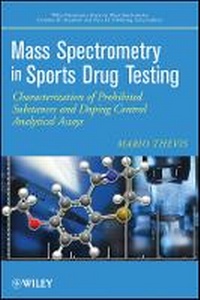
Mass Spectrometry in Sports Drug Testing - Characterization of Prohibited Structures and Doping Control Analytical Assays
Published on 18. August 2010
Software
Other digital
368 pages
978-0-470-62663-4 (ISBN)
Description
Mass spectrometry is a major tool to characterize, identify, and detect hundreds of known and unknown drugs. This book provides a detailed overview about the mass spectrometry of numerous classes of therapeutics and agents relevant to doping control laboratories, the necessity of various analyzers enabling the detection of low- and high molecular weight drugs as well as the discrimination between endogenously produced and synthetically derived compounds. It adds perspective to the health and ethical issues of doping in sports, and the role mass spectrometry plays in both detecting unknown drugs and protecting athletes. Scientists and researchers involved in drug design, metabolite identification, and environmental analysis, and sports medicine and drug research bodies will utilize this resource.
Reviews / Votes
"Mass Spectrometry in Sports Drug Testing is an excellent textbook for anyone involved in the analytical characterization of illicit substances and abused drugs." ( Anal Bioanal Chem , 2011)More details
Language
English
Place of publication
Hoboken
United Kingdom
Publishing group
John Wiley and Sons Ltd
Target group
Professional and scholarly
Dimensions
Height: 241 mm
Width: 162 mm
Thickness: 25 mm
Weight
696 gr
ISBN-13
978-0-470-62663-4 (9780470626634)
Copyright in bibliographic data and cover images is held by Nielsen Book Services Limited or by the publishers or by their respective licensors: all rights reserved.
Schweitzer Classification
Other editions
Additional editions
Mario Thevis
Mass Spectrometry in Sports Drug Testing
Characterization of Prohibited Substances and Doping Control Analytical Assays
E-Book
12/2010
Wiley
€110.99
Available for download
Mario Thevis
Mass Spectrometry in Sports Drug Testing
Characterization of Prohibited Substances and Doping Control Analytical Assays
E-Book
08/2010
Wiley
€107.99
Available for download
Person
Mario Thevis, PhD, is Professor for Preventive Doping Research at the German Sport University Cologne. He has published more than 115 articles in peer-reviewed journals, mainly on mass spectrometry and sports drug testing. Dr. Tevis is often invited to national and international conferences as a speaker and keynote lecturer on mass spectrometry and doping controls.
Content
Preface. Acknowledgments. 1 History of Sports Drug Testing. 1.1 Historical Attempts of Artificial Performance Enhancement. 1.2 Background and Rationale of Doping Controls. 1.3 Early Detection Methods: Possibilities and Limitations of Assays Without Mass Spectrometry. 1.4 Introduction of Mass Spectrometry to Doping Control Analysis. References. 2. Mass Spectrometry and the List of Prohibited Substances and Methods of Doping. 2.1 Criteria for the Mass Spectrometric Identification of Prohibited Compounds. 2.2 Modern Mass Spectrometers in Doping Controls: Advantages and Disadvantages of Available Techniques. References. 3. Structure Characterization of Low Molecular Weight Target Analytes -Electron Ionization. 3.1 Stimulants. 3.2 Narcotics. 3.3 Anabolic Androgenic Steroids. 3.4 Selective Androgen Receptor Modulators (SARMs). 3.5 Diuretics. 3.6 beta 2 -Agonists. 3.7 beta-Receptor Blocking Agents. 3.8 Calcium-Channel Modulators (RYCALS). 3.9 Carbohydrate-Based Agents. References. 4. Structure Characterization of Low Molecular Weight Target Analytes: Electrospray Ionization. 4.1 Stimulants. 4.2 Narcotics. 4.3 Anabolic Androgenic Steroids. 4.4 Selective Androgen Receptor Modulators (SARMs). 4.5 Diuretics. 4.6 beta 2 -Agonists. 4.7 Calcium-Channel Modulators (RYCALS). 4.8 Peroxisome-Proliferator Activated Receptor-delta (PPARdelta) And Adenosine Monophosphate Activated Protein Kinase (AMPK) Agonists. 4.9 Hypoxia-Inducible Factor (HIF)-Stabilizers And Sirtuin Activators. 4.10 beta-Receptor Blocking Agents. 4.11 Glucuronic Acid and Sulfate Conjugates of Target Analytes. References. 5. Structure Characterization of High Molecular Weight Target Analytes: Electrospray Ionization. 5.1 Human Chorionic Gonadotrophin (hCG). 5.2 Erythropoietins (EPO). 5.3 Synacthen. 5.4 Insulins. 5.5 Hemoglobin-Based Oxygen Carriers (HBOCs). 5.6 Human Growth Hormone (hGH). 5.7 Sermorelin (Geref). 5.8 Insulin-Like Growth Factor-1 (IGF-1). 5.9 Gonadorelin (LHRH). References. 6. Modern Mass Spectrometry-Based Analytical Assays. 6.1 GC-MS and Isotope Ratio Mass Spectrometry. 6.2 LC-MS/MS. References. 7. Limitations and Perspectives of Mass Spectrometry-Based Procedures in Doping Control Analysis. 7.1 Recombinant Biomolecules. 7.2 Unknown Compounds. 7.3 Profiling of Urine and/or Blood. 7.4 Alternative Specimens. References. Index.