

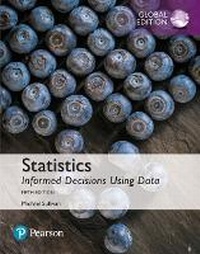
Statistics: Informed Decisions Using Data, Global Edition -- MyLab Statistics with Pearson eText
5th Edition
Published on 6. May 2016
Software
Product license key
4 pages
978-1-292-15722-1 (ISBN)
More details
Edition
5th edition
Language
English
Place of publication
Harlow
United Kingdom
Target group
College/higher education
Professional and scholarly
Dimensions
Height: 165 mm
Width: 130 mm
Thickness: 1 mm
Weight
7 gr
ISBN-13
978-1-292-15722-1 (9781292157221)
Copyright in bibliographic data and cover images is held by Nielsen Book Services Limited or by the publishers or by their respective licensors: all rights reserved.
Schweitzer Classification
Other editions
New editions
Michael Sullivan
Statistics: Informed Decisions Using Data, Global Edition + MyLab Statistics with Pearson eText (Package)
Book
07/2017
5th Edition
Pearson Education Limited
€135.05
Shipment within 10-20 days
Content
PART 1: GETTING THE INFORMATION YOU NEED
1. Data Collection
1.1 Introduction to the Practice of Statistics
1.2 Observational Studies versus Designed Experiments
1.3 Simple Random Sampling
1.4 Other Effective Sampling Methods
1.5 Bias in Sampling
1.6 The Design of Experiments
PART 2: DESCRIPTIVE STATISTICS
2. Organizing and Summarizing Data
2.1 Organizing Qualitative Data
2.2 Organizing Quantitative Data: The Popular Displays
2.3 Additional Displays of Quantitative Data
2.4 Graphical Misrepresentations of Data
3. Numerically Summarizing Data
3.1 Measures of Central Tendency
3.2 Measures of Dispersion
3.3 Measures of Central Tendency and Dispersion from Grouped Data
3.4 Measures of Position and Outliers
3.5 The Five-Number Summary and Boxplots
4. Describing the Relation between Two Variables
4.1 Scatter Diagrams and Correlation
4.2 Least-Squares Regression
4.3 Diagnostics on the Least-Squares Regression Line
4.4 Contingency Tables and Association
4.5 Nonlinear Regression: Transformations (online) 4-1
PART 3: PROBABILITY AND PROBABILITY DISTRIBUTIONS
5. Probability
5.1 Probability Rules
5.2 The Addition Rule and Complements
5.3 Independence and the Multiplication Rule
5.4 Conditional Probability and the General Multiplication Rule
5.5 Counting Techniques
5.6 Putting It Together: Which Method Do I Use?
5.7 Bayes's Rule (online) 5-1
6. Discrete Probability Distributions
6.1 Discrete Random Variables
6.2 The Binomial Probability Distribution
6.3 The Poisson Probability Distribution
6.4 The Hypergeometric Probability Distribution (online) 6-1
7. The Normal Probability Distribution
7.1 Properties of the Normal Distribution
7.2 Applications of the Normal Distribution
7.3 Assessing Normality
7.4 The Normal Approximation to the Binomial Probability Distribution
PART 4: INFERENCE: FROM SAMPLES TO POPULATION
8. Sampling Distributions
8.1 Distribution of the Sample Mean
8.2 Distribution of the Sample Proportion
9. Estimating the Value of a Parameter
9.1 Estimating a Population Proportion
9.2 Estimating a Population Mean
9.3 Estimating a Population Standard Deviation
9.4 Putting It Together: Which Procedure Do I Use?
9.5 Estimating with Bootstrapping
10. Hypothesis Tests Regarding a Parameter
10.1 The Language of Hypothesis Testing
10.2 Hypothesis Tests for a Population Proportion
10.3 Hypothesis Tests for a Population Mean
10.4 Hypothesis Tests for a Population Standard Deviation
10.5 Putting It Together: Which Method Do I Use?
10.6 The Probability of a Type II Error and the Power of the Test
11. Inferences on Two Samples
11.1 Inference about Two Population Proportions
11.2 Inference about Two Means: Dependent Samples
11.3 Inference about Two Means: Independent Samples
11.4 Inference about Two Population Standard Deviations
11.5 Putting It Together: Which Method Do I Use?
12. Inference on Categorical Data
1. Data Collection
1.1 Introduction to the Practice of Statistics
1.2 Observational Studies versus Designed Experiments
1.3 Simple Random Sampling
1.4 Other Effective Sampling Methods
1.5 Bias in Sampling
1.6 The Design of Experiments
PART 2: DESCRIPTIVE STATISTICS
2. Organizing and Summarizing Data
2.1 Organizing Qualitative Data
2.2 Organizing Quantitative Data: The Popular Displays
2.3 Additional Displays of Quantitative Data
2.4 Graphical Misrepresentations of Data
3. Numerically Summarizing Data
3.1 Measures of Central Tendency
3.2 Measures of Dispersion
3.3 Measures of Central Tendency and Dispersion from Grouped Data
3.4 Measures of Position and Outliers
3.5 The Five-Number Summary and Boxplots
4. Describing the Relation between Two Variables
4.1 Scatter Diagrams and Correlation
4.2 Least-Squares Regression
4.3 Diagnostics on the Least-Squares Regression Line
4.4 Contingency Tables and Association
4.5 Nonlinear Regression: Transformations (online) 4-1
PART 3: PROBABILITY AND PROBABILITY DISTRIBUTIONS
5. Probability
5.1 Probability Rules
5.2 The Addition Rule and Complements
5.3 Independence and the Multiplication Rule
5.4 Conditional Probability and the General Multiplication Rule
5.5 Counting Techniques
5.6 Putting It Together: Which Method Do I Use?
5.7 Bayes's Rule (online) 5-1
6. Discrete Probability Distributions
6.1 Discrete Random Variables
6.2 The Binomial Probability Distribution
6.3 The Poisson Probability Distribution
6.4 The Hypergeometric Probability Distribution (online) 6-1
7. The Normal Probability Distribution
7.1 Properties of the Normal Distribution
7.2 Applications of the Normal Distribution
7.3 Assessing Normality
7.4 The Normal Approximation to the Binomial Probability Distribution
PART 4: INFERENCE: FROM SAMPLES TO POPULATION
8. Sampling Distributions
8.1 Distribution of the Sample Mean
8.2 Distribution of the Sample Proportion
9. Estimating the Value of a Parameter
9.1 Estimating a Population Proportion
9.2 Estimating a Population Mean
9.3 Estimating a Population Standard Deviation
9.4 Putting It Together: Which Procedure Do I Use?
9.5 Estimating with Bootstrapping
10. Hypothesis Tests Regarding a Parameter
10.1 The Language of Hypothesis Testing
10.2 Hypothesis Tests for a Population Proportion
10.3 Hypothesis Tests for a Population Mean
10.4 Hypothesis Tests for a Population Standard Deviation
10.5 Putting It Together: Which Method Do I Use?
10.6 The Probability of a Type II Error and the Power of the Test
11. Inferences on Two Samples
11.1 Inference about Two Population Proportions
11.2 Inference about Two Means: Dependent Samples
11.3 Inference about Two Means: Independent Samples
11.4 Inference about Two Population Standard Deviations
11.5 Putting It Together: Which Method Do I Use?
12. Inference on Categorical Data