

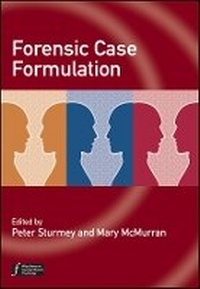
Forensic Case Formulation
Published on 24. August 2011
Software
Other digital
336 pages
978-1-119-97701-8 (ISBN)
Description
Forensic Case Formulation is the first text that describes the principles and application of case formulation specifically to forensic clinical practice. * Addresses risk assessment and its implications for case formulation and treatment* Covers a range of serious forensic problems such as violence, sexual offending, personality disorder, and substance misuse* Offers guidance in training clinicians on ways to create useful formulations
More details
Language
English
Place of publication
New York
United States
Target group
Professional and scholarly
Dimensions
Height: 244 mm
Width: 168 mm
Thickness: 15 mm
Weight
666 gr
ISBN-13
978-1-119-97701-8 (9781119977018)
Copyright in bibliographic data and cover images is held by Nielsen Book Services Limited or by the publishers or by their respective licensors: all rights reserved.
Schweitzer Classification
Other editions
Additional editions
Peter Sturmey | Mary McMurran
Forensic Case Formulation
E-Book
08/2011
Wiley-Blackwell
€41.99
Available for download
Person
Peter Sturmey is Professor of Psychology at Queens College and The Graduate Center, City University of New York. He has published extensively on developmental disabilities, applied behavior analysis, and on issues relating to staff and parent training. Mary McMurran is Professor in the University of Nottingham's Institute of Mental Health. She has written extensively on personality disorders, alcohol-related aggression, and readiness to engage in therapy.
Content
List of Contributors. Series Editors' Preface. Editors' Preface. GENERAL ISSUES. Chapter 1. Theoretical and Evidence-Based Approaches to Case Formulation (Tracey D. Eells and Kenneth G. Lombart, University of Kentucky, USA). Chapter 2. Current Issues in Case Formulation (Gregory H. Mumma, Texas Tech University). Chapter 3. Does Case Formulation Make a Difference To Treatment Outcome? (Ata Ghaderi, Uppsala University, Sweden). VIOLENCE. Chapter 4. Formulation of Violence Risk Using Evidence-Based Assessments: The Structured Professional Judgment Approach (Stephen D. Hart, Simon Fraser University and University of Bergen and Caroline Logan, Greater Manchester West Mental Health NHS Foundation Trust and University of Manchester). Chapter 5. Cognitive-Behavioral Approaches To Formulating Aggression And Violence (Kevin Howells, University of Nottingham, UK). Chapter 6. Formulation of Serious Violent Offending Using Multiple Sequential Functional Analysis (Aidan J. P. Hart, David M. Gresswell,University of Lincoln and Louise Braham, University of Nottingham). Chapter 7. Forensic Case Formulation, Substance Abuse Disorders and Anger (Ellen Vedel, Jellinek Substance Abuse Treatment Center and Paul M. G. Emmelkamp, University of Amsterdam). SEXUAL OFFENDING. Chapter 8. Sexual Offenses Against Children (James Vess & Tony Ward, Victoria University of Wellington, New Zealand). Chapter 9. Sexual Offenses Against Adults (Stacey L. Shipley, North Texas State Hospital and Bruce A. Arrigo, University of North Carolina - Charlotte). SPECIFIC POPULATIONS. Chapter 10. Forensic Case Formulation with Children and Adolescents (Phil Rich, Stetson School, Massachussetts). Chapter 11 Formulating Offending Behaviour In People With Mild Learning Disabilities (William Lindsay, University of Abertay Dundee, UK). Chapter 12. Case formulation for Individuals With Personality Disorder (Lawrence Jones, Nottinghamshire Healthcare NHS Trust, United Kingdom). CONCLUSION. Chapter 13. Forensic Case Formulation: Emerging Issues (Peter Sturmey, City University of New York and Mary McMurran, University of Nottingham, United Kingdom).