

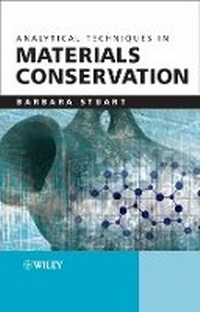
Analytical Techniques in Materials Conservation
Published on 9. February 2007
Software
Other digital
444 pages
978-0-470-06052-0 (ISBN)
Description
This book will introduce the reader to the wide variety of analytical techniques that are employed by those working on the conservation of materials. An introduction to each technique is provided with explanations of how data may be obtained and interpreted. Examples and case studies will be included to illustrate how each technique is used in practice. The fields studied include: inorganic materials, polymers, biomaterials and metals. Clear examples of data analysis feature, designed to assist the reader in their choice of analytical method.
Reviews / Votes
"Offers a unique source of useful up-to-date information about a vast variety of modern analytical techniques." (Journal of Raman Spectroscopy, 2008) "...An excellent starting point when mastering a specific technique..." (ABC, Monday 10th September 2007)More details
Language
English
Place of publication
Hoboken
United Kingdom
Publishing group
John Wiley and Sons Ltd
Target group
Professional and scholarly
Dimensions
Height: 226 mm
Width: 162 mm
Thickness: 25 mm
Weight
644 gr
ISBN-13
978-0-470-06052-0 (9780470060520)
Copyright in bibliographic data and cover images is held by Nielsen Book Services Limited or by the publishers or by their respective licensors: all rights reserved.
Schweitzer Classification
Other editions
Additional editions
Barbara H. Stuart
Analytical Techniques in Materials Conservation
E-Book
03/2007
Wiley
€71.99
Available for download
Person
Content
1. Conservation materials. 1.1 Introduction. 1.2 Proteins. 1.3 Lipids. 1.4 Carbohydrates. 1.5 Natural resins. 1.6 Natural materials. 1.7 Synthetic polymers. 1.8 Dyes and pigments. 1.9 Textiles. 1.10 Paintings. 1.11 Written material. 1.12 Glass. 1.13 Ceramics. 1.14 Stone. 1.15 Metals. 2. Basic identification techniques. 2.1 Introduction. 2.2 Visual examination. 2.3 Chemical tests. 2.4 Density and specific gravity. 2.5 Solubility. 2.6 Heat tests. 3. Light examination and microscopy. 3.1 Introduction. 3.2 Infrared techniques. 3.3 Ultraviolet techniques. 3.4 Radiography. 3.5 Refractometry. 3.6 Optical microscopy. 3.7 Transmission electron microscopy. 3.8 Scanning electron microscopy. 3.9 Scanning probe microscopy. 4. Molecular spectroscopy. 4.1 Introduction. 4.2 Infrared spectroscopy. 4.3 Raman spectroscopy. 4.4 Ultraviolet-visible spectroscopy. 4.5 Photoluminescence spectroscopy. 4.6 Nuclear magnetic resonance spectroscopy. 4.7 Electron spin resonance spectroscopy. 4.8 Mossbauer spectroscopy. 5. Atomic spectroscopy. 5.1 Introduction. 5.2 Atomic absorption spectroscopy. 5.3 Atomic emission spectroscopy. 5.4 Laser induced breakdown spectroscopy. 6. X-ray techniques. 6.1 Introduction. 6.2 X-ray diffraction. 6.3 X-ray fluorescence spectroscopy. 6.4 Electron microprobe analysis. 6.5 Proton induced X-ray emission. 6.6 X-ray photoelectron spectroscopy and Auger spectroscopy. 7. Mass spectrometry. 7.1 Introduction. 7.2 Molecular mass spectrometry. 7.3 Secondary ion mass spectrometry. 7.4 Atomic mass spectrometry. 8. Chromatography and electrophoresis. 8.1 Introduction. 8.2 Paper chromatography. 8.3 Thin layer chromatography. 8.4 Gas chromatography. 8.5 High performance liquid chromatography. 8.6 Size exclusion chromatography. 8.7 Ion chromatography. 8.8 Capillary electrophoresis. 9. Thermal and mechanical analysis. 9.1 Introduction. 9.2 Thermogravimetric analysis. 9.3 Differential Scanning Calorimetry/Differential Thermal Analysis. 9.4 Tensile Testing. 9.5 Flexural Testing. 9.6 Thermal Mechanical Analysis. 9.7 Dynamic Mechanical Analysis. 9.8 Hardness. 10. Nuclear methods. 10.1 Introduction. 10.2 Radioisotopic dating. 10.3 Neutron activation analysis. 10.4 Luminescence. 10.5 Neutron diffraction. Appendix Infrared spectra of polymers. Index.