

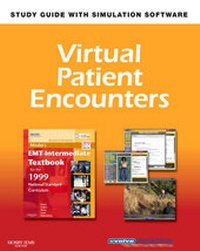
Virtual Patient Encounters for Mosby's EMT - Intermediate Textbook for the 1999 National Standard Curriculum - Revised Reprint
3rd Edition
Published on 12. April 2012
Software
CD-ROM
978-0-323-08677-6 (ISBN)
Description
Virtual Patient Encounters is a breakthrough in EMS education! Users can get real-world prehospital experience without leaving the classroom or home! The Virtual Patient Encounters learning triad - a textbook, interactive patient simulation software, and a study guide that ties everything together - offers a state-of-the-art tool for developing critical thinking skills. Users can apply what they're learning in Mosby's EMT-Intermediate Textbook for the 1999 National Standard Curriculum, 3rd Edition, Revised Reprint on 15 virtual patients in a variety of prehospital environments. It's an incredible opportunity to make real patient care decisions in a safe environment!
An extraordinary study guide that helps students take the knowledge they learn in Mosby's EMT-Intermediate Textbook for the 1999 National Standard Curriculum, 3rd Edition, Revised Reprint and apply it to 15 complex patient care scenarios in a virtual prehospital setting - promoting mastery of NSC competencies.
Utilizes interactive patient care simulation software, featuring scenario-setting videos, virtual assessment tools, treatment protocols, emergency drug information, intervention wizards, and more.
Serves as a bridge between the classroom and clinicals - so students truly understand how theory applies to situations they'll face in the real world.
Presents realistic emerging conditions that are a direct result of students' interventions.
Provides hands-on learning - making it easy for audio, visual and kinesthetic learners.
Offers students peace of mind - preparing them for clinicals by removing the risk of harming real patients and building their confidence throughout the course.
Makes assessment of students easy - instructors can gauge student comprehension and ability to think critically through study guide exercises and logs from the software.
Provides the opportunity for class discussion on the same patient - so the entire class can discuss learning points of each virtual patient and their outcomes.
An extraordinary study guide that helps students take the knowledge they learn in Mosby's EMT-Intermediate Textbook for the 1999 National Standard Curriculum, 3rd Edition, Revised Reprint and apply it to 15 complex patient care scenarios in a virtual prehospital setting - promoting mastery of NSC competencies.
Utilizes interactive patient care simulation software, featuring scenario-setting videos, virtual assessment tools, treatment protocols, emergency drug information, intervention wizards, and more.
Serves as a bridge between the classroom and clinicals - so students truly understand how theory applies to situations they'll face in the real world.
Presents realistic emerging conditions that are a direct result of students' interventions.
Provides hands-on learning - making it easy for audio, visual and kinesthetic learners.
Offers students peace of mind - preparing them for clinicals by removing the risk of harming real patients and building their confidence throughout the course.
Makes assessment of students easy - instructors can gauge student comprehension and ability to think critically through study guide exercises and logs from the software.
Provides the opportunity for class discussion on the same patient - so the entire class can discuss learning points of each virtual patient and their outcomes.
More details
Edition
3rd edition
Language
English
Place of publication
St Louis
United States
Publishing group
Elsevier - Health Sciences Division
Target group
College/higher education
Weight
450 gr
ISBN-13
978-0-323-08677-6 (9780323086776)
Copyright in bibliographic data and cover images is held by Nielsen Book Services Limited or by the publishers or by their respective licensors: all rights reserved.
Schweitzer Classification
Other editions
Previous edition
Bruce R. Shade
Virtual Patient Encounters for Mosby's EMT-Intermediate Textbook for the 1999 National Standard Curriculum
Software
09/2007
3rd Edition
Mosby/JEMS
€54.60
Article exhausted; check for reprint
Person
Content
Getting Started
Orientation to Virtual Patient Encounters
DIVISION ONE: PREPARATORY
Lesson 1: Foundations of EMT-Intermediate (Chapter 1)
Lesson 2: Your Well-Being (Chapter 2)
Lesson 3: Medical-Legal Aspects (Chapter 3)
Lesson 4: Overview of Human Systems (Chapter 4)
Lesson 5: Emergency Pharmacology (Chapter 5)
Lesson 6: Venous Access (Chapter 6)
Lesson 7: Medication Math (Chapter 7)
Lesson 8: Medication Administration (Chapter 8)
DIVISION TWO: AIRWAY
Lesson 9: Airway Management (Chapter 9)
DIVISION THREE: PATIENT ASSESSMENT
Lesson 10: History Taking (Chapter 10)
Lesson 11: Techniques of Physical Examination (Chapter 11)
Lesson 12: Patient Assessment (Chapter 12)
Lesson 13: Clinical Decision Making (Chapter 13)
Lesson 14: Communications (Chapter 14)
Lesson 15: Documentation (Chapter 15)
DIVISION FOUR: TRAUMA
Lesson 16: Trauma Systems and Mechanism of Injury (Chapter 16)
* Lesson 17: Multisystem Trauma (Chapters 17, 19, 20, and 21)
Lesson 18: Burns (Chapter 18)
DIVISION FIVE: MEDICAL
* Lesson 19: Respiratory Emergencies (Chapter 22)
* Lesson 20: Cardiology I (Chapters 23 and 24)
* Lesson 21: Cardiology II (Chapter 24)
* Lesson 22: Diabetic Emergencies (Chapter 25)
* Lesson 23: Allergic Reactions (Chapter 26)
* Lesson 24: Poisoning and Overdose Emergencies (Chapter 27)
* Lesson 25: Neurological Emergencies (Chapter 28)
* Lesson 26: Nontraumatic Abdominal Emergencies (Chapters 29)
* Lesson 27: Environmental Emergencies (Chapter 30)
* Lesson 28: Behavioral Emergencies and Substance Abuse (Chapter 31)
* Lesson 29: Gynecological Emergencies (Chapter 32)
DIVISION SIX: SPECIAL CONSIDERATIONS
* Lesson 30: Obstetrical Emergencies (Chapter 33)
Lesson 31: Neonatal Resuscitation (Chapter 34)
* Lesson 32: Pediatric Emergencies I (Chapter 35)
* Lesson 33: Pediatric Emergencies II (Chapter 35)
Lesson 34: Geriatrics (Chapter 36)
Lesson 35: Patients with Special Challenges (Chapter 37)
DIVISION SEVEN: ASSESSMENT-BASED MANAGEMENT
Lesson 36: Assessment-Based Management (Chapter 38)
APPENDIX
Patient Care Report Blanks
Summative Lessons Listed by Case
Case #1: 20-year-old male - difficulty breathing (Lesson 23)
Case #2: 56-year-old female - fell (Lesson 20)
Case #3: 7-year-old female - seizure (Lesson 25)
Case #4: 64-year-old male - unknown medical (Lesson 22)
Case #5: 40-year-old male - vomiting blood (Lesson 26)
Case #6: 16-year-old female - unknown medical (Lesson 24)
Case #7: 8-year-old male - submersion (Lesson 32)
Case #8: 38-year-old male - suicide attempt (Lesson 28)
Case #9: 22-year-old female - assault (Lesson 29)
Case #10: 25-year-old female - abdominal pain (Lesson 30)
Case #11: 32-year-old male - gunshot wounds (Lesson 17)
Case #12: 57-year-old male - man down (Lesson 27)
Case #13: 5-month-old male - unresponsive (Lesson 33)
Case #14: 65-year-old male - difficulty breathing (Lesson 21)
Case #15: 42-year-old male - difficulty breathing (Lesson 19)
Orientation to Virtual Patient Encounters
DIVISION ONE: PREPARATORY
Lesson 1: Foundations of EMT-Intermediate (Chapter 1)
Lesson 2: Your Well-Being (Chapter 2)
Lesson 3: Medical-Legal Aspects (Chapter 3)
Lesson 4: Overview of Human Systems (Chapter 4)
Lesson 5: Emergency Pharmacology (Chapter 5)
Lesson 6: Venous Access (Chapter 6)
Lesson 7: Medication Math (Chapter 7)
Lesson 8: Medication Administration (Chapter 8)
DIVISION TWO: AIRWAY
Lesson 9: Airway Management (Chapter 9)
DIVISION THREE: PATIENT ASSESSMENT
Lesson 10: History Taking (Chapter 10)
Lesson 11: Techniques of Physical Examination (Chapter 11)
Lesson 12: Patient Assessment (Chapter 12)
Lesson 13: Clinical Decision Making (Chapter 13)
Lesson 14: Communications (Chapter 14)
Lesson 15: Documentation (Chapter 15)
DIVISION FOUR: TRAUMA
Lesson 16: Trauma Systems and Mechanism of Injury (Chapter 16)
* Lesson 17: Multisystem Trauma (Chapters 17, 19, 20, and 21)
Lesson 18: Burns (Chapter 18)
DIVISION FIVE: MEDICAL
* Lesson 19: Respiratory Emergencies (Chapter 22)
* Lesson 20: Cardiology I (Chapters 23 and 24)
* Lesson 21: Cardiology II (Chapter 24)
* Lesson 22: Diabetic Emergencies (Chapter 25)
* Lesson 23: Allergic Reactions (Chapter 26)
* Lesson 24: Poisoning and Overdose Emergencies (Chapter 27)
* Lesson 25: Neurological Emergencies (Chapter 28)
* Lesson 26: Nontraumatic Abdominal Emergencies (Chapters 29)
* Lesson 27: Environmental Emergencies (Chapter 30)
* Lesson 28: Behavioral Emergencies and Substance Abuse (Chapter 31)
* Lesson 29: Gynecological Emergencies (Chapter 32)
DIVISION SIX: SPECIAL CONSIDERATIONS
* Lesson 30: Obstetrical Emergencies (Chapter 33)
Lesson 31: Neonatal Resuscitation (Chapter 34)
* Lesson 32: Pediatric Emergencies I (Chapter 35)
* Lesson 33: Pediatric Emergencies II (Chapter 35)
Lesson 34: Geriatrics (Chapter 36)
Lesson 35: Patients with Special Challenges (Chapter 37)
DIVISION SEVEN: ASSESSMENT-BASED MANAGEMENT
Lesson 36: Assessment-Based Management (Chapter 38)
APPENDIX
Patient Care Report Blanks
Summative Lessons Listed by Case
Case #1: 20-year-old male - difficulty breathing (Lesson 23)
Case #2: 56-year-old female - fell (Lesson 20)
Case #3: 7-year-old female - seizure (Lesson 25)
Case #4: 64-year-old male - unknown medical (Lesson 22)
Case #5: 40-year-old male - vomiting blood (Lesson 26)
Case #6: 16-year-old female - unknown medical (Lesson 24)
Case #7: 8-year-old male - submersion (Lesson 32)
Case #8: 38-year-old male - suicide attempt (Lesson 28)
Case #9: 22-year-old female - assault (Lesson 29)
Case #10: 25-year-old female - abdominal pain (Lesson 30)
Case #11: 32-year-old male - gunshot wounds (Lesson 17)
Case #12: 57-year-old male - man down (Lesson 27)
Case #13: 5-month-old male - unresponsive (Lesson 33)
Case #14: 65-year-old male - difficulty breathing (Lesson 21)
Case #15: 42-year-old male - difficulty breathing (Lesson 19)