

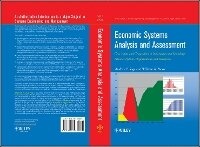
Economic Systems Analysis and Assessment - Intensive Systems, Organizations and Enterprises
Published on 14. March 2011
Software
Other digital
500 pages
978-1-118-01549-0 (ISBN)
Description
This important book fills the need for a textbook on economic systems analysis and assessment, providing extensive coverage on various topics including microeconomic systems and assessment, cost effectiveness, cost estimation for software and systems, strategic investments, and valuation methods. It serves as an effective textbook for senior undergraduate and first-year graduate courses in economic systems analysis and assessment, as well as a valuable reference for engineers and managers involved in information technology intensive systems.
More details
Language
English
Place of publication
New York
United States
Target group
Professional and scholarly
Dimensions
Height: 250 mm
Width: 150 mm
Thickness: 15 mm
Weight
666 gr
ISBN-13
978-1-118-01549-0 (9781118015490)
Copyright in bibliographic data and cover images is held by Nielsen Book Services Limited or by the publishers or by their respective licensors: all rights reserved.
Schweitzer Classification
Other editions
Additional editions
Andrew P. Sage | William B. Rouse
Economic Systems Analysis and Assessment
Intensive Systems, Organizations,and Enterprises
E-Book
04/2011
Wiley
€133.99
Available for download
Andrew P. Sage | William B. Rouse
Economic Systems Analysis and Assessment
Intensive Systems, Organizations,and Enterprises
E-Book
02/2011
Wiley
€129.99
Available for download
Person
Andrew P. Sage, PhD , is University Professor and First American Bank Professor at George Mason University in Fairfax, Virginia. He is a Fellow of the IEEE, the American Association for the Advancement of Science, and International Council on Systems Engineering (INCOSE). The winner of numerous awards, Dr. Sage is the editor of the Wiley Series in Systems Engineering and Management and the founding editor of the INCOSE journal Systems Engineering. He is a member of the National Academy of Engineering. William B. Rouse, PhD, is the Executive Director of the Tennenbaum Institute at the Georgia Institute of Technology, and a faculty member in the School of Industrial and Systems Engineering and the College of Computing. A former CEO of two innovative software companies, he has four decades of experience in research, education, engineering, management, and marketing. Dr. Rouse has written hundreds of articles and book chapters and has authored many books. He is a member of the National Academy of Engineering and a fellow of several professional societies.
Content
PREFACE. Chapter 1 Introduction to Economic Systems Analysis and Assessment: Cost, Value, and Competition in Information and Knowledge Intensive Systems, Organizations, and Enterprises. 1.1 Inroduction. 1.2 A Framework for Systems Engineering and Management. 1.3 Theory of the Firm. 1.4 Theory of the Consumer. 1.5 The Interaction of the Theories of the Firms and Consumers: Microeconomic Models of Economic Activity. 1.6 Welfare or Normative Economics. 1.7 Program and Program Management Economics. 1.8 Contemporary Issues Concerning Information and Information Technology Economic. 1.9 Economic Pitfalls in the Engineering of Systems. 1.10 Summary. Chapter 2 Production and the Theory of the Firm. 2.1 Introduction. 2.2 The Production Function. 2.3 Multiproduct Firms and Multiproduct Production Functions. 2.4 Classical Theory of the Firm. 2.5 Imperfect Competition. 2.6 Summary. Chapter 3 The Theory of the Consumer. 3.1 Introduction. 3.2 Economic Utility Theory and Its Axioms. 3.3 Property of Utility Functions. 3.4 The Fundamental Problem of the Consumer. 3.5 Sensitivity and Substitution Effects. 3.6 Summary. Chapter 4 Supply-Demand Equilibria and Microeconomic Systems Analysis and Assessment Models . 4.1 Introduction. 4.2 Basic Supply-Demand Equilibrium for a Single Good. 4.3 General Supply-Demand Equilibrium Conditions. 4.4 Extensions to General Equilibrium to Include Market Interdependencies. 4.5 Microeconomics Models. 4.6 Summary. Chapter 5 Normative or Welfare Economics, Decisions and Games, and Behavioral Economics. 5.1 Introduction. 5.2 Pareto Optimality Under Perfect Competitive Conditions. 5.3 External Effects and Imperfect Competition-Public Goods. 5.4 External Effects and Imperfect Competition-Nonindependent Production and Consumption. 5.5 Welfare Maximization and Social Choice. 5.6 Summary. 5.7 Selected Bibliography. Chapter 6 Cost-Benefit and Cost-Effectiveness Analysis and Assessments. 6.1 Introduction. 6.2 The Time Value of Money. 6.3 Identification of Costs and Benefits. 6.4 The Identification and Quantification of Effectiveness. 6.5 A Guide to Cost-Benefit Analysis. Chapter 7 Cost Assessment. 7.1 Model-Based Parameters for Productivity. 7.2 Early Models for Estimation of Costs, Including Effort and Schedule. 7.3 The Constructive Cost Model. 7.4 Summary. CHAPTER 8 APPROACHES TO INVESTMENT VALUATION. 8.1. Microeconomics. 8.2. The Investment Problem. 8.3. Investment Valuation. 8.4. Summary. CHAPTER 9 REAL OPTIONS FOR INVESTMENT VALUATION. 9.1. Nature of Options. 9.2. Option Pricing Theory. 9.3. Option Calculator. 9.4. Strategic Metrics. 9.5. Investment Decision Making. 9.6. Value-Centered R&D. 9.7. Summary. CHAPTER 10 CONTEMPORARY PERSPECTIVES. 10.1. Introduction. 10.2. Evolutionary Economics. 10.3. Path Dependence and Network Effects. 10.4. Intellectual Capital. 10.5. Value of Information. 10.6. Investing in Humans. 10.7. Summary. INDEX.