

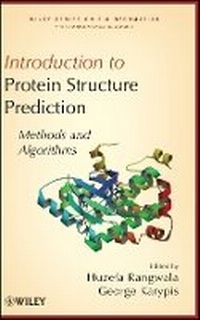
Protein Structure Methods and Algorithms
Published on 7. September 2010
Software
Other digital
520 pages
978-0-470-88220-7 (ISBN)
Description
This book helps unravel the relationship of pure sequence information and three-dimensional structure, which remains one of the great fundamental problems in molecular biology and bioinformatics. It describes key applications of modeled structures, focusing on the methods and algorithms that are used to predict protein structure written by experts who participate in the structure prediction competition. The book also delivers applications used for predicted models in other studies. Researchers in bioinformatics and molecular biology will find this text highly useful, as will students in graduate courses in protein prediction.
More details
Language
English
Place of publication
Hoboken
United Kingdom
Publishing group
John Wiley and Sons Ltd
Target group
Professional and scholarly
Dimensions
Height: 250 mm
Width: 150 mm
Thickness: 15 mm
Weight
666 gr
ISBN-13
978-0-470-88220-7 (9780470882207)
Copyright in bibliographic data and cover images is held by Nielsen Book Services Limited or by the publishers or by their respective licensors: all rights reserved.
Schweitzer Classification
Other editions
Additional editions
E-Book
03/2011
Wiley
€137.99
Available for download
E-Book
09/2010
Wiley
€134.99
Available for download
Person
DR. HUZEFA RANGWALA is an assistant professor in computer science and bioengineering at George Mason University. He has published in various conferences and journals on the topic of bioinformatics. DR. GEORGE KARYPIS is a professor in computer science and engineering at the University of Minnesota. He has authored more than one hundred journal and conference papers and also serves on the editorial board of the International Journal of Data Mining and Bioinformatics.
Content
Preface. Contributors. 1 Introduction to Protein Structure Prediction ( Huzefa Rangwala and George Karypis ). 2 CASP: A Driving Force in Protein Structure Modeling ( Andriy Kryshtafovych, Krzysztof Fidelis, and John Moult ). 3 The Protein Structure Initiative ( Andras Fiser, Adam Godzik, Christine Orengo, and Burkhard Rost ). 4 Prediction of One-Dimensional Structural Properties of Proteins by Integrated Neural Networks ( Yaoqi Zhou and Eshel Faraggi ). 5 Local Structure Alphabets ( Agnel Praveen Joseph, Aurelie Bornot, and Alexandre G. de Brevern ). 6 Shedding Light on Transmembrane Topology ( Gabor E. Tusnady and Istvan Simon ). 7 Contact Map Prediction by Machine Learning ( Alberto J.M. Martin, Catherine Mooney, Ian Walsh, and Gianluca Pollastri ). 8 A Survey of Remote Homology Detection and Fold Recognition Methods ( Huzefa Rangwala ). 9 Interactive Protein Fold Recognition by Alignments and Machine Learning ( Allison N. Tegge, Zheng Wang, and Jianlin Cheng ). 10 Tasser-Based Protein Structure Prediction ( Shashi Bhushan Pandit, Hongyi Zhou, and Jeffrey Skolnick ). 11 Composite Approaches to Protein Tertiary Structure Prediction: A Case-Study by I-Tasser ( Ambrish Roy, Sitao Wu, and Yang Zhang ). 12 Hybrid Methods for Protein Structure Prediction ( Dmitri Mourado, Bostjan Kobe, Nicholas E. Dixon, and Thomas Huber ). 13 Modeling Loops in Protein Structures ( Narcis Fernandez-Fuentes, Andras Fiser ). 14 Model Quality Assessment Using A Statistical Program that Adopts A Side Chain Environment Viewpoint ( Genki Terashi, Mayuko Takeda-Shitaka, Kazuhiko Kanou and Hideaki Umeyama ). 15 Model Quality Prediction ( Liam J. McGuffin ). 16 Ligand-Binding Residue Prediction ( Chris Kauffman and George Karypis ). 17 Modeling and Validation of Transmembrane Protein Structures ( Maya Schushan and Nir Ben-Tal ). 18 Structure-Based Machine Learning Models for Computational Mutagenesis ( Majid Masso and Iosif I. Vaisman ). 19 Conformational Search for the Protein Native State ( Amarda Shehu ). 20 Modeling Mutations in Proteins Using MEDUSA and Discrete Molecule Dynamics ( Shuangye Yin, Feng Ding, and Nikolay V. Dokholyan ). Index.