

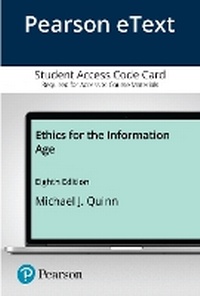
Ethics for the Information Age
8th Edition
Will be published approx. on 23. April 2019
Software
Product license key
608 pages
978-0-13-521772-6 (ISBN)
Description
The New Normal: Evaluating Social and Ethical Concerns in the Information Age.
In our age of unparalleled technological advancement, it is important that we address the social and ethical considerations that these advances engender. Ethics for the Information Age seeks to do exactly that, proposing a thoughtful approach that considers not only the short-term benefits of a piece of technology, but what the possible long-term effects could be, as well. Such an approach requires a solid grounding in ethics and logic, an understanding of the history of technology, and a familiarity with current and cutting edge information technologies and their related issues.
The 8th Edition has been updated considerably, notably in the inclusion of a new appendix, Appendix B, which focuses on common logical fallacies and structuring local arguments, and material relating to a multitude of emergent information technology developments and controversies.
For courses in computer ethics.
Pearson eText is an easy-to-use digital textbook that you can purchase on your own or instructors can assign for their course. The mobile app lets you keep on learning, no matter where your day takes you -- even offline. You can also add highlights, bookmarks, and notes in your Pearson eText to study how you like.
NOTE: This ISBN is for the Pearson eText access card. Pearson eText is a fully digital delivery of Pearson content. Before purchasing, check that you have the correct ISBN. To register for and use Pearson eText, you may also need a course invite link, which your instructor will provide. Follow the instructions provided on the access card to learn more.
In our age of unparalleled technological advancement, it is important that we address the social and ethical considerations that these advances engender. Ethics for the Information Age seeks to do exactly that, proposing a thoughtful approach that considers not only the short-term benefits of a piece of technology, but what the possible long-term effects could be, as well. Such an approach requires a solid grounding in ethics and logic, an understanding of the history of technology, and a familiarity with current and cutting edge information technologies and their related issues.
The 8th Edition has been updated considerably, notably in the inclusion of a new appendix, Appendix B, which focuses on common logical fallacies and structuring local arguments, and material relating to a multitude of emergent information technology developments and controversies.
For courses in computer ethics.
Pearson eText is an easy-to-use digital textbook that you can purchase on your own or instructors can assign for their course. The mobile app lets you keep on learning, no matter where your day takes you -- even offline. You can also add highlights, bookmarks, and notes in your Pearson eText to study how you like.
NOTE: This ISBN is for the Pearson eText access card. Pearson eText is a fully digital delivery of Pearson content. Before purchasing, check that you have the correct ISBN. To register for and use Pearson eText, you may also need a course invite link, which your instructor will provide. Follow the instructions provided on the access card to learn more.
More details
Edition
8th edition
Language
English
Place of publication
United States
Publishing group
Pearson Education (US)
Target group
College/higher education
Dimensions
Width: 190 mm
Weight
20 gr
ISBN-13
978-0-13-521772-6 (9780135217726)
Copyright in bibliographic data and cover images is held by Nielsen Book Services Limited or by the publishers or by their respective licensors: all rights reserved.
Schweitzer Classification
Other editions
Previous edition
Michael Quinn
Ethics for the Information Age
Book
02/2016
7th Edition
Pearson
€157.21
Article exhausted; check different version
Person
About our authors Michael J. Quinn earned a BS in mathematics from Gonzaga University and an MS in computer science from the University of Wisconsin-Madison. He worked for 2 years as a software engineer at Tektronix, Inc., then returned to graduate school to complete a PhD in computer science from Washington State University. For a total of 24 years, he was a computer science professor at the University of New Hampshire and Oregon State University. He did pioneering research in the field of parallel computing, and his textbooks on that subject have been used by hundreds of universities worldwide. In the early 2000s his focus shifted to computer ethics, and the result was Ethics for the Information Age. Since 2007 he has served as Dean of the College of Science and Engineering at Seattle University.
Content
1. Catalysts for Change
2. Introduction to Ethics
3. Networked Communications
4. Intellectual Property
5. Information Privacy
6. Privacy and the Government
7. Computer and Network Security
8. Computer Reliability
9. Professional Ethics
10. Work and Wealth
2. Introduction to Ethics
3. Networked Communications
4. Intellectual Property
5. Information Privacy
6. Privacy and the Government
7. Computer and Network Security
8. Computer Reliability
9. Professional Ethics
10. Work and Wealth