

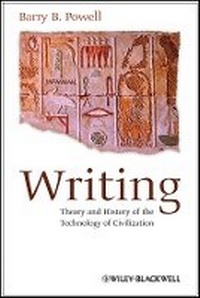
Writing: Theory and History of the Technology of Civilization
Published on 24. February 2012
Software
Other digital
296 pages
978-1-118-29351-5 (ISBN)
Description
Writing: Theory and History of the Technology of Civilization traces the origins of writing tied to speech from ancient Sumer through the Greek alphabet and beyond. * Examines the earliest evidence for writing in Mesopotamia in the fourth millennium BC, the origins of purely phonographic systems, and the mystery of alphabetic writing * Includes discussions of Ancient Egyptian,Chinese, and Mayan writing * Shows how the structures of writing served and do serve social needs and in turn create patterns of social behavior * Clarifies the argument with many illustrations
Reviews / Votes
"For anyone interested in language, writing, and their fascinating history across many cultures and centuries of development, this engagingly written, well-illustrated book will provide a very readable mine of information." ( CHOICE, December 2009) "Powell's concentration on precise names for terms used in discourse clears up some of the confusion common to histories of work on ancient scripts." ( About.com , May 2009) "A feature ... is the use of the ancient scripts in the text with numerous illustrations to familiarize the reader with the different writing systems. The result is a readable and enlightening study of a complex topic." ( Bryn Mawr Classical Review, April 2010) "Writing is stimulating and impressive." (Science, April 2009 )More details
Language
English
Place of publication
New York
United States
Target group
Professional and scholarly
Dimensions
Height: 250 mm
Width: 150 mm
Thickness: 15 mm
Weight
666 gr
ISBN-13
978-1-118-29351-5 (9781118293515)
Copyright in bibliographic data and cover images is held by Nielsen Book Services Limited or by the publishers or by their respective licensors: all rights reserved.
Schweitzer Classification
Other editions
Person
Barry B. Powell is Halls-Bascom Professor Emeritus of Classics at the University of Wisconsin-Madison. He has written extensively on ancient Greek literature and the history of writing. His books include Homer and the Origin of the Greek Alphabet (1991), A New Companion to Homer (editor, with Ian Morris) (1997), Writing and the Origins of Greek Literature (2001), and two editions of Homer (second edition, Blackwell, 2007).
Content
List of Illustrations ix Maps xiv Preface xv Chronology xvii Introduction: A Difficult Topic, Little Studied, Poorly Understood 1 1 What Is Writing? 11 2 Writing with Signs 19 3 Categories and Features of Writing 38 4 Some General Issues in the Study of Writing 51 5 Protocuneiform and Counting Tokens 60 6 Origin of Lexigraphic Writing in Mesopotamia 70 7 Plato's Ideas and Champollion's Decipherment of the Egyptian Hieroglyphs 85 8 Egyptian Writing and Egyptian Speech 100 9 The Origin and Nature of Egyptian Writing 108 10 "The House of Life": Scribes and Writing in Ancient Egypt 120 11 Syllabic Scripts of the Aegean 128 12 The West Semitic Revolution 148 13 What Kind of Writing Was West Semitic? 163 14 The Origins of West Semitic Writing 175 15 Chinese Logography 187 16 Lexigraphic Writing in Mesoamerica 206 17 The Greek Alphabet: A Writing That Changed the World 227 18 Summary and Conclusions 245 Glossary 255 Bibliography 263 Index 270