

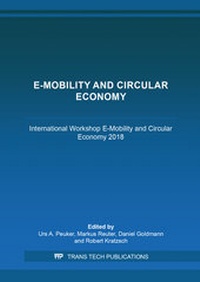
E-Mobility and Circular Economy
Published on 22. August 2019
Software
Digital media
202 pages
978-3-0357-2280-2 (ISBN)
Description
The International Workshop E-Mobility and Circular Economy, which has been jointly organized by TU Bergakademie Freiberg, Helmholtz Institute Freiberg for Resource Technology and TU Clausthal, was held in 2018. The conference was dedicated to key technological and economical questions which arise in the recycling of materials commonly used in e-mobility and electronics. It was aimed both at presenting new solutions for mechanical and metallurgic recycling and the substitution of conventional engineering materials. As there is an increasing need for rare chemical species in the generation of certain electronic, electrical, and mechanical properties in e-mobility and electronics, there was an additional focus on trace elements.
More details
Series
Language
English
Place of publication
Switzerland
Publishing group
Trans Tech Publications
Target group
Professional and scholarly
Dimensions
Height: 142 mm
Width: 125 mm
Thickness: 10 mm
Weight
200 gr
ISBN-13
978-3-0357-2280-2 (9783035722802)
DOI
10.4028/www.scientific.net/MSF.959
Schweitzer Classification
Other editions
Additional editions
Urs A. Peuker | Markus Reuter | Daniel Goldmann
E-Mobility and Circular Economy
Book
08/2019
Trans Tech Publications Ltd
€225.31
Shipment within 10-20 days
Urs A. Peuker | Markus Reuter | Daniel Goldmann
E-Mobility and Circular Economy
E-Book
06/2019
Trans Tech Publications Ltd
€211.86
Available for download
Content
Copper Availability from the Recycling of Electric Vehicles in Europe, North America and China: A Model Based Estimation until 2050Potential Contribution of Secondary Materials to Overall Supply - The Example of the European Cobalt CyclePredictive and Flexible Circular Economy Approaches for Highly Integrated Products and their Materials as Given in E-Mobility and ICTAllocation Procedures for Generic Cascade Use Cases - An Evaluation Using Monte Carlo AnalysisRecycling of Lithium Iron Phosphate Batteries: Future Prospects and Research NeedsIntegrated Direct Carbonation Process for Lithium Recovery from Primary and Secondary ResourcesEfficient Process for Li-Ion Battery Recycling via Electrohydraulic FragmentationLiquid-Liquid Extraction and Chromatography Process Routes for the Purification of LithiumRecycling of Printed Circuit Boards Employing Supercritical Carbon DioxideSilicon Waste from the Photovoltaic Industry - A Material Source for the Next Generation Battery Technology?Selective Separation Using Fluid-Liquid InterfacesCarrier Flotation: State of the Art and its Potential for the Separation of Fine and Ultrafine Mineral ParticlesCues to Greater Recycling Efficiency - Characterization of a Crushed Mobile Phone by Mineral Liberation Analysis (MLA)Review: Possibilities of Steel Scrap DecopperizationCopper-Alloyed PHFP Steel for Energy-Efficient and Distortion-Reduced Production of Cold-Formed, High-Strength Structural ComponentsCorrosion of Carbon Free and Bonded Refractories for Application in Steel Ingot Casting: An Approach for Improving Steel QualitySynthesis of High Performance Geopolymers by Wet Milling of Blast Furnace SlagsBundling Analytical Capacities to Understand Phase Formation in Recycling of Functional Materials