

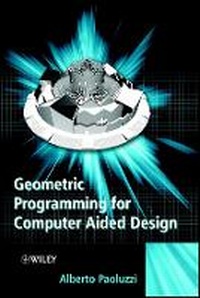
Geometric Programming for Computer-Aided Design
Published on 28. January 2005
Software
Other digital
815 pages
978-0-470-01388-5 (ISBN)
Description
Geometric Programming is currently of interest in CAD (Computer Aided Design) and related areas such as computer graphics, modeling and animation, scientific simulation and robotics. A growing interest towards gemotric programming is forecast in the next few years with respect to market specific CAD applications (e.g. for architecture and mechanical CAD) and web-based collaborative design environments. PLaSM is a general purpose functional language to compute with geometry which the authors use throughout their text. The PLaSM language output produces VRML (Virtual Reality Modelling Language) files which are used to create virtual worlds. PLaSM blends the powerful algebraic approach to programming developed at IBM research, with a dimension-independent approach to geometric data structures and algorithms, This book shows that such geometric code can be surprisingly compact and easy to write. It begins by introducing the basic programming with PLaSM and algebraic and geometric foundations of shape modeling, the foundations of computer graphics, solid modeling and geometric modeling of manifolds follows and finally discusses the application of geometric programming.
For each topic, the mathematics is given, together with the PLaSM implementation (usually with a few lines of readable code) and some worked examples. Combines excellent coverage of the theory with well-developed examples Numerous applications eg. scientific stimulation, robotics, CAD, Virtual Reality Worked exercises for each topic Uses PLaSM language (supplied) throughout to illustrate techniques Supported with web presence Written for Industrial Practioners developing CAD software, mechanical engineers in Graphics, CAD and CAM, undergraduate and postgraduate courses in Computer Science and Mechanical Engineering,as well as programmers involved with developing visualization software.
For each topic, the mathematics is given, together with the PLaSM implementation (usually with a few lines of readable code) and some worked examples. Combines excellent coverage of the theory with well-developed examples Numerous applications eg. scientific stimulation, robotics, CAD, Virtual Reality Worked exercises for each topic Uses PLaSM language (supplied) throughout to illustrate techniques Supported with web presence Written for Industrial Practioners developing CAD software, mechanical engineers in Graphics, CAD and CAM, undergraduate and postgraduate courses in Computer Science and Mechanical Engineering,as well as programmers involved with developing visualization software.
Reviews / Votes
"...an ambitious text that covers a lot of ground...very suitable for postgraduate research and teaching..." (Computer-Aided Design, 2004)More details
Language
English
Place of publication
Chichester
United Kingdom
Publishing group
John Wiley and Sons Ltd
Target group
Professional and scholarly
Dimensions
Height: 251 mm
Width: 178 mm
Thickness: 48 mm
Weight
1480 gr
ISBN-13
978-0-470-01388-5 (9780470013885)
Copyright in bibliographic data and cover images is held by Nielsen Book Services Limited or by the publishers or by their respective licensors: all rights reserved.
Schweitzer Classification
Other editions
Additional editions
Alberto Paoluzzi
Geometric Programming for Computer Aided Design
E-Book
01/2018
1st Edition
Wiley
€135.99
Available for download
Person
Content
Preface. I Programming and Geometry. Introduction to FL and PlaSM. Geometric programming. Elements of linear algebra. Elements of polyhedral geometry. Elements of differential geometry. II Graphics. Affine transformations. Graphic primitives. Hierarchical structures. Graphic pipelines. Viewing and rendering. III Modeling. Parametric curves. Parametric surfaces and solids. Basic solid modeling. Dimension-independent PLaSM operators. Motion modeling. Appendix A: Definition of MyFont. Appendix B: PLaSM libraries. Appendix C: References. Index.