

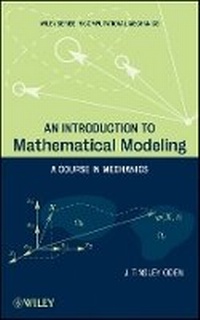
An Introduction to Mathematical Modeling - A Course in Mechanics
Published on 30. November 2011
Software
Other digital
348 pages
978-1-118-10573-3 (ISBN)
Description
An important resource, this book provides a short-course in nonlinear continuum mechanics, contains a brief account of electromagnetic wave theory and Maxwell's equations as well as an introductory account of quantum mechanics, and presents a brief introduction to statistical mechanics of systems in thermodynamic equilibrium. Also included is information on continuum mechanics, electrodynamics, quantum mechanics, and statistical mechanics. The author approaches mechanics as the branch of physics and mathematical science concerned with describing the motion of bodies, including their deformation and temperature changes, under the action of forces, and if the study of the propagation of waves and the transformation of energy in physical systems are added, then the term mechanics does indeed apply to everything that is covered within the book.
Reviews / Votes
"The book also serves as a valuable reference for professionals working in the areas of modeling and simulation, physics, and computational engineering." ( Zentralblatt MATH , 2012)More details
Language
English
Place of publication
New York
United States
Target group
College/higher education
Dimensions
Height: 250 mm
Width: 150 mm
Thickness: 15 mm
Weight
666 gr
ISBN-13
978-1-118-10573-3 (9781118105733)
Copyright in bibliographic data and cover images is held by Nielsen Book Services Limited or by the publishers or by their respective licensors: all rights reserved.
Schweitzer Classification
Other editions
Additional editions
E-Book
02/2012
Wiley
€119.99
Available for download
E-Book
10/2011
Wiley
€119.99
Available for download
Person
Content
Preface. I. Nonlinear Continuum Mechanics. 1. Kinematics of Deformable Bodies. 2. Mass and Momentum. 3. Force and Stress in Deformable Bodies. 4. The Principles of Balance of Linear and Angular Momentum. 5. The Principle of Conservation of Energy. 6. Thermodynamics of Continua and the Second Law. 7. Constitutive Equations. 8. Examples and Applications. II. Electromagnetic Field Theory and Quantum Mechanics. 9. Electromagnetic Waves. 10. Introduction to Quantum Mechanics. 11. Dynamical Variables and Observables in Quantum Mechanics: The Mathematical Formalism. 12. Applications: The Harmonic Oscillator and the Hydrogen Atom. 13. Spin and Pauli's Principle. 14. Atomic and Molecular Structure. 15. Ab Initio Methods: Approximate Methods and Density Functional Theory. III. Statistical Mechanics. 16. Basic Concepts: Ensembles, Distribution Functions and Averages. 17. Statistical Mechanics Basis of Classical Thermodynamics. Exercises. References.