

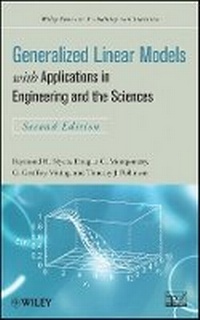
Generalized Linear Models: With Applications in En gineering and the Sciences, Second Edition
Published on 30. January 2012
Software
Other digital
520 pages
978-0-470-55698-6 (ISBN)
Description
Maintaining the same nontechnical approach as its acclaimed predecessor, this second edition of Generalized Linear Models is now thoroughly extended to include the latest developments in the field, the most relevant computational approaches, and the most relevant examples from the fields of engineering and physical sciences. This new edition is more tutorial in nature with added examples, exercises, and step-by-step analyses that can be easily worked using the SAS, Minitab, JMP, and R software packages. Its relevant for upper-undergraduate and graduate students as well as engineers, scientists, and statisticians.
Reviews / Votes
"Generalized linear models, second edition, is an excellent book for courses on regression analysis and regression modeling at the upper-undergraduate and graduate levels. It also serves as a valuable reference for engineers, scientists, and statisticians who must understand and apply GLMs in their work." (Mathematical Reviews, 2011)More details
Language
English
Place of publication
Hoboken
United Kingdom
Publishing group
John Wiley and Sons Ltd
Target group
Professional and scholarly
Dimensions
Height: 250 mm
Width: 150 mm
Thickness: 15 mm
Weight
666 gr
ISBN-13
978-0-470-55698-6 (9780470556986)
Copyright in bibliographic data and cover images is held by Nielsen Book Services Limited or by the publishers or by their respective licensors: all rights reserved.
Schweitzer Classification
Other editions
Additional editions
Raymond H. Myers | Douglas C. Montgomery | G. Geoffrey Vining
Generalized Linear Models
with Applications in Engineering and the Sciences
E-Book
01/2012
2nd Edition
Wiley
€139.99
Available for download
Persons
Raymond H. Myers, PhD , is Professor Emeritus in the Department of Statistics at Virginia Polytechnic Institute and State University. He has more than forty years of academic experience in the areas of experimental design and analysis, response surface analysis, and designs for nonlinear models. A Fellow of the American Statistical Society, Dr. Myers is the coauthor of numerous books including Response Surface Methodology: Process and Product Optimization Using Designed Experiments, Third Edition (Wiley). Douglas C. Montgomery, PhD , is Regents' Professor of Industrial Engineering and Statistics at Arizona State University. Dr. Montgomery has more than thirty years of academic and consulting experience and has devoted his research to engineering statistics, specifically the design and analysis of experiments. He has authored or coauthored numerous journal articles and twelve books, including Response Surface Methodology: Process and Product Optimization Using Designed Experiments, Third Edition; Introduction to Linear Regression Analysis, Fourth Edition; and Introduction to Time Series Analysis and Forecasting, all published by Wiley. G. Geoffrey Vining, PhD, is Professor in the Department of Statistics at Virginia Polytechnic Institute and State University. A Fellow of both the American Statistical Association and the American Society for Quality, Dr. Vining is also the coauthor of Introduction to Linear Regression Analysis, Fourth Edition (Wiley). Timothy J. Robinson, PhD, is Associate Professor in the Department of Statistics at the University of Wyoming. He has written numerous journal articles in the areas of design of experiments, response surface methodology, and applications of categorical data analysis in engineering, medicine, and the environmental sciences.
Content
Preface. 1. Introduction to Generalized Linear Models. 1.1 Linear Models. 1.2 Nonlinear Models. 1.3 The Generalized Linear Model. 2. Linear Regression Models. 2.1 The Linear Regression Model and Its Application. 2.2 Multiple Regression Models. 2.3 Parameter Estimation Using Maximum Likelihood. 2.4 Model Adequacy Checking. 2.5 Using R to Perform Linear Regression Analysis. 2.6 Parameter Estimation by Weighted Least Squares. 2.7 Designs for Regression Models. 3. Nonlinear Regression Models. 3.1 Linear and Nonlinear Regression Models. 3.2 Transforming to a Linear Model. 3.3 Parameter Estimation in a Nonlinear System. 3.4 Statistical Inference in Nonlinear Regression. 3.5 Weighted Nonlinear Regression. 3.6 Examples of Nonlinear Regression Models. 3.7 Designs for Nonlinear Regression Models. 4. Logistic and Poisson Regression Models. 4.1 Regression Models Where the Variance Is a Function of the Mean. 4.2 Logistic Regression Models. 4.3 Poisson Regression. 4.4 Overdispersion in Logistic and Poisson Regression. 5. The Generalized Linear Model. 5.1 The Exponential Family of Distributions. 5.2 Formal Structure for the Class of Generalized Linear Models. 5.3 Likelihood Equations for Generalized Linear models. 5.4 Quasi-Likelihood. 5.5 Other Important Distributions for Generalized Linear Models. 5.6 A Class of Link Functions-The Power Function. 5.7 Inference and Residual Analysis for Generalized Linear Models. 5.8 Examples with the Gamma Distribution. 5.9 Using R to Perform GLM Analysis. 5.10 GLM and Data Transformation. 5.11 Modeling Both a Process Mean and Process Variance Using GLM. 5.12 Quality of Asymptotic Results and Related Issues. 6. Generalized Estimating Equations. 6.1 Data Layout for Longitudinal Studies. 6.2 Impact of the Correlation Matrix R. 6.3 Iterative Procedure in the Normal Case, Identity Link. 6.4 Generalized Estimating Equations for More Generalized Linear Models. 6.5 Examples. 6.6 Summary. 7. Random Effects in Generalized Linear Models. 7.1 Linear Mixed Effects Models. 7.2 Generalized Linear Mixed Models. 7.3 Generalized Linear Mixed Models Using Bayesian. 8. Designed Experiments and the Generalized Linear Model. 8.1 Introduction. 8.2 Experimental Designs for Generalized Linear Models. 8.3 GLM Analysis of Screening Experiments. Appendix A.1 Background on Basic Test Statistics. Appendix A.2 Background from the Theory of Linear Models. Appendix A.3 The Gauss-Markov Theorem, Var(epsilon) = sigma 2 I. Appendix A.4 The Relationship Between Maximum Likelihood Estimation of the Logistic Regression Model and Weighted Least Squares. Appendix A.5 Computational Details for GLMs for a Canonical Link. Appendix A.6 Computations Details for GLMs for a Noncanonical Link. References. Index.