

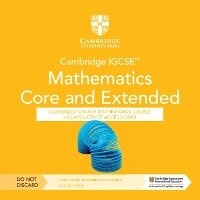
Cambridge IGCSE (TM) Mathematics Core and Extended Cambridge Online Mathematics Course - Class Licence Access Card (1 Year Access)
3rd Edition
Published on 22. June 2023
Software
Product license key
850 pages
978-1-009-34371-8 (ISBN)
Description
Our Cambridge Online Mathematics interactive digital teaching and learning platform is for students and teachers, for use at school or remotely. As a teacher, you can set activities and tasks for individuals or entire classes with the ability to compile reports on student progress and performance. Students can enjoy clear guidance and explanations, walkthroughs, quizzes, quick-fire challenges and more. This class licence is for Cambridge Online Mathematics only and consists of one code that can be used for up to 30 students. Individual licences are also available to purchase if your class size is larger.
More details
Series
Edition
3rd Revised edition
Language
English
Place of publication
Cambridge
United Kingdom
Target group
Children/juvenile
Edition type
Revised edition
Illustrations
Worked examples or Exercises
Dimensions
Height: 156 mm
Width: 155 mm
Weight
10 gr
ISBN-13
978-1-009-34371-8 (9781009343718)
Copyright in bibliographic data and cover images is held by Nielsen Book Services Limited or by the publishers or by their respective licensors: all rights reserved.
Schweitzer Classification
Content
1. Review of number concepts; 2. Making sense of algebra; 3. Lines, angles and shapes; 4. Collecting, organising and displaying data; 5. Fractions, percentages and standard form; 6. Equations, factors and formulae; 7. Perimeter, area and volume; 8. Introduction to probability; 9. Sequences, surds and sets; 10. Straight lines and quadratic equations; 11. Pythagoras' theorem and similar shapes; 12. Averages and measures of spread; 13. Understanding measurement; 14. Further solving of equations and inequalities; 15. Scale drawings, bearings and trigonometry; 16. Scatter diagrams and correlation; 17. Managing money; 18. Curved graphs; 19. Symmetry; 20. Histograms and cumulative frequency diagrams; 22. More equations, formulae and functions; 23. Transformations and vectors; 24. Probability using tree diagrams and Venn diagrams.