

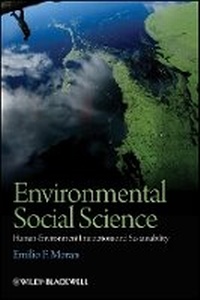
Environmental Social Science
Published on 23. February 2010
Software
Other digital
232 pages
978-1-4443-1905-7 (ISBN)
Description
Environmental Social Science offers a new synthesis of environmental studies, defining the nature of human-environment interactions and providing the foundation for a new cross-disciplinary enterprise that will make critical theories and research methods accessible across the natural and social sciences. Makes key theories and methods of the social sciences available to biologists and other environmental scientists Explains biological theories and concepts for the social sciences community working on the environment Helps bridge one of the difficult divides in collaborative work in human-environment research Includes much-needed descriptions of how to carry out research that is multinational, multiscale, multitemporal, and multidisciplinary within a complex systems theory context
Reviews / Votes
"Thanks to its capacity of surfing across natural and social sciences, Moran's work will at minimum help scholars from both sides to create bridges across the gap that still separates them; something that can already be seen as a non-trivial result." (Journal of Artificial Societies and Social Simulation, July 2010)More details
Language
English
Place of publication
Chicester
United Kingdom
Publishing group
John Wiley and Sons Ltd
Target group
Professional and scholarly
Dimensions
Height: 239 mm
Width: 163 mm
Thickness: 19 mm
Weight
490 gr
ISBN-13
978-1-4443-1905-7 (9781444319057)
Copyright in bibliographic data and cover images is held by Nielsen Book Services Limited or by the publishers or by their respective licensors: all rights reserved.
Schweitzer Classification
Other editions
Additional editions
E-Book
09/2011
Wiley-Blackwell
€31.99
Available for download
E-Book
01/2010
Wiley-Blackwell
€31.99
Available for download
Person
Emilio F. Moran is Distinguished Professor and Rudy Professor of Anthropology and Professor of Environmental Sciences at Indiana University in Bloomington. He is the author of Through Amazonian Eyes: the human ecology of Amazonian Populations (1993), Human Adaptability, 3rd Edition (2007), and People and Nature (2006, Blackwell).
Content
Preface. 1. The Challenge of Human-Environment Interactions Research. The Evolution of Social Ecological Systems. Characterization of Contemporary Global Environmental Changes. History of the Development of the Human Dimensions Agenda. Characteristics of the Research on the Human Dimensions. The Way Forward: Integrative Science. 2. Theories and Concepts from the Social Sciences. Population, Technology and Central Place Theories . Population and Environment Theories. Agency and History. Decision-theoretic Approaches. Political Economy and Political Ecology. Cultural Ecology. 3. Theories and Concepts from the Biological Sciences. Evolution by Natural Selection. Species respond individualistically, not as communities, to environmental change. Interactions with other species help determine if a particular species will persist in a particular place (Niche and Neutral Theories). Top-down vs. bottom-up control in ecosystems. Succession. Island Biogeography. Equilibrium/non-equilibrium theories of competition, coexistence, community composition Biodiversity and ecosystem processes/services. The Ecosystem Concept in Biology and the Social Sciences. 4. Spatially-Explicit Approaches. Remote Sensing and GIS. A Case Study using GIS/ Remote Sensing to study Amazonian Deforestation. Urban-rural spatial dynamics. Modeling and GIS. 5. Multi-Scale and Multi-temporal Analysis. An approach to multi-disciplinary, multi-scale research. Scale. Local level of analysis. Regional Level of Analysis. Global Level of Analysis. Future Directions. 6. Bio-complexity in Ecological Systems. Spatially-explicit Processes in Ecological and Social Systems. Agent-Based Modeling of Complex Systems. Hierarchical Modeling. Conclusions. 7. Environmental Decision-Making. Institutional Analysis. Individual Behavior and Environmental Decisions. Decisions and Social Context. Conclusions. 8. Towards Sustainability Science. Sustainability Science Research Priorities. Scales of Sustainability. Cities and Sustainability Science. Climate Change and Sustainability. Conclusions. Bibliography.