

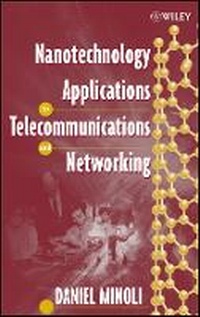
Nanotechnology Applications to Telecommunications and Networking
Published on 1. August 2005
Software
Other digital
512 pages
978-0-471-73660-8 (ISBN)
Description
Be a part of the nanotechnology revolution in telecommunications. This book provides a unique and thought provoking perspective on how nanotechnology is poised to revolutionize the telecommunications, computing, and networking industries. The author discusses emerging technologies as well as technologies under development that will lay the foundation for such innovations as: Nanomaterials with novel optical, electrical, and magnetic properties; faster and smaller non silicon based chipsets, memory, and processors; new science computers based on Quantum Computing Advanced microscopy and manufacturing systems; faster and smaller telecom switches, including optical switches; higher speed transmission phenomena based on plasmonics and other quantum level phenomena; Nanoscale MEMS: micro electro mechanical systems; and the author of this cutting edge publication has played a role in the development of actual nanotechnology based communication systems.
In this book, he examines a broad range of the science of nanotechnology and how this field will affect every facet of the telecommunications and computing industries, in both the near and far term, including: basic concepts of nanotechnology and its applications; essential physics and chemistry underlying nanotechnology science; nanotubes, nanomaterials, and nanomaterial processing; promising applications in nanophotonics, including nanocrystals and nanocrystal fibers; and, nanoelectronics, including metal nanoclusters, semiconducting nanoclusters, nanocrystals, nanowires, and quantum dots. This book is written for telecommunications professionals, researchers, and students who need to discover and exploit emerging revenue generating opportunities to develop the next generation of nanoscale telecommunications and network systems. Non scientists will find the treatment completely accessible. A detailed glossary clarifies unfamiliar terms and concepts. Appendices are provided for readers who want to delve further into the hard core science, including nanoinstrumentation and quantum computing.
Nanotechnology is the next industrial revolution, and the telecommunications industry will be radically transformed by it in a few years. This is the publication that readers need to understand how that transformation will happen, the science behind it, and how they can be a part of it.
In this book, he examines a broad range of the science of nanotechnology and how this field will affect every facet of the telecommunications and computing industries, in both the near and far term, including: basic concepts of nanotechnology and its applications; essential physics and chemistry underlying nanotechnology science; nanotubes, nanomaterials, and nanomaterial processing; promising applications in nanophotonics, including nanocrystals and nanocrystal fibers; and, nanoelectronics, including metal nanoclusters, semiconducting nanoclusters, nanocrystals, nanowires, and quantum dots. This book is written for telecommunications professionals, researchers, and students who need to discover and exploit emerging revenue generating opportunities to develop the next generation of nanoscale telecommunications and network systems. Non scientists will find the treatment completely accessible. A detailed glossary clarifies unfamiliar terms and concepts. Appendices are provided for readers who want to delve further into the hard core science, including nanoinstrumentation and quantum computing.
Nanotechnology is the next industrial revolution, and the telecommunications industry will be radically transformed by it in a few years. This is the publication that readers need to understand how that transformation will happen, the science behind it, and how they can be a part of it.
Reviews / Votes
"For scientists and researchers interested in learning the technical aspects of nanotechnology, this book will be a preferred choice." (IEEE Circuits & Devices Magazine, September/October 2006) " provides a thought provoking perspective on how nanotechnology is poised to revolutionize the telecommunications, computing, and networking industries." (IEEE Computer, January 2006)More details
Language
English
Place of publication
New York
United States
Publishing group
John Wiley and Sons Ltd
Target group
College/higher education
Professional and scholarly
Weight
10 gr
ISBN-13
978-0-471-73660-8 (9780471736608)
Copyright in bibliographic data and cover images is held by Nielsen Book Services Limited or by the publishers or by their respective licensors: all rights reserved.
Schweitzer Classification
Other editions
Additional editions
E-Book
10/2005
Wiley
€137.99
Available for download
Person
DANIEL MINOLI has many years experience providing telecommunications, networking, and IT architecture guidance and solutions for such organizations as the Advanced Research Projects Agency (ARPA), Bell Telephone Laboratories, ITT, Prudential Securities, Bell Communications Research (Bellcore/Telcordia), AT&T, New York University, Rutgers University, Stevens Institute of Technology, and Societe Generale de Financement du Quebec. An author of many technical references on information technology, telecommunications, and data communications, he has written columns for ComputerWorld, NetworkWorld, and Network Computing.
Content
Preface. About the Author. 1. What is Nanotechnology and What Are the Business Application. 1.1 Introduction and Scope. 1.2 Present Course of Investigation. 2. Basic Nanotechnology Science Physics. 2.1 Approach and Scope. 2.2 Basic Science. 2.3 Basic Properties of Conductors, Insulators, and Semiconductors. 2.4 Basic Properties of Silicon and Basic of Transistor Operations. 2.5 Conclusion. 3. Basic Nanotechnology Science Chemistry. 3.1 Introduction and Background. 3.2 Basic Chemistry Concepts. 3.3 Conclusion. 4. Nanotubes, Nanomaterials, and Nanomaterial Processing. 4.1 Introduction. 4.2 Basic Nanostructures. 4.3 Manufacturing Techniques. 4.4 System Design. 4.5 Conclusion. 5. Nanophotonics. 5.1 Introduction and Background: A Plethora of Opportunities. 5.2 General Photonics Trends. 5.3 Basic Nanophotonics. 5.4 Photonic Crystals. 5.5 Telecom Applications of Photonic Crystals. 5.6 Plasmonics. 5.7 Advanced Topics. 5.8 Conclusions. 6. Nanoelectronics. 6.1 Introduction. 6.2 Overview of Basic Nanoelectronic Technologies. 6.3 Additional Details on Nanoelectronic Systems. 6.4 Conclusion. Appendix A: Historical Developments Related to Atomic Theory and Additrional Perspectives. Appendix B. Brief Introduction to Hilbert Spaces. Appendix C: Reference Information. Appendix D: Basic Nanotechnology Science Quantum Physics. Appendix E: Mechanical Molecular Models and Quantum Aspects of Chemistry. Appendix F: Basic Molecular/Nanotechnology Intsrumentation. Appendix G: Quantum Computing. Glossary. References. Index.