

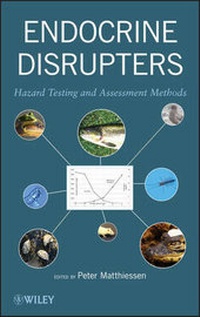
Endocrine Disrupters - Hazard Testing and Assessment Methods
Published on 25. March 2013
Software
Other digital
416 pages
978-1-118-35596-1 (ISBN)
Description
This book describes methodology and applications for endocrine disrupter toxicity testing, an issue of considerable urgency, because of international regulatory authorities currently considering such testing schemes. The coverage examines major animal groups for sensitivity to endocrine disrupting chemicals (EDCs), identifying endpoints and procedures for testing guidelines. Three EDC screening methods (two using fish and one using amphibians) are examined in detail for their efficacy and applicability. Edited by, and with contributions from, a leading participant in regulatory efforts, the book outlines methods that combine sensitivity, efficiency, statistical power, acceptable cost, and minimum ethical concern.
More details
Language
English
Place of publication
New York
United States
Target group
Professional and scholarly
Dimensions
Height: 275 mm
Width: 242 mm
Thickness: 44 mm
Weight
2695 gr
ISBN-13
978-1-118-35596-1 (9781118355961)
Copyright in bibliographic data and cover images is held by Nielsen Book Services Limited or by the publishers or by their respective licensors: all rights reserved.
Schweitzer Classification
Other editions
Additional editions
E-Book
02/2013
Wiley
€124.99
Available for download
E-Book
02/2013
Wiley
€124.99
Available for download
Content
Preface Chapter 1. Introduction Peter Matthiessen 1.1 Background 1.2 Regulatory concerns 1.3 Invertebrates 1.4 Vertebrates 1.5 Testing schemes for EDCs 1.6 References Chapter 2. Endocrine disruption in wildlife: background, effects and implications Dick Vethaak and Juliette Legler 2.1 Background to endocrine disruption 2.2 Effects of EDCs on wildlife 2.3 The weight of evidence and ecological significance of ED effects 2.4 Implications for effect assessment and toxicity testing 2.5 Need for more field studies and an integrated approach 2.6 Concluding points 2.7 References Chapter 3. The regulatory need for tests to detect EDCs and assess their hazards to wildlife Hans-Christian Stolzenberg, Tobias Frische, Anne Gourmelon, Taisen Iguchi, Flemming Ingerslev, Mike Roberts, and Gary Timm 3.1 Emerging concerns and policy responses, focusing on EDCs as a large pseudo-uniform group of substances 3.2 General approaches in substance-related regulatory frameworks (EU) 3.3 How to make EDC definitions operational for substance-related regulatory work 3.4 Future perspectives 3.5 Conclusions 3.6 References Chapter 4. Techniques for measuring endocrine disruption in insects Lennart Weltje 4.1 Introduction 4.2 Methods 4.3 Discussion 4.4 Conclusions 4.5 Acknowledgements 4.6 References Chapter 5. Crustaceans Magnus Breitholtz 5.1 Introduction 5.2 Background to crustacean endocrinology 5.3 State of the art - what do we know about endocrine disruption in crustaceans? 5.4 Available subchronic/chronic standard test protocols 5.5 Complementary tools for identification of endocrine disruption 5.6 Summary and conclusions 5.7 References 6. Endocrine disruption in mollusks (processes and testing Patricia D. McClellan-Green 6.1 Background and introduction 6.2 What constitutes the endocrine system in mollusks? 6.3 Endpoints and biomarkers of endocrine disruption 6.4 Current test methods using mollusks 6.5 Proposed test methods 6.6 Conclusions 6.7 References 7. Using fish to detect endocrine disrupters and assess their potential environmental hazards Peter Matthiessen 7.1 Introduction 7.2 International efforts to standardise fish-based methods for screening and testing endocrine disrupting chemicals 7.3 Fish-based screens developed by OECD for endocrine disrupting chemicals 7.4 Progress with developing fish partial life-cycle tests for endocrine disrupters 7.5 Prospects for the standardisation of fish full life-cycle and multi-generation tests 7.6 Strengths and weaknesses of a hazard evaluation strategy based partly on available and proposed fish screens and tests 7.7 Conclusions 7.8 References 8. Screening and testing for endocrine disrupting chemicals in amphibian models Daniel B. Pickford 8.1 Introduction 8.2 Potential uses of amphibians in endocrine disrupter screening and testing programmes 8.3 Embryonic development 8.4 Hatching 8.5 Larval development 8.6 Higher tier tests with amphibians 8.7 Other and emerging test methods 8.8 Summary and conclusions 8.9 References 9. Endocrine disruption and reptiles: using the unique attributes of temperature-dependent sex determination to assess impacts Satomi Kohno and Louis J. Guillette Jr. 9.1 Introduction 9.2 Approaches to examine effects of EDCs 9.3 Induction of sex reversal in ovo 9.4 Analysis of sex-reversed animals 9.5 Conclusions 9.6 References 10. Birds Paul D. Jones, Markus Hecker, Steve Wiseman and John P. Giesy 10.1 Introduction 10.2 Differences between birds and mammals and among bird species 10.3 In vitro techniques 10.4 Studies with embryos 10.5 In vivo techniques 10.6 Examples of EDC effects from field studies 10.7 Proposed 2-generation test 10.8 Conclusions 10.9 References 11. Mammalian methods for detecting and assessing endocrine-active compounds M. Sue Marty 11.1 Introduction 11.2 Mammalian Tier 1 screening assays 11.3 Tier 2 tests 11.4 Human and wildlife relevance of estrogen, androgen and thyroid screening assays 11.5 Potential future assays for endocrine screening 11.6 References 12. Application of the OECD Conceptual Framework for assessing the human health and ecological effects of endocrine disrupters Thomas H. Hutchinson, Jenny Odum and Anne Gourmelon 12.1 Introduction 12.2 Overview of the OECD revised Conceptual Framework 12.3 Application of the 'Klimisch Criteria' to the EE2 and VIN case studies 12.4 Case study: data examples for 17alpha-ethinylestradiol (EE2) 12.5 Case study: data examples for vinclozolin (VIN) 12.6 Conclusions 12.7 Disclaimer 12.8 References 13. The prospects for routine testing of chemicals for endocrine disrupting properties and potential ecological impacts Peter Matthiessen 13.1 Introduction 13.2 Are there gaps in the testing suite for EDCs? 13.3 'New' modes of endocrine disrupting action 13.4 How should tests for EDCs be deployed in an integrated fashion? 13.5 Use of weight-of-evidence when assessing possible EDCs 13.6 Conclusions 13.7 References Index