

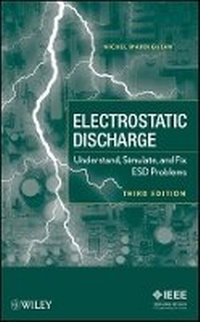
Electro Static Discharge - Understand, Simulate fix ESD Problems, Third Edition
Published on 22. September 2009
Software
Other digital
320 pages
978-0-470-49507-0 (ISBN)
Description
Of all the electro magnetic susceptibility problems found during test and in the field, ESD is one of the toughest to overcome. With the growing consumer demand for reliability and availability, this timely book provides design engineers with a clear understanding of the ESD threat and offers a methodic, step-by-step attack to reduce its risk and test for immunity at all levels. Complete with case histories and their successful fixes, this is truly the most thorough and concise treatment of the broad ESD continuum available.
More details
Language
English
Place of publication
Hoboken
United Kingdom
Publishing group
John Wiley and Sons Ltd
Target group
Professional and scholarly
ISBN-13
978-0-470-49507-0 (9780470495070)
Copyright in bibliographic data and cover images is held by Nielsen Book Services Limited or by the publishers or by their respective licensors: all rights reserved.
Schweitzer Classification
Other editions
Additional editions
E-Book
09/2011
3rd Edition
Wiley-IEEE Press
€119.99
Available for download
E-Book
11/2009
3rd Edition
Wiley-IEEE Press
€116.99
Available for download
Person
Michel Mardiguian is a private consultant in France, where he teaches EMI/RFI/ESD classes and consults on tasks from EMC design to firefighting. He has written or cowritten ten widely sold handbooks and has published twenty-eight conference papers and thirteen magazine articles.
Content
Preface to the First Edition. Preface to the Third Edition. Acknowledgements. 1. The Electrostatic Discharge Phenomenon. 1.1. Physics Involved. 1.2. Influencing Parameters. 1.3. Various Types of Electrostatic Charging with Humans and Objects. 1.4. Statistics of Voltages and Currents Reached During ESD. 1.5. Waveforms of Electrostatic Discharges. References. 2. Effects of ESD on Electronics. 2.1. Direct Discharge to an Electronic Component. 2.2. Direct Discharge to Electronic Equipment Enclosure. 2.3. Indirect Discharge. 2.4. Coupling Mechanisms of ESD Pulse into the Victim's Circuitry. 2.5. Response of Victim Circuits and Type of Errors. 2.6. Prediction of Actual ESD-Induced Error, Fast Approximation Method. 2.7. Remarks on the Actual Current Paths and Associated Radiation. 2.8. Personnel or Furniture ESD: Which One is Worse? References. 3. Principal ESD Specifications. 3.1. ESD Test Specifications for Device Sensitivity. 3.2. ESD Specifications for Equipment Immunity. 3.3. Antistatic Control Procedures. References. 4. ESD Diagnostics and Testing. 4.1. ESD Simulators: How They Work. 4.2. Furniture Versus Personnel ESD Simulation. 4.3. Other Types of ESD Simulators for Component Testing. 4.4. ESD Test Setup-Direct and Indirect ESD. 4.5. ESD Test Routine and Discharge Procedures. 4.6. No Error/No Damage Concept: The Several Layers of Severity. 4.7. The Error per Discharge Concept or Multiple-Trials Approach. 4.8. ESD Test During Design and Development. 4.9. ESD For Field Diagnostics and Forced Crash Method. 4.10. Home-Made Investigation Tools and Diagnostic Hints. References. 5. Design for ESD Immunity. 5.1. ESD Protection at Component Level. 5.2. ESD Protection at the PCB Level (Internal Circuitry). 5.3. ESD Protection by Internal Wiring and Mechanical Packaging. 5.4. ESD Protection by Box Shielding and Envelope Design. 5.5. ESD Protection of External Cables and I/O Ports. 5.6. ESD Immunity by Software and Noise Inhibition Techniques. 5.7. ESD Immunity with Miniature, Portable Devices. 5.8. System ESD Immunity. 5.9. ESD Control at Installation Level. References. 6. ESD Cases Studies. 6.1. Case 1: The Reradiating Ground Strap. 6.2. Case 2: ESD Hardening of a Printer. 6.3. Case 3: The Data Terminal with Floating Tray. 6.4. Case 4: The Safety Wire "Antenna". 6.5. Case 5: The Touchy Watchdog. 6.6. Case 6: The Trigger-Happy Air bag Initiator. 6.7. Conclusion: Troubleshooting Hints. Appendix A. ESD Protection by Design of Chips and Microcircuits. Appendix B. Prediction of ESD Damage Level for a Semiconductor Junction. Appendix C. Spark-Over Voltages. Appendix D. Fatigue Phenomena During Repeated ESD Testing. Appendix E. Prediction of ESD-Induced Noise by Fast Frequency- Domain Calculations. Appendix F. More Experiments on ESD Coupling to Boxes. Appendix G. Examples of Simple SPICE Modeling of ESD Coupling Effects. Appendix H. Time-to-Frequency Conversion for a Single Transient. Index.