

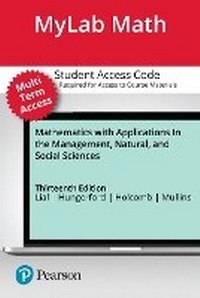
MyLab Math with Pearson eText (up to 24 months) Access Code for Mathematics with Applications In the Management, Natural, and Social Sciences
13th Edition
Published on 8. May 2023
Software
Product license key
978-0-13-808040-2 (ISBN)
Description
Mathematics with Applications in the Management, Natural, and Social Sciences is an applications-focused text that helps you build a strong foundation with solid coverage of college algebra, followed by topics in finite mathematics, and finally a careful treatment of applied calculus. It can be used for a variety of courses across many majors, and only a basic course in algebra is required as a prerequisite. Helpful learning features like Checkpoint Exercises give you the opportunity to pause, check your understanding of a concept, and move forward confidently. Case Studies at the end of each chapter offer up-to-date, real-world applications of the mathematics presented in the chapter.
Among many other enhancements, the 13th Edition significantly updates applications and examples to make them as interesting as possible. Throughout, 884 new or updated exercises and 130 new examples modernize the data and exercises.
Personalize learning with MyLab Math with Pearson+ eTextbook This flexible digital platform combines unrivaled content, online assessments and customizable features to personalize learning and improve results.
Pearson+ eTextbook is an easy-to-use digital textbook available within MyLab (R) that lets you read, highlight and take notes, all in one place.
NOTE: Before purchasing, check with your instructor to confirm the correct ISBN. Several versions of the MyLab and Mastering (R) platforms exist for each title, and registrations are not transferable. To register for and use MyLab, you will need either a course ID from your instructor or an invitation link that your instructor will send you directly.
Used books, rentals, and purchases made outside of Pearson If purchasing or renting from companies other than Pearson, the access codes for the MyLab platform may not be included, may be incorrect, or may be previously redeemed. Check with the seller before completing your purchase.
Among many other enhancements, the 13th Edition significantly updates applications and examples to make them as interesting as possible. Throughout, 884 new or updated exercises and 130 new examples modernize the data and exercises.
Personalize learning with MyLab Math with Pearson+ eTextbook This flexible digital platform combines unrivaled content, online assessments and customizable features to personalize learning and improve results.
Pearson+ eTextbook is an easy-to-use digital textbook available within MyLab (R) that lets you read, highlight and take notes, all in one place.
NOTE: Before purchasing, check with your instructor to confirm the correct ISBN. Several versions of the MyLab and Mastering (R) platforms exist for each title, and registrations are not transferable. To register for and use MyLab, you will need either a course ID from your instructor or an invitation link that your instructor will send you directly.
Used books, rentals, and purchases made outside of Pearson If purchasing or renting from companies other than Pearson, the access codes for the MyLab platform may not be included, may be incorrect, or may be previously redeemed. Check with the seller before completing your purchase.
More details
Edition
13th edition
Language
English
Place of publication
United States
Publishing group
Pearson Education (US)
Target group
College/higher education
ISBN-13
978-0-13-808040-2 (9780138080402)
Copyright in bibliographic data and cover images is held by Nielsen Book Services Limited or by the publishers or by their respective licensors: all rights reserved.
Schweitzer Classification
Persons
About our authors The late? Marge Lial was always interested in math; it was her favorite subject in the first grade! Marge's intense desire to educate both her students and herself has inspired the writing of numerous best-selling textbooks. Marge, who received Bachelor's and Master's degrees from California State University at Sacramento, was affiliated with American River College. An avid reader and traveler, her travel experiences often found their way into her books as applications, exercise sets and feature sets. Her interest in archeology led to trips to various digs and ruin sites, producing some fascinating problems for her textbooks involving such topics as the building of Mayan pyramids and the acoustics of ancient ball courts in the Yucatan.?
The late? Thomas W. Hungerford received his Bachelor's degree from Holy Cross and his PhD from the University of Chicago. He taught for many years at the University of Washington (Seattle) before moving to Cleveland State University in 1980 and then to St. Louis University to in 2003. He wrote a number of research articles in algebra and several in mathematics education. Dr. Hungerford is the author or coauthor of more than a dozen mathematics textbooks, ranging from high school to graduate level, several of which are published by Pearson. He passionately promoted the effective use of technology in mathematics instruction. Dr. Hungerford was also a referee and reviewer for various mathematical journals and served on National Science Foundation panels for selecting grant recipients.
John P. Holcomb, Jr. received his Bachelor's degree from St. Bonaventure University and his PhD from the University at Albany, State University of New York. He is professor and chair and frequently publishes with researchers in a variety of disciplines where he provides statistical analysis. Dr. Holcomb has also authored several papers in statistical education and is very active in the American Statistical Association and the Mathematical Association of America. He was named a Carnegie Scholar in 2000 by the Carnegie Foundation for the Advancement of Teaching and Learning and in 2003 received the Waller Award from the American Statistical Association for outstanding teaching of introductory statistics.?
Bernadette Mullins received her Bachelor's degree from Western Illinois University and her PhD from the University of Iowa. She is currently professor of mathematics at Birmingham-Southern College (BSC) in Birmingham, Alabama, where she arrived in 2000. She has published numerous articles in the fields of commutative ring theory and mathematics education. She has served as co-investigator for several National Science Foundation grants related to improving mathematics education. Dr. Mullins has won 4 awards for her excellence in teaching, including the Bob Whetstone award at BSC. Throughout her career she has been active in Project NExT (New Experiences in Teaching) and the Mathematical Association of America, and was elected Alabama State Director of the MAA in 2013.
The late? Thomas W. Hungerford received his Bachelor's degree from Holy Cross and his PhD from the University of Chicago. He taught for many years at the University of Washington (Seattle) before moving to Cleveland State University in 1980 and then to St. Louis University to in 2003. He wrote a number of research articles in algebra and several in mathematics education. Dr. Hungerford is the author or coauthor of more than a dozen mathematics textbooks, ranging from high school to graduate level, several of which are published by Pearson. He passionately promoted the effective use of technology in mathematics instruction. Dr. Hungerford was also a referee and reviewer for various mathematical journals and served on National Science Foundation panels for selecting grant recipients.
John P. Holcomb, Jr. received his Bachelor's degree from St. Bonaventure University and his PhD from the University at Albany, State University of New York. He is professor and chair and frequently publishes with researchers in a variety of disciplines where he provides statistical analysis. Dr. Holcomb has also authored several papers in statistical education and is very active in the American Statistical Association and the Mathematical Association of America. He was named a Carnegie Scholar in 2000 by the Carnegie Foundation for the Advancement of Teaching and Learning and in 2003 received the Waller Award from the American Statistical Association for outstanding teaching of introductory statistics.?
Bernadette Mullins received her Bachelor's degree from Western Illinois University and her PhD from the University of Iowa. She is currently professor of mathematics at Birmingham-Southern College (BSC) in Birmingham, Alabama, where she arrived in 2000. She has published numerous articles in the fields of commutative ring theory and mathematics education. She has served as co-investigator for several National Science Foundation grants related to improving mathematics education. Dr. Mullins has won 4 awards for her excellence in teaching, including the Bob Whetstone award at BSC. Throughout her career she has been active in Project NExT (New Experiences in Teaching) and the Mathematical Association of America, and was elected Alabama State Director of the MAA in 2013.
Content
Prerequisite Skills Test? Calculus Readiness Test? 1. Algebra and Equations?
1.1 The Real Numbers?
1.2 Polynomials?
1.3 Factoring?
1.4 Rational Expressions?
1.5 Exponents and Radicals?
1.6 First-Degree Equations?
1.7 Quadratic Equations?
Summary and Review?
Case Study 1: Energy Efficiency and Long-Term Cost Savings
2. Graphs, Lines, and Inequalities?
2.1 Graphs?
2.2 Equations of Lines?
2.3 Linear Models?
2.4 Linear Inequalities?
2.5 Polynomial and Rational Inequalities?
Summary and Review?
Case Study 2: Using Extrapolation and Interpolation for Prediction
3. Functions and Graphs?
3.1 Functions?
3.2 Graphs of Functions?and Transformations
3.3 Applications of Linear Functions?
3.4 Quadratic Functions and Applications?
3.5 Polynomial Functions?
3.6 Rational Functions?
3.7 Composition of Functions
Summary and Review?
Case Study 3: Maximizing Profit?
4. Exponential and Logarithmic Functions
4.1 Exponential Functions?
4.2 Applications of Exponential Functions?
4.3 Logarithmic Functions?
4.4 Logarithmic and Exponential Equations?
Summary and Review?
Case Study 4: Gapminder.org?
5. The Mathematics of Personal Finance?
5.1 Simple and Compound Interest?
5.2 Annuities, Future Value, and Sinking Funds?
5.3 Consumer Loans and Amortization?
5.4 Bonds and Treasury Bills
Summary and Review?
Case Study 5: Investing in Stocks and Using the Rule of 72?
6. Systems of Linear Equations and Matrices?
6.1 Systems of Two Linear Equations in Two Variables?
6.2 Larger Systems of Linear Equations?
6.3 Applications of Systems of Linear Equations?
6.4 Basic Matrix Operations?
6.5 Matrix Products and Inverses?
6.6 Applications of Matrices?
Summary and Review?
Case Study 6: Airline Route Maps?
7. Linear Programming?
7.1 Graphing Linear Inequalities in Two Variables?
7.2 Linear Programming: The Graphical Method?
7.3 Applications of Linear Programming?
7.4 The Simplex Method: Maximization?
7.5 Maximization Applications?
7.6 The Simplex Method: Duality and Minimization?
>7.7 The Simplex Method: Nonstandard Problems?
Summary and Review?
Case Study 7: Cooking with Linear Programming?
8. Sets and Probability
8.1 Sets?
8.2 Applications of Venn Diagrams and Contingency Tables?
8.3 Introduction to Probability?
8.4 Basic Concepts of Probability?
8.5 Conditional Probability and Independent Events?
8.6 Bayes' Formula?
Summary and Review?
Case Study 8: Medical Diagnosis
9. Counting, Probability Distributions, and Further Topics in Probability?
9.1 Probability Distributions and Expected Value?
9.2 The Multiplication Principle, Permutations, and Combinations?
9.3 Applications of Counting?
9.4 Binomial Probability?
9.5 Markov Chains?
9.6 Decision Making?
Summary and Review?
Case Study 9: Quick Draw (R)?from the New York State Lottery?
10. Introduction to Statistics
10.1 Frequency Distributions?
10.2 Measures of Center?
10.3 Measures of Variation and Boxplots?
10.4 Normal Distributions?
Summary and Review?
Case Study 10: Standard Deviation as a Measure of Risk??
11. Differential Calculus
11.1 Limits?
11.2 One-Sided Limits and Limits Involving Infinity?
11.3 Rates of Change?
11.4 Tangent Lines and Derivatives?
11.5 Techniques for Finding Derivatives?
11.6 Derivatives of Products and Quotients?
11.7 The Chain Rule?
11.8 Derivatives of Exponential and Logarithmic Functions?
11.9 Continuity and Differentiability?
Summary and Review?
Case Study 11: Price Elasticity of Demand<?
12. Applications of the Derivative?
12.1 Local Extrema?
12.2 The Second Derivative?
12.3 Optimization Applications?
12.4 Implicit Differentiation?
12.5 Related Rates?
12.6 Curve Sketching?
Summary and Review?
Case Study 12: Maximizing Profit?
13. Integral Calculus?
13.1 Antiderivatives?
13.2 Integration by Substitution?
13.3 Integration by Parts?
13.4 Area and the Definite Integral?
13.5 The Fundamental Theorem of Calculus?
13.6 Applications of Integrals?
13.7 Differential Equations?
Summary and Review?
Case Study 13: Logistic Population Growth??
14. Multivariate Calculus?
14.1 Functions of Several Variables?
14.2 Partial Derivatives?
14.3 Extrema of Functions of Several Variables?
14.4 Lagrange Multipliers?
Summary and Review?
Case Study 14: The Method of Least Squares?
Appendices
A:?Areas under the Normal Curve?
B:?Solutions to Prerequisite Skills Test and Calculus Readiness Test?
C:?Table of Integrals?
Answers to Selected Exercises? Index of Companies, Products, and Agencies? Index of Applications? Subject Index? Photo Credits? Reference Endpapers
Algebra Review
Geometric Formulas
Finite Math Review
Calculus Review
1.1 The Real Numbers?
1.2 Polynomials?
1.3 Factoring?
1.4 Rational Expressions?
1.5 Exponents and Radicals?
1.6 First-Degree Equations?
1.7 Quadratic Equations?
Summary and Review?
Case Study 1: Energy Efficiency and Long-Term Cost Savings
2. Graphs, Lines, and Inequalities?
2.1 Graphs?
2.2 Equations of Lines?
2.3 Linear Models?
2.4 Linear Inequalities?
2.5 Polynomial and Rational Inequalities?
Summary and Review?
Case Study 2: Using Extrapolation and Interpolation for Prediction
3. Functions and Graphs?
3.1 Functions?
3.2 Graphs of Functions?and Transformations
3.3 Applications of Linear Functions?
3.4 Quadratic Functions and Applications?
3.5 Polynomial Functions?
3.6 Rational Functions?
3.7 Composition of Functions
Summary and Review?
Case Study 3: Maximizing Profit?
4. Exponential and Logarithmic Functions
4.1 Exponential Functions?
4.2 Applications of Exponential Functions?
4.3 Logarithmic Functions?
4.4 Logarithmic and Exponential Equations?
Summary and Review?
Case Study 4: Gapminder.org?
5. The Mathematics of Personal Finance?
5.1 Simple and Compound Interest?
5.2 Annuities, Future Value, and Sinking Funds?
5.3 Consumer Loans and Amortization?
5.4 Bonds and Treasury Bills
Summary and Review?
Case Study 5: Investing in Stocks and Using the Rule of 72?
6. Systems of Linear Equations and Matrices?
6.1 Systems of Two Linear Equations in Two Variables?
6.2 Larger Systems of Linear Equations?
6.3 Applications of Systems of Linear Equations?
6.4 Basic Matrix Operations?
6.5 Matrix Products and Inverses?
6.6 Applications of Matrices?
Summary and Review?
Case Study 6: Airline Route Maps?
7. Linear Programming?
7.1 Graphing Linear Inequalities in Two Variables?
7.2 Linear Programming: The Graphical Method?
7.3 Applications of Linear Programming?
7.4 The Simplex Method: Maximization?
7.5 Maximization Applications?
7.6 The Simplex Method: Duality and Minimization?
>7.7 The Simplex Method: Nonstandard Problems?
Summary and Review?
Case Study 7: Cooking with Linear Programming?
8. Sets and Probability
8.1 Sets?
8.2 Applications of Venn Diagrams and Contingency Tables?
8.3 Introduction to Probability?
8.4 Basic Concepts of Probability?
8.5 Conditional Probability and Independent Events?
8.6 Bayes' Formula?
Summary and Review?
Case Study 8: Medical Diagnosis
9. Counting, Probability Distributions, and Further Topics in Probability?
9.1 Probability Distributions and Expected Value?
9.2 The Multiplication Principle, Permutations, and Combinations?
9.3 Applications of Counting?
9.4 Binomial Probability?
9.5 Markov Chains?
9.6 Decision Making?
Summary and Review?
Case Study 9: Quick Draw (R)?from the New York State Lottery?
10. Introduction to Statistics
10.1 Frequency Distributions?
10.2 Measures of Center?
10.3 Measures of Variation and Boxplots?
10.4 Normal Distributions?
Summary and Review?
Case Study 10: Standard Deviation as a Measure of Risk??
11. Differential Calculus
11.1 Limits?
11.2 One-Sided Limits and Limits Involving Infinity?
11.3 Rates of Change?
11.4 Tangent Lines and Derivatives?
11.5 Techniques for Finding Derivatives?
11.6 Derivatives of Products and Quotients?
11.7 The Chain Rule?
11.8 Derivatives of Exponential and Logarithmic Functions?
11.9 Continuity and Differentiability?
Summary and Review?
Case Study 11: Price Elasticity of Demand<?
12. Applications of the Derivative?
12.1 Local Extrema?
12.2 The Second Derivative?
12.3 Optimization Applications?
12.4 Implicit Differentiation?
12.5 Related Rates?
12.6 Curve Sketching?
Summary and Review?
Case Study 12: Maximizing Profit?
13. Integral Calculus?
13.1 Antiderivatives?
13.2 Integration by Substitution?
13.3 Integration by Parts?
13.4 Area and the Definite Integral?
13.5 The Fundamental Theorem of Calculus?
13.6 Applications of Integrals?
13.7 Differential Equations?
Summary and Review?
Case Study 13: Logistic Population Growth??
14. Multivariate Calculus?
14.1 Functions of Several Variables?
14.2 Partial Derivatives?
14.3 Extrema of Functions of Several Variables?
14.4 Lagrange Multipliers?
Summary and Review?
Case Study 14: The Method of Least Squares?
Appendices
A:?Areas under the Normal Curve?
B:?Solutions to Prerequisite Skills Test and Calculus Readiness Test?
C:?Table of Integrals?
Answers to Selected Exercises? Index of Companies, Products, and Agencies? Index of Applications? Subject Index? Photo Credits? Reference Endpapers
Algebra Review
Geometric Formulas
Finite Math Review
Calculus Review