

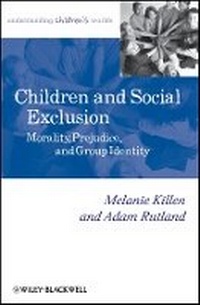
Children and Social Exclusion - Morality, Prejudice and Group Identity
Published on 20. April 2011
Software
Other digital
248 pages
978-1-4443-9631-7 (ISBN)
Description
Children and Social Exclusion: Morality, Prejudice, and Group Identity explores the origins of prejudice and the emergence of morality to explain why children include some and exclude others. Formulates an original theory about children's experiences with exclusion and how they understand the world of discrimination based on group membership Brings together Social Domain Theory and Social Identity Theory to explain how children view exclusion that often results in prejudice, and inclusion that reflects social justice and morality Presents new research data consisting of in-depth interviews from childhood to late adolescence, observational findings with peer groups, and experimental paradigms that test how children understand group dynamics and social norms, and show either group bias or morality Illustrates data with direct quotes from children along with diagrams depicting their social understanding Presents new insights about the origins of prejudice and group bias, as well as morality and fairness, drawn from extensive original data
Reviews / Votes
"Killen and Rutland provide expert broad-ranging reviews of relevant theories, research, and interventions and conclude with an integrative framework for understanding and addressing peer exclusion." ( Journal of Applied Developmental Psychology , 2012) "Highly recommended. Upper-division undergraduates through faculty and professionals." (Choice, 1 November 2011)More details
Language
English
Place of publication
Chicester
United Kingdom
Publishing group
John Wiley and Sons Ltd
Target group
Professional and scholarly
Dimensions
Height: 250 mm
Width: 150 mm
Thickness: 15 mm
Weight
666 gr
ISBN-13
978-1-4443-9631-7 (9781444396317)
Copyright in bibliographic data and cover images is held by Nielsen Book Services Limited or by the publishers or by their respective licensors: all rights reserved.
Schweitzer Classification
Other editions
Additional editions
E-Book
03/2011
Wiley-Blackwell
€22.99
Available for download
E-Book
02/2011
Wiley-Blackwell
€22.99
Available for download
Persons
Melanie Killen is Professor of Human Development, Professor of Psychology (Affiliate), and the Associate Director for the Center for Children, Relationships, and Culture at the University of Maryland. She is a Fellow of both the American Psychological Association and the Association for Psychological Science. She is also a recent recipient of the Distinguished Scholar-Teacher Award by the Provost from the University of Maryland. Her book with Dan Hart, Morality in Everyday Life: Developmental Perspectives (1995), received the outstanding book award from AERA, and her book with Sheri Levy, Intergroup Attitudes and Relations from Childhood to Adulthood, received an Honorable Mention for the Otto Klineberg Memorial Prize from SPSSI. She has over 100 publications. Her research examines the development of morality, intergroup attitudes, exclusion and inclusion, peer relationships, prejudice, culture, and how diversity in social experience is related to social cognitive development. Adam Rutland is Professor of Developmental Psychology at the Child Development Unit and Centre for the Study of Group Processes in the School of Psychology at the University of Kent. Previously he has been a British Academy Post-doctoral Fellow at the University of Surrey and been a member of Faculty at the University of Aberdeen. His research examines the development of children's prejudice and social identities. He has conducted recent research into when and how children learn to self-present their explicit attitudes; how intergroup contact can reduce children's prejudice; children's exclusion of peers within groups and acculturation amongst ethnic minority children. Professor Rutland's research has primarily been funded by the Economic and Social Research Council and the British Academy in the UK. He has published over 40 publications in international journals and has edited volumes in the fields of developmental and social psychology.
Content
Series Editor's Preface. Preface. Chapter 1: Introduction: Exclusion and Inclusion in Children's Lives. Chapter 2: Emergence of Morality and Inclusion. Chapter 3: Emergence of Categorization and Prejudice. Chapter 4: Development of Group Identity and Prejudice. Chapter 5: What we know about Peer Relations, Group Identity, and Exclusion. Chapter 6: Intragroup and Intergroup Exclusion: An In-depth Study. Chapter 7: Peer Exclusion and Group Identity Around the World: The Role of Culture. Chapter 8 : Interventions for Promoting Morality and Positive Intergroup Attitudes. Chapter 9 : Integration of Morality, Prejudice, and Group Identity: A New Perspective. References. Index.