

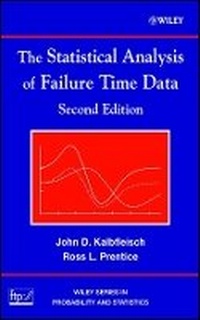
The Statistical Analysis of Failure Time Data 2e
Published on 31. January 2011
Software
Other digital
462 pages
978-1-118-03298-5 (ISBN)
Description
Contains additional discussion and examples on left truncation as well as material on more general censoring and truncation patterns. Introduces the martingale and counting process formulation swil lbe in a new chapter. Develops multivariate failure time data in a separate chapter and extends the material on Markov and semi Markov formulations. Presents new examples and applications of data analysis.
Reviews / Votes
"...provides excellent exposure to the theory." ( Journal of Statistical Computation and Simulation , June 2005) "The book contains a wealth of material and analytic insight...will continue to be an invaluable resource for all researchers and graduate students in the field...for years to come." ( Journal of the American Statistical Association , December 2003) "...researchers in hazard function are likely to find new and valuable information in this book..." ( Journal of Mathematical Psychology , Vol. 47 2003)More details
Language
English
Place of publication
New York
United States
Target group
Professional and scholarly
Dimensions
Height: 238 mm
Width: 162 mm
Thickness: 30 mm
Weight
774 gr
ISBN-13
978-1-118-03298-5 (9781118032985)
Copyright in bibliographic data and cover images is held by Nielsen Book Services Limited or by the publishers or by their respective licensors: all rights reserved.
Schweitzer Classification
Other editions
Additional editions
John D. Kalbfleisch | Ross L. Prentice
The Statistical Analysis of Failure Time Data
E-Book
01/2011
2nd Edition
Wiley
€179.99
Available for download
Person
JOHN D. KALBFLEISCH, PhD, is Professor of Biostatistics at the University of Michigan in Ann Arbor and the University of Waterloo in Ontario, Canada. ROSS L. PRENTICE, PhD, is Professor of Biostatistics at the Fred Hutchinson Cancer Research Center and the University of Washington in Seattle.
Content
Preface. 1. Introduction. 1.1 Failure Time Data. 1.2 Failure Time Distributions. 1.3 Time Origins, Censoring, and Truncation. 1.4 Estimation of the Survivor Function. 1.5 Comparison of Survival Curves. 1.6 Generalizations to Accommodate Delayed Entry. 1.7 Counting Process Notation. Bibliographic Notes. Exercises and Complements. 2. Failure Time Models. 2.1 Introduction. 2.2 Some Continuous Parametric Failure Time Models. 2.3 Regression Models. 2.4 Discrete Failure Time Models. Bibliographic Notes. Exercises and Complements. 3. Inference in Parametric Models and Related Topics. 3.1 Introduction. 3.2 Censoring Mechanisms. 3.3 Censored Samples from an Exponential Distribution. 3.4 Large-Sample Likelihood Theory. 3.5 Exponential Regression. 3.6 Estimation in Log-Linear Regression Models. 3.7 Illustrations in More Complex Data Sets. 3.8 Discrimination Among Parametric Models. 3.9 Inference with Interval Censoring. 3.10 Discussion. Bibliographic Notes. Exercises and Complements. 4. Relative Risk (Cox) Regression Models. 4.1 Introduction. 4.2 Estimation of . 4.3 Estimation of the Baseline Hazard or Survivor Function. 4.4 Inclusion of Strata. 4.5 Illustrations. 4.6 Counting Process Formulas. 4.7 Related Topics on the Cox Model. 4.8 Sampling from Discrete Models. Bibliographic Notes. Exercises and Complements. 5. Counting Processes and Asymptotic Theory. 5.1 Introduction. 5.2 Counting Processes and Intensity Functions. 5.3 Martingales. 5.4 Vector-Valued Martingales. 5.5 Martingale Central Limit Theorem. 5.6 Asymptotics Associated with Chapter 1. 5.7 Asymptotic Results for the Cox Model. 5.8 Asymptotic Results for Parametric Models. 5.9 Efficiency of the Cox Model Estimator. 5.10 Partial Likelihood Filtration. Bibliographic Notes. Exercises and Complements. 6. Likelihood Construction and Further Results. 6.1 Introduction. 6.2 Likelihood Construction in Parametric Models. 6.3 Time-Dependent Covariates and Further Remarks on Likelihood Construction. 6.4 Time Dependence in the Relative Risk Model. 6.5 Nonnested Conditioning Events. 6.6 Residuals and Model Checking for the Cox Model. Bibliographic Notes. Exercises and Complements. 7. Rank Regression and the Accelerated Failure Time Model. 7.1 Introduction. 7.2 Linear Rank Tests. 7.3 Development and Properties of Linear Rank Tests. 7.4 Estimation in the Accelerated Failure Time Model. 7.5 Some Related Regression Models. Bibliographic Notes. Exercises and Complements. 8. Competing Risks and Multistate Models. 8.1 Introduction. 8.2 Competing Risks. 8.3 Life-History Processes. Bibliographic Notes. Exercises and Complements. 9. Modeling and Analysis of Recurrent Event Data. 9.1 Introduction. 9.2 Intensity Processes for Recurrent Events. 9.3 Overall Intensity Process Modeling and Estimation. 9.4 Mean Process Modeling and Estimation. 9.5 Conditioning on Aspects of the Counting Process History. Bibliographic Notes. Exercises and Complements. 10. Analysis of Correlated Failure Time Data. 10.1 Introduction. 10.2 Regression Models for Correlated Failure Time Data. 10.3 Representation and Estimation of the Bivariate Survivor Function. 10.4 Pairwise Dependency Estimation. 10.5 Illustration: Australian Twin Data. 10.6 Approaches to Nonparametric Estimation of the Bivariate Survivor Function. 10.7 Survivor Function Estimation in Higher Dimensions. Bibliographic Notes. Exercises and Complements. 11. Additional Failure Time Data Topics. 11.1 Introduction. 11.2 Stratified Bivariate Failure Time Analysis. 11.3 Fixed Study Period Survival Studies. 11.4 Cohort Sampling and Case-Control Studies. 11.5 Missing Covariate Data. 11.6 Mismeasured Covariate Data. 11.7 Sequential Testing with Failure Time Endpoints. 11.8 Bayesian Analysis of the Proportional Hazards Model. 11.9 Some Analyses of a Particular Data Set. Bibliographic Notes. Exercises and Complements. Glossary of Notation. Appendix A: Some Sets of Data. Appendix B: Supporting Technical Material. Bibliography. Author Index. Subject Index.