

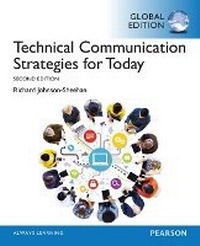
Technical Communication Strategies for Today, Global Edition -- MyLab Tech Comm with Pearson eText
2nd Edition
Published on 5. November 2014
Software
Product license key
4 pages
978-1-292-08043-7 (ISBN)
More details
Edition
2nd edition
Language
English
Place of publication
Harlow
United Kingdom
Target group
Adult education
Dimensions
Height: 166 mm
Width: 128 mm
Thickness: 1 mm
Weight
8 gr
ISBN-13
978-1-292-08043-7 (9781292080437)
Copyright in bibliographic data and cover images is held by Nielsen Book Services Limited or by the publishers or by their respective licensors: all rights reserved.
Schweitzer Classification
Other editions
New editions
Richard Johnson-Sheehan
Technical Communication Strategies for Today with MyTechCommLab, Global Edition
Book
12/2014
2nd Edition
Pearson Education Limited
€96.74
Article is exhausted; no reprint
Content
Part 1: Elements of Technical Communication
Chapter 1 Communicating in the Technical Workplace
Developing a Workplace Writing Process
Genres and the Technical Writing Process
Stage 1: Planning and Researching
Stage 2: Organizing and Drafting
Stage 3: Improving the Style
Stage 4: Designing
Stage 5: Revising and Editing
What Is Technical Communication?
Technical Communication Is Interactive and Adaptable
Technical Communication Is Reader Centered
Technical Communication Relies on Teamwork
Technical Communication Is Visual
Technical Communication Has Ethical, Legal, and Political
Dimensions
Technical Communication Is International and Cross-Cultural
How Important Is Technical Communication?
Chapter Review
Exercises and Projects
Chapter 2 Readers and Contexts of Use
Profiling Your Readers
Identifying Your Readers
Profiling Your Readers' Needs, Values, and Attitudes
Profiling Contexts of Use
Identifying the Context of Use
Using Profiles to Your Own Advantage
International and Cross-Cultural Communication
Differences in Content
Differences in Organization
Differences in Style
Differences in Design
Listen and Learn: The Key to International and Cross-Cultural Communication
At Work: What Are Some Strategies for Communicating with People from Another Culture?
Chapter Review
Exercises and Projects
Case Study: Installing a Medical Waste Incinerator
Chapter 3 Working in Teams
The Stages of Teaming
Forming: Strategic Planning
Step 1: Define the Project Mission and Objectives
Step 2: Identify Project Outcomes
Step 3: Define Team Member Responsibilities
Step 4: Create a Project Calendar
Step 5: Write Out a Work Plan
Step 6: Agree on How Conflicts Will Be Resolved
Storming: Managing Conflict
Running Effective Meetings
Mediating Conflicts
Firing a Team Member
Norming: Determining Team Roles
Revising Objectives and Outcomes
Help: Virtual Teaming
Identifying Team Roles
Using Groupware to Facilitate Work
Performing: Improving Quality
The Keys to Teaming
Chapter Review
Exercises and Projects
Case Study: Not a Sunny Day
Chapter 4 Letters, Memos, and E-Mails
Features of Letters, Memos, and E-Mails
Planning and Researching
Determining the Rhetorical Situation
Ethics in the Technical Workplace
What Are Ethics?
Where Do Ethics Come From?
Personal Ethics
Social Ethics
Conservation Ethics
Resolving Ethical Dilemmas
Help: Stopping Cyberbullying and Computer Harassment
Confronting an Ethical Dilemma
Resolving an Ethical Dilemma
When You Disag
Chapter 1 Communicating in the Technical Workplace
Developing a Workplace Writing Process
Genres and the Technical Writing Process
Stage 1: Planning and Researching
Stage 2: Organizing and Drafting
Stage 3: Improving the Style
Stage 4: Designing
Stage 5: Revising and Editing
What Is Technical Communication?
Technical Communication Is Interactive and Adaptable
Technical Communication Is Reader Centered
Technical Communication Relies on Teamwork
Technical Communication Is Visual
Technical Communication Has Ethical, Legal, and Political
Dimensions
Technical Communication Is International and Cross-Cultural
How Important Is Technical Communication?
Chapter Review
Exercises and Projects
Chapter 2 Readers and Contexts of Use
Profiling Your Readers
Identifying Your Readers
Profiling Your Readers' Needs, Values, and Attitudes
Profiling Contexts of Use
Identifying the Context of Use
Using Profiles to Your Own Advantage
International and Cross-Cultural Communication
Differences in Content
Differences in Organization
Differences in Style
Differences in Design
Listen and Learn: The Key to International and Cross-Cultural Communication
At Work: What Are Some Strategies for Communicating with People from Another Culture?
Chapter Review
Exercises and Projects
Case Study: Installing a Medical Waste Incinerator
Chapter 3 Working in Teams
The Stages of Teaming
Forming: Strategic Planning
Step 1: Define the Project Mission and Objectives
Step 2: Identify Project Outcomes
Step 3: Define Team Member Responsibilities
Step 4: Create a Project Calendar
Step 5: Write Out a Work Plan
Step 6: Agree on How Conflicts Will Be Resolved
Storming: Managing Conflict
Running Effective Meetings
Mediating Conflicts
Firing a Team Member
Norming: Determining Team Roles
Revising Objectives and Outcomes
Help: Virtual Teaming
Identifying Team Roles
Using Groupware to Facilitate Work
Performing: Improving Quality
The Keys to Teaming
Chapter Review
Exercises and Projects
Case Study: Not a Sunny Day
Chapter 4 Letters, Memos, and E-Mails
Features of Letters, Memos, and E-Mails
Planning and Researching
Determining the Rhetorical Situation
Ethics in the Technical Workplace
What Are Ethics?
Where Do Ethics Come From?
Personal Ethics
Social Ethics
Conservation Ethics
Resolving Ethical Dilemmas
Help: Stopping Cyberbullying and Computer Harassment
Confronting an Ethical Dilemma
Resolving an Ethical Dilemma
When You Disag