

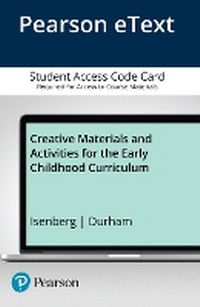
Creative Materials and Activities for the Early Childhood Curriculum -- Enhanced Pearson eText
Will be published approx. on 14. August 2014
Software
Product license key
512 pages
978-0-13-352301-0 (ISBN)
Description
Innovative, practical and easy to use, Creative Materials and Activities for the Early Childhood Curriculum is the ideal research-based resource for helping all children from infancy through grade 5 learn in, through, and with the arts, while meeting national and state standards.
Pearson eText is an easy-to-use digital textbook that you can purchase on your own or instructors can assign for their course. The mobile app lets you keep on learning, no matter where your day takes you -- even offline. You can also add highlights, bookmarks, and notes in your Pearson eText to study how you like.
NOTE: This ISBN is for the Pearson eText access card. Pearson eText is a fully digital delivery of Pearson content. Before purchasing, check that you have the correct ISBN. To register for and use Pearson eText, you may also need a course invite link, which your instructor will provide. Follow the instructions provided on the access card to learn more.
Pearson eText is an easy-to-use digital textbook that you can purchase on your own or instructors can assign for their course. The mobile app lets you keep on learning, no matter where your day takes you -- even offline. You can also add highlights, bookmarks, and notes in your Pearson eText to study how you like.
NOTE: This ISBN is for the Pearson eText access card. Pearson eText is a fully digital delivery of Pearson content. Before purchasing, check that you have the correct ISBN. To register for and use Pearson eText, you may also need a course invite link, which your instructor will provide. Follow the instructions provided on the access card to learn more.
More details
Language
English
Place of publication
United States
Publishing group
Pearson Education (US)
Target group
Professional and scholarly
Dimensions
Height: 255 mm
Width: 205 mm
Thickness: 1 mm
Weight
6 gr
ISBN-13
978-0-13-352301-0 (9780133523010)
Copyright in bibliographic data and cover images is held by Nielsen Book Services Limited or by the publishers or by their respective licensors: all rights reserved.
Schweitzer Classification
Persons
Joan Packer Isenberg is Professor Emerita of Education at George Mason University, where she also served as associate dean in the College of Education and Human Development from 2003-2011 and as the founding director of the Advanced Studies in Teaching and Learning (ASTL) program from 1999-2003. She is past president of the National Association of Early Childhood Teacher Educators and was the 2006 recipient of the Early Childhood Teacher Educator of the Year Award from NAECTE/Allyn & Bacon. Isenberg also served as the first visiting scholar for the National Board for Professional Teaching Standards (NBPTS) from 2002-2003. For most of her academic career she has studied and written about early childhood curriculum, play, and arts integration, particularly as they affect children's learning and development. She has taught children from preschool through grade four in both public and private settings. Among her numerous authored or co-authored publications are Creative Thinking and Arts-Based Learning (6th edition 2014), Exploring Your Role in Early Childhood Education (4th edition, 2012), The Master's Degree in Education as Teacher Professional Development (2012, Rowman & Littlefield), and Major Trends and Issues in Early Childhood Education, (2nd edition, 2003). She currently is doctoral affiliate faculty with the Union Institute and University.
Jennifer L. Durham is a certified K-12 special education teacher. She is currently the Curriculum and Technology Coordinator at the Lab School of Washington. Dr. Durham is also a professor at American University in the School of Education, Teaching, and Health and a supervisor of student teachers. Her work at American University focuses both on formal and informal assessment and the preparation of special education teachers to be able to use multi-sensory, project-based, arts-integrated learning in their teaching practices. She received her bachelor's degree from Austin College in Sherman, TX; her master's degree from American University in Washington, DC, and her Ph. D. in special education and arts integration from George Mason University in Fairfax, VA. Dr. Durham has been a public school teacher, an owner of her own private educational consulting company, and has completed over 120 hours of professional development in arts integration through the John F. Kennedy Center for the Performing Arts. With Professor Isenberg, Dr. Durham completed a four-year study of the effects of an arts integration program on school culture in selected schools in the Washington D.C. area. She has presented at several conferences on the Power of the Arts in everyday learning.
Jennifer L. Durham is a certified K-12 special education teacher. She is currently the Curriculum and Technology Coordinator at the Lab School of Washington. Dr. Durham is also a professor at American University in the School of Education, Teaching, and Health and a supervisor of student teachers. Her work at American University focuses both on formal and informal assessment and the preparation of special education teachers to be able to use multi-sensory, project-based, arts-integrated learning in their teaching practices. She received her bachelor's degree from Austin College in Sherman, TX; her master's degree from American University in Washington, DC, and her Ph. D. in special education and arts integration from George Mason University in Fairfax, VA. Dr. Durham has been a public school teacher, an owner of her own private educational consulting company, and has completed over 120 hours of professional development in arts integration through the John F. Kennedy Center for the Performing Arts. With Professor Isenberg, Dr. Durham completed a four-year study of the effects of an arts integration program on school culture in selected schools in the Washington D.C. area. She has presented at several conferences on the Power of the Arts in everyday learning.
Content
Part I: Exploring Creativity and the Arts
Chapter 1: Creativity and the Arts
Chapter 2: Facilitating Creativity and the Arts
Chapter 3: Designing Environments for Creativity and the Arts
Part II: Teaching the Creative Arts: What Does It Look Like?
Chapter 4: Visual Arts and Children's Development
Chapter 5: Creative Materials and Activities for the Visual Arts
Chapter 6: Creative Materials and Activities for Drama
Chapter 7: Creative Materials and Activities for Music, Movement, and Dance
Part III: Creative Materials and Activities in the Content Areas
Chapter 8: Language, Literacy and the Creative Arts
Chapter 9: Mathematics and the Creative Arts
Chapter 10: Science and the Creative Arts
Chapter 11: Social Studies and the Creative Arts
Part IV: Planning and Assessing Creative Experiences
Chapter 12: Assessing Creative Learning
Chapter 13: Planning Effective Arts-Based Lessons
Chapter 14: Integrating the Curriculum through Arts-Based Units
Chapter 1: Creativity and the Arts
Chapter 2: Facilitating Creativity and the Arts
Chapter 3: Designing Environments for Creativity and the Arts
Part II: Teaching the Creative Arts: What Does It Look Like?
Chapter 4: Visual Arts and Children's Development
Chapter 5: Creative Materials and Activities for the Visual Arts
Chapter 6: Creative Materials and Activities for Drama
Chapter 7: Creative Materials and Activities for Music, Movement, and Dance
Part III: Creative Materials and Activities in the Content Areas
Chapter 8: Language, Literacy and the Creative Arts
Chapter 9: Mathematics and the Creative Arts
Chapter 10: Science and the Creative Arts
Chapter 11: Social Studies and the Creative Arts
Part IV: Planning and Assessing Creative Experiences
Chapter 12: Assessing Creative Learning
Chapter 13: Planning Effective Arts-Based Lessons
Chapter 14: Integrating the Curriculum through Arts-Based Units