

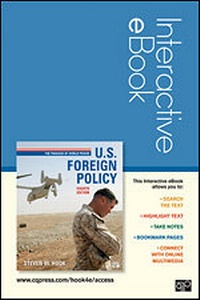
U.S. Foreign Policy Interactive eBook
The Paradox of World Power
4th Edition
Published on 18. December 2013
Software
Product license key
1 pages
978-1-4522-9011-9 (ISBN)
Description
The United States faces growing challenges to its primacy in the global balance of power. The very factors that have given rise to its dominance-a sense of exceptionalism, the fragmentation of political power, and the engagement of civil society in the foreign policy process-also create vulnerabilities for the country. Fast-moving developments overseas won't wait for U.S. leaders to adopt perfect foreign policy strategies. The fourth edition of Hook's best-seller provides a concise and accessible overview of this foreign policy paradox, and highlights the challenges facing policy makers. Key updates include complete coverage of President Obama's first term in office, the administration's turn to global engagement and "soft power" and a renewed focus on Asia, the ongoing war in Afghanistan, the U.S. responses to the Arab Spring movements, and the ongoing economic crisis. A new full-color interior design and expanded graphics program enhance student learning.
More details
Edition
4th Revised edition
Language
English
Place of publication
Washington
United States
Publishing group
SAGE Publications Inc
Target group
College/higher education
Edition type
Revised edition
Weight
27 gr
ISBN-13
978-1-4522-9011-9 (9781452290119)
Copyright in bibliographic data and cover images is held by Nielsen Book Services Limited or by the publishers or by their respective licensors: all rights reserved.
Schweitzer Classification
Person
Steven W. Hook (1959-2022) was professor of political science at Kent State University. In addition to this book, he was co-author of American Foreign Policy Since World War II (CQ Press, 2019, 21st ed., with John Spanier) and author of National Interest and Foreign Aid (Lynne Rienner, 1995). His edited books include U.S. Foreign Policy Today: American Renewal? (CQ Press, 2012, with James M. Scott), the Routledge Handbook of American Foreign Policy (Routledge Press, 2012, with Christopher M. Jones), and Democratic Peace in Theory and Practice (Kent State University Press, 2010). His journal articles have appeared in World Politics, International Studies Quarterly, Asian Survey, Foreign Policy Analysis, International Interactions, and other leading journals. Professor Hook received a BA (1982) in Journalism and Political Science from the University of Michigan and an MA (1990) and PhD (1993) in International Studies from the University of South Carolina. At Kent State, he received the university's Distinguished Teaching Award in 2007 and served as department chair from 2008 to 2012. He was a past president of the Foreign Policy Analysis sections of the American Political Science Association and the International Studies Association.
Content
Contents
I. THE SETTING OF U.S. FOREIGN POLICY
1. The United States in a Turbulent World
2. The Expansion of U.S. Power
3. Dynamics of Decision Making
II. INSIDE-OUT: GOVERNMENT SOURCES OF FOREIGN POLICY
4. Presidential Power
5. Congress beyond the "Water's Edge"
6. The Foreign Policy Bureaucracy
III. OUTSIDE-IN: EXTERNAL SOURCES OF FOREIGN POLICY
7. Public Opinion at Home and Abroad
8. The Impact of Mass Communications
9. Social Movements and Interest Groups
IV. POLICY DOMAINS
10. National Security and Defense Policy
11. Economic Statecraft
12. Transnational Policy Problems
Appendix A: U.S. Administrations since World War II
Appendix B: The War Powers Resolution of 1973
Glossary
References
Map Credits
Photo Credits
Author Citations Index
Subject Index
I. THE SETTING OF U.S. FOREIGN POLICY
1. The United States in a Turbulent World
2. The Expansion of U.S. Power
3. Dynamics of Decision Making
II. INSIDE-OUT: GOVERNMENT SOURCES OF FOREIGN POLICY
4. Presidential Power
5. Congress beyond the "Water's Edge"
6. The Foreign Policy Bureaucracy
III. OUTSIDE-IN: EXTERNAL SOURCES OF FOREIGN POLICY
7. Public Opinion at Home and Abroad
8. The Impact of Mass Communications
9. Social Movements and Interest Groups
IV. POLICY DOMAINS
10. National Security and Defense Policy
11. Economic Statecraft
12. Transnational Policy Problems
Appendix A: U.S. Administrations since World War II
Appendix B: The War Powers Resolution of 1973
Glossary
References
Map Credits
Photo Credits
Author Citations Index
Subject Index