

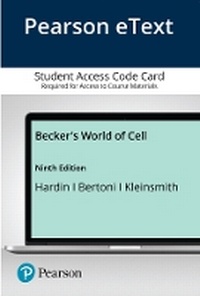
Pearson eText Becker's World of the Cell -- Access Card
9th Edition
Published on 15. September 2020
Software
Product license key
978-0-13-487366-4 (ISBN)
Description
Explore the world of the cell.
Becker's World of the Cell provides a beautifully-illustrated, up-to-date introduction to cell and molecular biology concepts, processes, and applications.
For courses in cell biology.
Pearson eText is an easy-to-use digital textbook that you can purchase on your own or instructors can assign for their course. The mobile app lets you keep on learning, no matter where your day takes you -- even offline. You can also add highlights, bookmarks, and notes in your Pearson eText to study how you like.
NOTE: This ISBN is for the Pearson eText access card. Pearson eText is a fully digital delivery of Pearson content. Before purchasing, check that you have the correct ISBN. To register for and use Pearson eText, you may also need a course invite link, which your instructor will provide. Follow the instructions provided on the access card to learn more.
Becker's World of the Cell provides a beautifully-illustrated, up-to-date introduction to cell and molecular biology concepts, processes, and applications.
For courses in cell biology.
Pearson eText is an easy-to-use digital textbook that you can purchase on your own or instructors can assign for their course. The mobile app lets you keep on learning, no matter where your day takes you -- even offline. You can also add highlights, bookmarks, and notes in your Pearson eText to study how you like.
NOTE: This ISBN is for the Pearson eText access card. Pearson eText is a fully digital delivery of Pearson content. Before purchasing, check that you have the correct ISBN. To register for and use Pearson eText, you may also need a course invite link, which your instructor will provide. Follow the instructions provided on the access card to learn more.
More details
Edition
9th edition
Language
English
Place of publication
United States
Publishing group
Pearson Education (US)
Target group
College/higher education
Dimensions
Height: 279 mm
Width: 216 mm
Thickness: 2 mm
Weight
43 gr
ISBN-13
978-0-13-487366-4 (9780134873664)
Copyright in bibliographic data and cover images is held by Nielsen Book Services Limited or by the publishers or by their respective licensors: all rights reserved.
Schweitzer Classification
Other editions
Previous edition
Jeff Hardin | Gregory Paul Bertoni | Lewis J. Kleinsmith
Becker's World of the Cell
United States Edition
Book
02/2011
8th Edition
Pearson
€170.83
Article exhausted; check for reprint
Persons
Jeff Hardin is Professor and Chair of the Zoology Department at the University of Wisconsin-Madison. He is also Faculty Director of the Biology Core Curriculum, a four-semester honors biology sequence for undergraduates at Wisconsin known for its teaching innovations. Jeff's research interests center on how cells migrate and adhere to one another to change the shape of animal embryos. Jeff's teaching is enhanced by his extensive use of digital microscopy and his Web-based teaching materials, which are used on many campuses in the United States and other countries. As part of his interest in teaching biology, Jeff has received several awards, including a Lily Teaching Fellowship, a National Science Foundation Young Investigator Award, and a Chancellor's Distinguished Teaching Award.
Gregory Bertoni has been active in teaching, research, and scientific writing for over 30 years. He earned a Ph.D. in Cell and Molecular Biology from the University of Wisconsin-Madison with Wayne Becker, where his research investigated the effects of light quality and carbon dioxide concentration on photorespiratory gene expression. His teaching experiences include introductory and graduate-level biochemistry, sophomore cell biology, and plant physiology. At Madison, he and Wayne helped to develop a new course entitled "Ways of Knowing" designed to introduce entering freshmen to the learning process itself. His published research includes studies in bacterial pathogenesis, plant-microbe interactions, and plant gene expression. Currently, Gregory is a Science Editor for The Plant Cell, a leading international research journal in plant cell and molecular biology, for which he assists authors in preparing manuscripts and files for publication. His duties include communicating with authors around the world to ensure that published papers are accurate and accessible to both general and expert readers. In addition, he has written numerous one-page summaries for the journal front matter to highlight key research articles. For the past 12 years, Gregory has been teaching biology, chemistry, and microbiology part-time at the community college level, mostly for nursing training, and is currently at Southern Maine Community College in South Portland, Maine. He is also a freelance scientific writer who contributes to text- and web-based projects in biology, physics, and microbiology. His hobbies include hiking, gardening, and growing certified organic seedlings for A Good Start, a small business founded by him and his wife Marianne Potter in 2003.
Gregory Bertoni has been active in teaching, research, and scientific writing for over 30 years. He earned a Ph.D. in Cell and Molecular Biology from the University of Wisconsin-Madison with Wayne Becker, where his research investigated the effects of light quality and carbon dioxide concentration on photorespiratory gene expression. His teaching experiences include introductory and graduate-level biochemistry, sophomore cell biology, and plant physiology. At Madison, he and Wayne helped to develop a new course entitled "Ways of Knowing" designed to introduce entering freshmen to the learning process itself. His published research includes studies in bacterial pathogenesis, plant-microbe interactions, and plant gene expression. Currently, Gregory is a Science Editor for The Plant Cell, a leading international research journal in plant cell and molecular biology, for which he assists authors in preparing manuscripts and files for publication. His duties include communicating with authors around the world to ensure that published papers are accurate and accessible to both general and expert readers. In addition, he has written numerous one-page summaries for the journal front matter to highlight key research articles. For the past 12 years, Gregory has been teaching biology, chemistry, and microbiology part-time at the community college level, mostly for nursing training, and is currently at Southern Maine Community College in South Portland, Maine. He is also a freelance scientific writer who contributes to text- and web-based projects in biology, physics, and microbiology. His hobbies include hiking, gardening, and growing certified organic seedlings for A Good Start, a small business founded by him and his wife Marianne Potter in 2003.
Content
1. A Preview of Cell Biology
2. The Chemistry of the Cell
3. The Macromolecules of the Cell
4. Cells and Organelles
5. Bioenergetics: The Flow of Energy in the Cell
6. Enzymes: The Catalysts of Life
7. Membranes: Their Structure, Function, and Chemistry
8. Transport Across Membranes: Overcoming the Permeability Barrier
9. Chemotrophic Energy Metabolism: Glycolysis and Fermentation
10. Chemotrophic Energy Metabolism: Aerobic Respiration
11. Phototrophic Energy Metabolism: Photosynthesis
12. The Endomembrane System
13. Cytoskeletal Systems
14. Cellular Movement: Motility and Contractility
15. Beyond the Cell: Cell Adhesions, Cell Junctions, and Extracellular Structures
16. The Structural Basis of Cellular Information: DNA, Chromosomes, and Genome Organization
17. DNA Replication, Repair, and Recombination
18. Gene Expression I: The Genetic Code and Transcription
19. Gene Expression II: Protein Synthesis and Sorting
20. Regulation of Gene Expression
21. Molecular Biology Techniques for Cell Biology
22. Signal Transduction Mechanisms I: Electrical and Synaptic Signaling in Neurons
23. Signal Transduction Mechanisms II: Messengers and Receptors
24. The Cell Cycle and Mitosis
25. Sexual Reproduction, Meiosis, and Genetic Recombination
26. Cancer Cells
Appendix - Visualizing Cells and Molecules
Glossary
Photo, Illustration, and Text Credits
Index
2. The Chemistry of the Cell
3. The Macromolecules of the Cell
4. Cells and Organelles
5. Bioenergetics: The Flow of Energy in the Cell
6. Enzymes: The Catalysts of Life
7. Membranes: Their Structure, Function, and Chemistry
8. Transport Across Membranes: Overcoming the Permeability Barrier
9. Chemotrophic Energy Metabolism: Glycolysis and Fermentation
10. Chemotrophic Energy Metabolism: Aerobic Respiration
11. Phototrophic Energy Metabolism: Photosynthesis
12. The Endomembrane System
13. Cytoskeletal Systems
14. Cellular Movement: Motility and Contractility
15. Beyond the Cell: Cell Adhesions, Cell Junctions, and Extracellular Structures
16. The Structural Basis of Cellular Information: DNA, Chromosomes, and Genome Organization
17. DNA Replication, Repair, and Recombination
18. Gene Expression I: The Genetic Code and Transcription
19. Gene Expression II: Protein Synthesis and Sorting
20. Regulation of Gene Expression
21. Molecular Biology Techniques for Cell Biology
22. Signal Transduction Mechanisms I: Electrical and Synaptic Signaling in Neurons
23. Signal Transduction Mechanisms II: Messengers and Receptors
24. The Cell Cycle and Mitosis
25. Sexual Reproduction, Meiosis, and Genetic Recombination
26. Cancer Cells
Appendix - Visualizing Cells and Molecules
Glossary
Photo, Illustration, and Text Credits
Index