

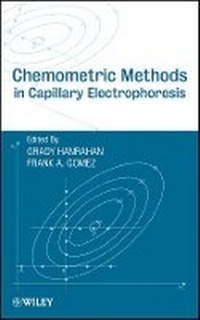
Chemometric Methods in Capillary Electrophoresis
Published on 3. November 2009
Software
Other digital
336 pages
978-0-470-53019-1 (ISBN)
Description
Chemometric Methods in Capillary Electrophoresis presents chemometric methods utilized in capillary electrophoresis (CE) to alleviate problems encountered during routine analysis and method development. It focuses on current chemometric methods - techniques developed and incorporated by active experts in the field. It includes a unique blend of information from authors researching developments of chemometrics in CE, and presents timely chemometric methods in applications including biological, medical, pharmaceutical, food, forensic and environmental science. This book is not only highly significant to capillary electrophoresis-based endeavors, but instructive for investigators active in other areas of separation science.
Reviews / Votes
"This book can be used as an initial desktop reference for chemometric applications for CE but readers interested in more in-depth applications of such techniques will need other chemometrics textbooks ... The concise presentation of the chemometric methods and their application to CE-relevant data makes the content with this book quite accessible to the novice and provides a valuable data analysis resource for the practicing CE analyst." (Anal Bioanal Chem, 2010)More details
Language
English
Place of publication
Hoboken
United Kingdom
Publishing group
John Wiley and Sons Ltd
Target group
Professional and scholarly
Dimensions
Height: 250 mm
Width: 150 mm
Thickness: 15 mm
Weight
666 gr
ISBN-13
978-0-470-53019-1 (9780470530191)
Copyright in bibliographic data and cover images is held by Nielsen Book Services Limited or by the publishers or by their respective licensors: all rights reserved.
Schweitzer Classification
Other editions
Additional editions
Grady Hanrahan | Frank A. Gomez
Chemometric Methods in Capillary Electrophoresis
E-Book
11/2009
Wiley
€126.99
Available for download
Persons
Grady Hanrahan, PhD , received his doctorate in environmental analytical chemistry from the University of Plymouth, England. Dr. Hanrahan is currently the John Stauffer Endowed Professor of Analytical Chemistry at California Lutheran University with research interests in the use of modern chemometric methods in the design and development of environmental and bioanalytical instrumentation. He is also exploring the use of neural and evolutionary computational techniques for solving complex chemical problems. Frank A. Gomez, PhD, received his BS in chemistry from California State University, Los Angeles (CSULA), and his PhD in chemistry from UCLA, where he was a NIH Predoctoral Fellow. From 1991-1994, he was a Damon Runyon-Walter Winchell Cancer Research Fund Postdoctoral Fellow in the department of chemistry at Harvard University. He is a professor of chemistry at CSULA and is a visiting associate at Caltech in the Applied Physics department.
Content
PREFACE. ACKNOWLEDGMENTS. EDITOR BIOGRAPHIES. CONTRIBUTORS. KEY ACRONYMS. I EXPERIMENTAL DESIGN AND OPTIMIZATION CONSIDERATIONS. 1 INTRODUCTION ( Grady Hanrahan and Frank A. Gomez). 2 EXPERIMENTAL DESIGN IN METHOD OPTIMIZATION AND ROBUSTNESS TESTING ( Bieke Dejaegher, Alexandra Durand, and Yvan Vander Heyden). 3 CHEMOMETRICAL EXPERIMENTAL DESIGN-BASED OPTIMIZATION STUDIES IN CAPILLARY ELECTROPHORESIS APPLICATIONS ( Ruthy Montes, Toni Ann Riveros, Froseen Dahdouh, Grady Hanrahan, and Frank A. Gomez). 4 APPLICATION OF CHEMOMETRIC METHODS IN DRUG PURITY DETERMINATION BY CAPILLARY ELECTROPHORESIS ( Gerhard K.E. Scriba). 5 OPTIMIZATION OF MICELLAR ELECTROKINETIC CHROMATOGRAPHY SEPARATION CONDITIONS BY CHEMOMETRIC METHODS ( Jessica L. Felhofer and Carlos D. Garcia). 6 CHEMOMETRIC METHODS FOR THE OPTIMIZATION OF CE AND CE-MS IN PHARMACEUTICAL, ENVIRONMENTAL, AND FOOD ANALYSIS ( Javier Hernandez-Borges, Miguel Angel Rodriguez-Delgado, and Alejandro Cifuentes). 7 OPTIMIZATION OF THE SEPARATION OF AMINO ACIDS BY CAPILLARY ELECTROPHORESIS USING ARTIFICIAL NEURAL NETWORKS ( Amanda Van Gramberg, Alison Beavis Lucas Blanes, and Philip Doble). II EXPLORATORY DATA ANALYSIS, PREDICTION, AND CLASSIFICATION. 8 DEVELOPMENT OF CAPILLARY ELECTROPHORESIS FINGERPRINTS AND MULTIVARIATE STATISTICS FOR THE DIFFERENTIATION OF OPIUM AND POPPY STRAW SAMPLES ( Raymond G. Reid, Susanne P. Boyle, Ann S. Low, and David G. Durham). 9 MULTIVARIATE CURVE RESOLUTION BASED ON ALTERNATING LEAST SQUARES IN CAPILLARY ELECTROPHORESIS ( Javier Saurina). 10 APPLICATION OF CHEMOMETRICS IN CAPILLARY ELECTROPHORESIS ANALYSIS OF HERBAL MEDICINES ( Shao-Ping Li, Xiao-Jia Chen, and Feng-Qing Yang). 11 CLINICAL PATTERN RECOGNITION ANALYSIS APPLYING ARTIFICIAL NEURAL NETWORKS BASED ON PRINCIPAL COMPONENT ANALYSIS INPUT SELECTION ( Yaxiong Zhang and Hua Li). 12 CHEMOMETRIC METHODS APPLIED TO GENETIC ANALYSES BY CAPILLARY ELECTROPHORESIS AND ELECTROPHORESIS MICROCHIP TECHNOLOGIES ( Maribel Elizabeth Funes-Huacca, Juliana Vieira Alberice, Lucas Blanes, and Emanuel Carrilho). 13 EXPLORATORY DATA ANALYSIS AND CLASSIFICATION OF CAPILLARY ELECTROPHORETIC DATA ( Melanie Dumarey, Bieke Dejaegher, Alexandra Durand, and Yvan Vander Heyden). III QUANTITATIVE STRUCTURE RELATIONSHIPS. 14 CHEMOMETRICAL MODELING OF ELECTROPHORETIC MOBILITIES IN CAPILLARY ELECTROPHORESIS ( Mehdi Jalali-Heravi). 15 ASSESSMENT OF SOLUTE-MICELLE INTERACTIONS IN ELECTROKINETIC CHROMATOGRAPHY USING QUANTITATIVE STRUCTURE-RETENTION RELATIONSHIPS ( Edgar P. Moraes, Fernando G. Tonin, Luis G. Dias, Joao P.S. Farah, and Marina F.M. Tavares). 16 CHEMOMETRICAL ANALYSIS OF CHEESE PROTEOLYSIS PROFILES BY CAPILLARY ELECTROPHORESIS: PREDICTION OF RIPENING TIMES ( Natividad Ortega, Silvia M. Albillos, and Maria D. Busto). IV TRANSFORMATION TECHNIQUES. 17 TRANSFORMATION TECHNIQUES FOR CAPILLARY AND MICROCHIP ELECTROPHORESIS ( Takashi Kaneta). INDEX.