

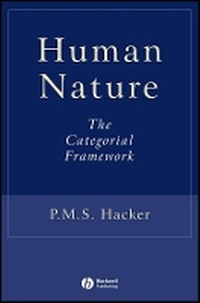
Human Nature - The Categorical Framework
Published on 15. April 2008
Software
Other digital
340 pages
978-0-470-69216-5 (ISBN)
Description
This major new study by one of the most penetrating and persistent critics of philosophical and scientific orthodoxy, returns to Aristotle in order to examine the salient categories in terms of which we think about ourselves and our nature, and the distinctive forms of explanation we invoke to render ourselves intelligible to ourselves. * The culmination of 40 years of thought on the philosophy of mind and the nature of the mankind * Written by one of the world's leading philosophers, the co-author of the monumental 4 volume Analytical Commentary on the Philosophical Investigations (Blackwell Publishing, 1980-2004) * Uses broad categories, such as substance, causation, agency and power to examine how we think about ourselves and our nature * Platonic and Aristotelian conceptions of human nature are sketched and contrasted * Individual chapters clarify and provide an historical overview of a specific concept, then link the concept to ideas contained in other chapters
Reviews / Votes
"A remarkable contribution. A brilliant work in philosophical anthropology. This is philosophy as it should be. Thoroughly original and completely convincing. It is difficult to imagine a more perspicuous rendering of the ramifying network of concepts that comprise 'the human.'" Dennis Patterson, Rutgers University<!--end--> "Full of helpful distinctions and arguments which show in different ways how carefully we must proceed ... and how sensitive we must be to contexts." Notre Dame Philosophical Reviews "Hacker's book represents the culmination of nearly 40 years of philosophical reflection on the nature of mind and world. This volume 'clears old pathways from overgrowth and uproots misleading signposts' in an effort not only to provide clear insight into the character of human reason, disposition, and action, but also to offer a better understanding of the human mind, self, and person. Recommended." Choice ReviewsMore details
Language
English
Place of publication
Hoboken
United Kingdom
Publishing group
John Wiley and Sons Ltd
Target group
Professional and scholarly
Dimensions
Height: 240 mm
Width: 165 mm
Thickness: 32 mm
Weight
650 gr
ISBN-13
978-0-470-69216-5 (9780470692165)
Copyright in bibliographic data and cover images is held by Nielsen Book Services Limited or by the publishers or by their respective licensors: all rights reserved.
Schweitzer Classification
Other editions
Additional editions
E-Book
07/2011
Wiley-Blackwell
€32.99
Available for download
E-Book
05/2008
Wiley-Blackwell
€32.99
Available for download
Person
P. M. S. Hacker is the leading authority on the philosophy of Wittgenstein. He is author of the four-volume Analytical Commentary on the Philosophical Investigations, the first two volumes co-authored with G. P. Baker (Blackwell, 1980-96) and of Wittgenstein's Place in Twentieth-century Analytic Philosophy (Blackwell, 1996). He has also written extensively on philosophy of language and philosophy of mind, most recently Philosophical Foundations of Neuroscience (Blackwell, 2003), co-authored with M. R. Bennett.
Content
Preface. Part I: The Project. 1. Human Nature. 2. Philosophical Anthropology. 3. Grammatical Investigation. 4. Philosophical Investigation. 5. Philosophy and 'Mere Words'. 6. A Challenge to the Autonomy of the Philosophical Enterprise: Quine. 7. The Platonic and the Aristotelian Traditions in Philosophical Anthropology. Part II: Substance. 1. Substances: Things. 2. Substances: Stuffs. 3. Substance-referring Expressions. 4. Conceptual Connections between Things and Stuffs. 5. Substances and their Substantial parts. 6. Substances Conceived as Natural Kinds. 7. Substances Conceived as a Common Logico-linguistic Category. 8. A Historical Digression: Misconceptions of the Category of Substance. Part III: Causation. 1. Causation: Humean, Neo-Humean and Anti-Humean. 2. On Causal Necessity. 3. Event Causation is not a Prototype. 4. The Inadequacy of Hume's Analysis: Observability, Spatio-temporal Relations, and Regularity. 5. The Flaw in the Early Modern Debate. 6. Agent Causation as Prototype. 7. Agent Causation is Only a Prototype. 8. Event Causation and Other Centres of Variation. 9. Overview. Part IV: Powers. 1. Possibility. 2. Powers of the Inanimate. 3. Active and Passive Powers of the Inanimate. 4. Power and its Actualization. 5. Power and its Vehicle. 6. First- and Second-order Powers; Loss of Power. 7. Human Powers: Basic Distinctions. 8. Human Powers: Further Distinctions. 9. Dispositions. Part V: Agency. 1. Inanimate Agents. 2. Inanimate Needs. 3. Animate Agents: Needs and Wants. 4. Volitional Agency: Preliminaries. 5. Doings, Acts and Actions. 6. Human Agency and Action. 7. A Historical Overview. 8. Human Action as Agential Causation of Movement. Part VI: Teleology and Teleological Explanation. 1. Teleology and Purpose. 2. What Things have a Purpose?. 3. Purpose and Axiology. 4. The Beneficial. 5. A Historical Digression: Teleology and Causality. Part VII: Reasons and Explanation of Human Action. 1. Rationality and Reasonableness. 2. Reason, Reasoning and Reasons. 3. Explaining Human Behaviour. 4. Explanation in Terms of Agential Reasons. 5. Causal Mythologies. Part VIII: The Mind. 1. Homo loquens. 2. The Cartesian Mind. 3. The Nature of the Mind. Part IX: The Self and the Body. 1. The Emergence of the Philosophers' Self. 2. The Illusions of the Philosophers' Self. 3. The Body. 4. The Relationship between Human Beings and their Bodies. Part X: The Person. 1. The Emergence of the Concept. 2. An Unholy Trinity: Descartes, Locke and Hume. 3. Changing Bodies and Switching Brains: Puzzle Cases and Red Herrings. 4. The Concept of a Person. Index