

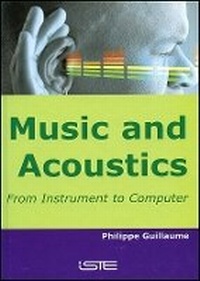
Music and Acoustics - From Instrument to Computer
Published on 17. October 2006
Software
Other digital
200 pages
978-0-470-61244-6 (ISBN)
Description
How can a piano tuner obtain such high precision with no other measuring device than their own ears? How can a sequence of notes seem to rise continuously despite coming back periodically to the same notes? What are the possibilities and the limits of digital sound? These are a few examples of questions that are discussed in this book, which presents an overview on the nature of musical sounds, from their production by acoustic music instruments to synthesized sounds obtained with computers. The topics that are treated include sound propagation, Fourier and time-frequency analysis, psychoacoustics, analog and digital signal processing theory, computer science and MP3 sound compression, and of course ...music!
More details
Language
English
Place of publication
Hoboken
United Kingdom
Publishing group
John Wiley and Sons Ltd
Target group
Professional and scholarly
Dimensions
Height: 250 mm
Width: 150 mm
Thickness: 15 mm
Weight
666 gr
ISBN-13
978-0-470-61244-6 (9780470612446)
Copyright in bibliographic data and cover images is held by Nielsen Book Services Limited or by the publishers or by their respective licensors: all rights reserved.
Schweitzer Classification
Other editions
Additional editions
Music and Acoustics
From Instrument to Computer
E-Book
03/2013
Wiley-ISTE
€144.99
Available for download
Music and Acoustics
From Instrument to Computer
E-Book
02/2013
Wiley-ISTE
€144.99
Available for download
Person
Philippe Guillaume is a Professor at INSA Toulouse, France where he teaches applied mathematics and musical acoustics. He is a researcher within the Laboratory of Mathematics for Industry and Physics in the same Institute. He worked for many years in his youth as a piano tuner for famous pianists.
Content
Foreword. Chapter1. Sounds. 1.1 Sound Propagation. 1.2 Music Theory Interlude. 1.3 Different Types of Sounds. 1.4 Representation of Sound. 1.5 Filtering. 1.6 Study Problems. 1.7 Practical Computer Applications. Chapter 2. Musical Instruments. 2.1 Strings. 2.2 Bars. 2.3 Membranes. 2.4 Tubes. 2.5 Timbre of Instruments. 2.6 Study Problems. 2.7 Practical Computer Applications. Chapter 3. Scales and Temperaments. 3.1 The Pythagorean Scale. 3.2 The Zarlino Scale. 3.3 The Tempered Scales. 3.4 A Brief History of A4. 3.5 Giving Names to Notes. 3.6 Other examples of Scales. 3.7 Study Problems. 3.8 Practical Computer Applications. Chapter 4. Psychoacoustics. 4.1 Sound Intensity and Loudness. 4.2 The Ear. 4.3 Frequency and Pitch. 4.4 Frequency Masking. 4.5 Study Problems. 4.6 Practical Computer Applications. Chapter 5. Digital Sound. 5.1 Sampling. 5.2 Audio Compression. 5.3 Digital Filtering and the Z-transform. 5.4 Study Problems. 5.5 Practical Computer Applications. Chapter 6. Synthesis and Sound Effects. 6.1 Synthesis of Musical Sounds. 6.2 Time Effects: Echo and Reverberation. 6.3 Effects Based on Spectrum Modification. 6.4 Study Problems. 6.5 Practical Computer Applications. Bibliography. Index.