

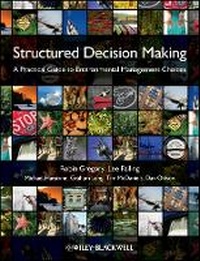
Structured Decision Making - A Practical Guide to Environmental Management Choices
Published on 17. February 2012
Software
Other digital
312 pages
978-1-4443-9855-7 (ISBN)
Description
This book is about the creative and messy process of making environmental management decisions. The approach we describe is called Structured Decision Making , a distinctly pragmatic label given to ways for helping individuals and groups think through tough multidimensional choices characterized by uncertain science, diverse stakeholders, and difficult tradeoffs. This is the everyday reality of environmental management, yet many important decisions currently are made on an ad hoc basis that lacks a solid value-based foundation, ignores key information, and results in selection of an inferior alternative. Making progress -- in a way that is rigorous, inclusive, defensible and transparent -- requires combining analytical methods drawn from the decision sciences and applied ecology with deliberative insights from cognitive psychology, facilitation and negotiation. The authors review key methods and discuss case-study examples based in our experiences in communities, boardrooms, and stakeholder meetings. The goal of this book is to lay out a compelling guide that will change how you think about making environmental decisions. Visit www.wiley.com/go/gregory/sdm to access the figures and tables from the book.
Reviews / Votes
"I recommend this book to anyone who must function at the interface between environmental science and decision making. Even if you do not have the opportunity to implement the full structured decision-making process, it will give you a better idea of how to think about your role and those of the other parties. The authors write clearly and forcefully." ( Integrated Environmental Assessment and Management (IEAM ), 1 October 2012) "I highly recommend the groundbreaking and very accessible book Structured Decision Making: A Practical Guide to Environmental Management Choices by Robin Gregory, Lee Failing, Michael Harstone, Graham Long, Tim McDaniels, Dan Ohlson, to anyone in resource management, risk analysis, land use planning, industry leadership, environmental NGOs, facilitation and negotiation, government, policy making, academia, and undergraduate or graduate studies who is seeking a clear and concise approach to developing workable solutions to even the most challenging environmental problems." ( Blog Business World , 13 August 2012)More details
Language
English
Place of publication
Chicester
United Kingdom
Publishing group
John Wiley and Sons Ltd
Target group
Professional and scholarly
Dimensions
Height: 250 mm
Width: 150 mm
Thickness: 15 mm
Weight
666 gr
ISBN-13
978-1-4443-9855-7 (9781444398557)
Copyright in bibliographic data and cover images is held by Nielsen Book Services Limited or by the publishers or by their respective licensors: all rights reserved.
Schweitzer Classification
Other editions
Additional editions
Robin Gregory | Lee Failing | Michael Harstone
Structured Decision Making
A Practical Guide to Environmental Management Choices
E-Book
02/2012
Wiley-Blackwell
€54.99
Available for download
Robin Gregory | Lee Failing | Michael Harstone
Structured Decision Making
A Practical Guide to Environmental Management Choices
E-Book
02/2012
Wiley-Blackwell
€54.99
Available for download
Persons
Robin Gregory , Senior Researcher, Decision Research Lee Failing , Principal, Compass Resource Management Michael Harstone , Principal, Compass Resource Management Graham Long , Principal, Compass Resource Management Tim McDaniels , University of British Columbia Dan Ohlson , Principal, Compass Resource Management
Content
Foreword Foreword vii Preface ix 1 Structuring Environmental Management Choices 1 2 Foundations of Structured Decision Making 21 3 Decision Sketching 47 4 Understanding Objectives 69 5 Identifying Performance Measures 93 6 Incorporating Uncertainty 122 7 Creating Alternatives 150 8 Characterizing Consequences 173 9 Making Trade-Offs 208 10 Learning 239 11 Reality Check: Implementation 262 12 Conclusion 282 Index 289