

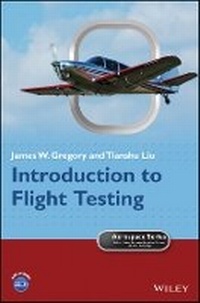
Introduction to Flight Testing
Published on 21. May 2021
Software
Other digital
352 pages
978-1-118-94981-8 (ISBN)
Description
Provides an introduction to the basic flight testing methods employed on general aviation aircraft and unmanned aerial vehicles Introduction to Flight Testing of Light Aircraft and UAVs provides a concise introduction to the basic flight testing methods employed on general aviation aircraft and unmanned aerial vehicles for courses in aeronautical engineering. There is particular emphasis on the use of modern on-board instruments and inexpensive, off-the-shelf portable devices that make flight testing accessible to nearly any student. This text presents a clear articulation of standard methods for measuring aircraft performance characteristics. Topics covered include aircraft and instruments, digital data acquisition techniques, flight test planning, the standard atmosphere, uncertainty analysis, level flight performance, airspeed calibration, stall, climb and glide, take-off and landing, level turn, and static and dynamic longitudinal stability. Unique to this book is a detailed discussion of digital data acquisition (DAQ) techniques, which are an integral part of modern flight test programs.
This treatment includes discussion of the analog-to-digital conversion, sample rate, aliasing, and filtering. These critical details provide the flight test engineer with the insight needed to understand the capabilities and limitations of digital DAQ. Key features: * Provides an introduction to the basic flight testing methods and instrumentation employed on general aviation aircraft and unmanned aerial vehicles. * Includes examples of flight testing on general aviation aircraft such as Cirrus, Piper, and Cessna aircraft, along with unmanned aircraft vehicles. * Suitable for courses on Aircraft Flight Test Engineering. Introduction to Flight Testing of Light Aircraft and UAVs provides resources and guidance for practitioners in the rapidly-developing field of UAV performance flight test and the general aviation flight test community.
This treatment includes discussion of the analog-to-digital conversion, sample rate, aliasing, and filtering. These critical details provide the flight test engineer with the insight needed to understand the capabilities and limitations of digital DAQ. Key features: * Provides an introduction to the basic flight testing methods and instrumentation employed on general aviation aircraft and unmanned aerial vehicles. * Includes examples of flight testing on general aviation aircraft such as Cirrus, Piper, and Cessna aircraft, along with unmanned aircraft vehicles. * Suitable for courses on Aircraft Flight Test Engineering. Introduction to Flight Testing of Light Aircraft and UAVs provides resources and guidance for practitioners in the rapidly-developing field of UAV performance flight test and the general aviation flight test community.
More details
Language
English
Place of publication
New York
United States
Target group
Professional and scholarly
Dimensions
Height: 250 mm
Width: 150 mm
Thickness: 15 mm
Weight
666 gr
ISBN-13
978-1-118-94981-8 (9781118949818)
Copyright in bibliographic data and cover images is held by Nielsen Book Services Limited or by the publishers or by their respective licensors: all rights reserved.
Schweitzer Classification
Other editions
Additional editions
James W. Gregory | Tianshu Liu
Introduction to Flight Testing
E-Book
05/2021
1st Edition
Wiley-ISTE
€82.99
Available for download
James W. Gregory | Tianshu Liu
Introduction to Flight Testing
E-Book
05/2021
1st Edition
Wiley-ISTE
€82.99
Available for download
Persons
James W. Gregory is an associate professor in the Department of Mechanical and Aerospace Engineering, and Associate Director for UAS of the Aerospace Research Center at The Ohio State University. He received his Bachelor of Aerospace Engineering from Georgia Tech, and masters and doctorate degrees in Aeronautics and Astronautics from Purdue University. His research interests focus on development of pressure-sensitive paint as an advanced measurement technique, drag reduction of bluff body wakes via aerodynamic flow control, and flight testing of unmanned aircraft systems. His work experience includes stints at the US Air Force Research Laboratory Air Vehicles Directorate, the US Air Force Academy, Delta Air Lines, NASA Glenn Research Center, Tohoku University in Japan, and as a Fulbright Scholar at the Technion in Israel. He is an instrument-rated private pilot. Tianshu Liu is a professor and the director of Applied Aerodynamics Laboratory at Western Michigan University. He received a Ph.D. in aeronautics and astronautics from Purdue University in 1996. He was a research scientist at NASA Langley Research Center in 1999-2004. His research areas are experimental and applied aerodynamics and fluid mechanics. In particular, he has contributed to image-based measurement techniques for various physical quantities such as surface pressure, temperature/heat-transfer, skin friction, velocity fields, aeroelastic deformation, and distributed and integrated forces. His topics also include videogrammetry and vision for aerospace applications, flow control, flapping flight, flight vehicle design, turbulence and transition, and flight tests.