

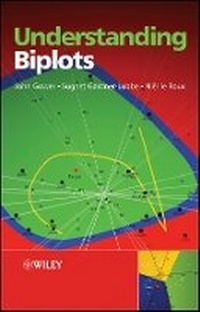
Understanding Biplots
Published on 3. November 2010
Software
Other digital
480 pages
978-0-470-97319-6 (ISBN)
Description
Biplots are a graphical method for simultaneously displaying two kinds of information; typically, the variables and sample units described by a multivariate data matrix or the items labelling the rows and columns of a two-way table. This book aims to popularize what is now seen to be a useful and reliable method for the visualization of multidimensional data associated with, for example, principal component analysis, canonical variate analysis, multidimensional scaling, multiplicative interaction and various types of correspondence analysis. Understanding Biplots: Introduces theory and techniques which can be applied to problems from a variety of areas, including ecology, biostatistics, finance, demography and other social sciences. Provides novel techniques for the visualization of multidimensional data and includes data mining techniques. Uses applications from many fields including finance, biostatistics, ecology, demography. Looks at dealing with large data sets as well as smaller ones. Includes colour images, illustrating the graphical capabilities of the methods. Is supported by a Website featuring R code and datasets.
Researchers, practitioners and postgraduate students of statistics and the applied sciences will find this book a useful introduction to the possibilities of presenting data in informative ways.
Researchers, practitioners and postgraduate students of statistics and the applied sciences will find this book a useful introduction to the possibilities of presenting data in informative ways.
Reviews / Votes
It is a monograph rather than a textbook, but individual chapters could very well be incorporated in a course on statistics. (Mathematical Reviews Clippings, 1 January 2013)More details
Language
English
Place of publication
Hoboken
United Kingdom
Publishing group
John Wiley and Sons Ltd
Target group
Professional and scholarly
Dimensions
Height: 244 mm
Width: 168 mm
Thickness: 15 mm
Weight
666 gr
ISBN-13
978-0-470-97319-6 (9780470973196)
Copyright in bibliographic data and cover images is held by Nielsen Book Services Limited or by the publishers or by their respective licensors: all rights reserved.
Schweitzer Classification
Other editions
Additional editions
John Gower | Sugnet Gardner Lubbe | Niel Le Roux
Understanding Biplots
E-Book
02/2011
Wiley
€92.99
Available for download
John Gower | Sugnet Gardner Lubbe | Niel Le Roux
Understanding Biplots
E-Book
10/2010
Wiley
€92.99
Available for download
Content
Preface. 1 Introduction. 1.1 Types of biplots. 1.2 Overview of the book. 1.3 Software. 1.4 Notation. 2 Biplot basics. 2.1 A simple example revisited. 2.2 The biplot as a multidimensional scatterplot. 2.3 Calibrated biplot axes. 2.4 Refining the biplot display. 2.5 Scaling the data. 2.6 A closer look at biplot axes. 2.7 Adding new variables: the regression method. 2.8 Biplots and large data sets. 2.9 Enclosing a configuration of sample points. 2.10 Buying by mail order catalogue data set revisited. 2.11 Summary. 3 Principal component analysis biplots. 3.1 An example: risk management. 3.2 Understanding PCA and constructing its biplot. 3.3 Measures of fit for PCA biplots. 3.4 Predictivities of newly interpolated samples. 3.5 Adding new axes to a PCA biplot and defining their predictivities. 3.6 Scaling the data in a PCA biplot. 3.7 Functions for constructing a PCA biplot. 3.8 Some novel applications and enhancements of PCA biplots. 3.9 Conclusion. 4 Canonical variate analysis biplots. 4.1 An example: revisiting the Ocotea data. 4.2 Understanding CVA and constructing its biplot. 4.3 Geometric interpretation of the transformation to the canonical space. 4.4 CVA biplot axes. 4.5 Adding new points and variables to a CVA biplot. 4.6 Measures of fit for CVA biplots. 4.7 Functions for constructing a CVA biplot. 4.8 Continuing the Ocotea example. 4.9 CVA biplots for two classes. 4.10 A five-class CVA biplot example. 4.11 Overlap in two-dimensional biplots. 5 Multidimensional scaling and nonlinear biplots. 5.1 Introduction. 5.2 The regression method. 5.3 Nonlinear biplots. 5.4 Providing nonlinear biplot axes for variables. 5.5 A PCA biplot as a nonlinear biplot. 5.6 Constructing nonlinear biplots. 5.7 Examples. 5.8 Analysis of distance. 5.9 Functions AODplot and PermutationAnova. 6 Two-way tables: biadditive biplots. 6.1 Introduction. 6.2 A biadditive model. 6.3 Statistical analysis of the biadditive model. 6.4 Biplots associated with biadditive models. 6.5 Interpolating new rows or columns. 6.6 Functions for constructing biadditive biplots. 6.7 Examples of biadditive biplots: the wheat data. 6.8 Diagnostic biplots. 7 Two-way tables: biplots associated with correspondence analysis. 7.1 Introduction. 7.2 The correspondence analysis biplot. 7.3 Interpolation of new (supplementary) points in CA biplots. 7.4 Other CA related methods. 7.5 Functions for constructing CA biplots. 7.6 Examples. 7.7 Conclusion. 8 Multiple correspondence analysis. 8.1 Introduction. 8.2 Multiple correspondence analysis of the indicator matrix. 8.3 The Burt matrix. 8.4 Similarity matrices and the extended matching coefficient. 8.5 Category-level points. 8.6 Homogeneity analysis. 8.7 Correlational approach. 8.8 Categorical (nonlinear) principal component analysis. 8.9 Functions for constructing MCA related biplots. 8.10 Revisiting the remuneration data: examples of MCA and categorical PCA biplots. 9 Generalized biplots. 9.1 Introduction. 9.2 Calculating inter-sample distances. 9.3 Constructing a generalized biplot. 9.4 Reference system. 9.5 The basic points. 9.6 Interpolation. 9.7 Prediction. 9.8 An example. 9.9 Function for constructing generalized biplots. 10 Monoplots. 10.1 Multidimensional scaling. 10.2 Monoplots related to the covariance matrix. 10.3 Skew-symmetry. 10.4 Area biplots. 10.5 Functions for constructing monoplots. References. Index.