

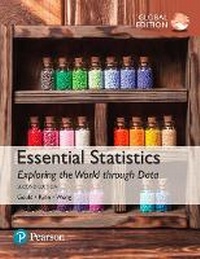
Essential Statistics, Global Edition -- MyLab Statistics with Pearson eText
2nd Edition
Published on 25. April 2016
Software
Product license key
4 pages
978-1-292-16124-2 (ISBN)
More details
Edition
2nd edition
Language
English
Place of publication
Harlow
United Kingdom
Target group
College/higher education
Professional and scholarly
Dimensions
Height: 165 mm
Width: 125 mm
Thickness: 1 mm
Weight
6 gr
ISBN-13
978-1-292-16124-2 (9781292161242)
Copyright in bibliographic data and cover images is held by Nielsen Book Services Limited or by the publishers or by their respective licensors: all rights reserved.
Schweitzer Classification
Other editions
New editions
Robert Gould | Colleen Ryan | Rebecca Wong
Essential Statistics, Global Edition + MyLab Statistics with Pearson eText
Book
02/2017
2nd Edition
Pearson Education Limited
€126.28
Shipment within 10-20 days
Content
Preface
Index of Applications
1. Introduction to Data
Case Study-Deadly Cell Phones?
1.1 What Are Data?
1.2 Classifying and Storing Data
1.3 Organizing Categorical Data
1.4 Collecting Data to Understand Causality
Exploring Statistics-Collecting a Table of Different Kinds of Data
2. Picturing Variation with Graphs
Case Study-Student-to-Teacher Ratio at Colleges
2.1 Visualizing Variation in Numerical Data
2.2 Summarizing Important Features of a Numerical Distribution
2.3 Visualizing Variation in Categorical Variables
2.4 Summarizing Categorical Distributions
2.5 Interpreting Graphs
Exploring Statistics-Personal Distance
3. Numerical Summaries of Center and Variation
Case Study-Living in a Risky World
3.1 Summaries for Symmetric Distributions
3.2 What's Unusual? The Empirical Rule and z-Scores
3.3 Summaries for Skewed Distributions
3.4 Comparing Measures of Center
3.5 Using Boxplots for Displaying Summaries
Exploring Statistics-Does Reaction Distance Depend on Gender?
4. Regression Analysis: Exploring Associations between Variables
Case Study-Catching Meter Thieves
4.1 Visualizing Variability with a Scatterplot
4.2 Measuring Strength of Association with Correlation
4.3 Modeling Linear Trends
4.4 Evaluating the Linear Model
Exploring Statistics-Guessing the Age of Famous People
5. Modeling Variation with Probability
Case Study-SIDS or Murder?
5.1 What Is Randomness?
5.2 Finding Theoretical Probabilities
5.3 Associations in Categorical Variables
5.4 Finding Empirical Probabilities
Exploring Statistics-Let's Make a Deal: Stay or Switch?
6. Modeling Random Events: The Normal and Binomial Models
Case Study-You Sometimes Get More Than You Pay For
6.1 Probability Distributions Are Models of Random Experiments
6.2 The Normal Model
6.3 The Binomial Model (optional)
Exploring Statistics-ESP with Coin Flipping
7. Survey Sampling and Inference
Case Study-Spring Break Fever: Just What the Doctors Ordered?
7.1 Learning about the World through Surveys
7.2 Measuring the Quality of a Survey
7.3 The Central Limit Theorem for Sample Proportions
7.4 Estimating the Population Proportion with Confidence Intervals
7.5 Comparing Two Population Proportions with Confidence
Exploring Statistics-Simple Random Sampling Prevents Bias
8. Hypothesis Testing for Population Proportions
Case Study-Dodging the Question
8.1 The Essential Ingredients of Hypothesis Testing
8.2 Hypothesis Testing in Four Steps
8.3 Hypothesis Tests in Detail
8.4 Comparing Proportions from Two Populations
Exploring Statistics-Identifying Flavors of Gum through Smell
9. Inferring Population Means
Case Study-Epilepsy Drugs and Children
9.1 Sample Means of Random Samples
9.2 The Central Limit Theorem for Sample Means
9.3 Answering Questions about the Mean of a Population
9.4 Hypothesis Testing for Means
9.5 Comparing Two Population
Index of Applications
1. Introduction to Data
Case Study-Deadly Cell Phones?
1.1 What Are Data?
1.2 Classifying and Storing Data
1.3 Organizing Categorical Data
1.4 Collecting Data to Understand Causality
Exploring Statistics-Collecting a Table of Different Kinds of Data
2. Picturing Variation with Graphs
Case Study-Student-to-Teacher Ratio at Colleges
2.1 Visualizing Variation in Numerical Data
2.2 Summarizing Important Features of a Numerical Distribution
2.3 Visualizing Variation in Categorical Variables
2.4 Summarizing Categorical Distributions
2.5 Interpreting Graphs
Exploring Statistics-Personal Distance
3. Numerical Summaries of Center and Variation
Case Study-Living in a Risky World
3.1 Summaries for Symmetric Distributions
3.2 What's Unusual? The Empirical Rule and z-Scores
3.3 Summaries for Skewed Distributions
3.4 Comparing Measures of Center
3.5 Using Boxplots for Displaying Summaries
Exploring Statistics-Does Reaction Distance Depend on Gender?
4. Regression Analysis: Exploring Associations between Variables
Case Study-Catching Meter Thieves
4.1 Visualizing Variability with a Scatterplot
4.2 Measuring Strength of Association with Correlation
4.3 Modeling Linear Trends
4.4 Evaluating the Linear Model
Exploring Statistics-Guessing the Age of Famous People
5. Modeling Variation with Probability
Case Study-SIDS or Murder?
5.1 What Is Randomness?
5.2 Finding Theoretical Probabilities
5.3 Associations in Categorical Variables
5.4 Finding Empirical Probabilities
Exploring Statistics-Let's Make a Deal: Stay or Switch?
6. Modeling Random Events: The Normal and Binomial Models
Case Study-You Sometimes Get More Than You Pay For
6.1 Probability Distributions Are Models of Random Experiments
6.2 The Normal Model
6.3 The Binomial Model (optional)
Exploring Statistics-ESP with Coin Flipping
7. Survey Sampling and Inference
Case Study-Spring Break Fever: Just What the Doctors Ordered?
7.1 Learning about the World through Surveys
7.2 Measuring the Quality of a Survey
7.3 The Central Limit Theorem for Sample Proportions
7.4 Estimating the Population Proportion with Confidence Intervals
7.5 Comparing Two Population Proportions with Confidence
Exploring Statistics-Simple Random Sampling Prevents Bias
8. Hypothesis Testing for Population Proportions
Case Study-Dodging the Question
8.1 The Essential Ingredients of Hypothesis Testing
8.2 Hypothesis Testing in Four Steps
8.3 Hypothesis Tests in Detail
8.4 Comparing Proportions from Two Populations
Exploring Statistics-Identifying Flavors of Gum through Smell
9. Inferring Population Means
Case Study-Epilepsy Drugs and Children
9.1 Sample Means of Random Samples
9.2 The Central Limit Theorem for Sample Means
9.3 Answering Questions about the Mean of a Population
9.4 Hypothesis Testing for Means
9.5 Comparing Two Population