

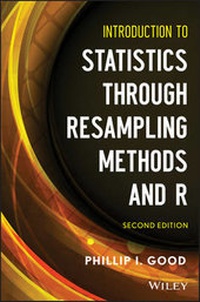
Introduction to Statistics Through Resampling Methods and R, Second Edition
Published on 4. March 2013
Software
Other digital
224 pages
978-1-118-49759-3 (ISBN)
Description
Written in an informal, highly accessible style, this text is an excellent guide to descriptive statistics, estimation, testing hypotheses, and model building. It includes all the tools needed to facilitate quick learning, including: more than 250 exercises with selected hints, multiple explanations of basic concepts, real-life applications in client-, and statistics-related disciplines, a companion FTP site with data sets and R programs, and more.
More details
Language
English
Place of publication
New York
United States
Target group
Professional and scholarly
Dimensions
Height: 185 mm
Width: 135 mm
Thickness: 5 mm
Weight
2 gr
ISBN-13
978-1-118-49759-3 (9781118497593)
Copyright in bibliographic data and cover images is held by Nielsen Book Services Limited or by the publishers or by their respective licensors: all rights reserved.
Schweitzer Classification
Other editions
Additional editions
Phillip I. Good
Introduction to Statistics Through Resampling Methods and R
E-Book
01/2013
2nd Edition
Wiley
€59.99
Available for download
Phillip I. Good
Introduction to Statistics Through Resampling Methods and R
E-Book
12/2012
2nd Edition
Wiley
€61.99
Available for download
Person
Content
Preface 1. Variation 1.1. Variation 1.2. Collecting Data 1.2.1 A worked through example 1.3. Summarizing Your Data 1.3.1 Learning to Use R 1.4. Reporting Your Results 1.4.1 Picturing Data 1.4.2. Better Graphics 1.5. Types of Data 1.5.1. Depicting Categorical Data 1.6. Displaying Multiple Variables 1.6.1. From Observations to Questions 1.7. Measures of Location 1.7.1. Which Measure of Location? 1.7.2 Estimating Precision 1.7.3. Estimating with the Bootstrap 1.8. Samples and Populations 1.8.1. Drawing a Random Sample 1.8.2. Ensuring the Sample is Representative 1.9. Summary and Review 2. Probability 2.1. Probability 2.1.1.Events and Outcomes 2.1.2 Venn Diagrams 2.2. Binomial Trials 2.2.1. Permutations and Rearrangements 2.2.2Programming Your Own Functions in R 2.2.3.Back to The Binomial 2.2. 4. Problem Jury 2.3. Conditional Probability 2.3.1. Market Basket Analysis 2.3.2 Negative Results 2.4. Independence 2.5. Applications to Genetics 2.6. Summary and Review 3. Two Natural Distributions Distribution of Values 1. Cumulative Distribution Function 2. Empirical Distribution Function Discrete Distributions Binomial Distribution 1. Properties of the Binomial Variance and Standard Deviation Events Rare in Time and Space 1. Applying the Poisson 2. Comparing Observed and Theoretical Distributions 3. Comparing Two Poisson Processes Continuous Distributions 1. Exponential Distribution Summary and Review 4. Estimation and the Normal Distribution Point Estimates Properties of the Normal Distribution Student's t Mixtures of Normal Distributions Using Confidence Intervals to Test Hypotheses Should we have used the bootstrap The Parametric Bootstrap Properties of Independent Observations Summary and Review 5. Testing Hypotheses Analyzing an Experiment Two Types of Errors Estimating Effect Size Using Confidence Intervals to Test Hypotheses Applying the t-test to Measurements One-sample Problem Two-sample Problem Paired Comparison Permutation Monte Carlo Which Test Should We Use 0. One-sided vs. Two-sided 1. p-values and Significance Levels 2. Test Assumptions 3. Robustness 4. Power of a Test Procedure Summary and Review 6. Designing an Experiment or Survey The Hawthorne Effect Crafting an experiment. Designing an Experiment or Survey Objectives Sample from the right population Coping with variation Matched pairs Experimental unit Formulate your hypotheses What are you going to measure? Random, representative samples Treatment allocation Choosing a random sample Ensuring your observations are independent How Large a Sample Samples of fixed size Known distribution Almost normal data Bootstrap Sequential Sampling Adaptive sampling Meta-Analysis Summary and Review 7. Guide to Entering, Saving, and Retrieving Large Quantities of Data Using R Creating and Editing a Data File Saving and Retrieving a Data File Retrieving and Using Data Created by Other Programs Example: Using R to Draw a Random Sample 8. Analyzing Complex Experiments A. Changes Measured in Percentages B. Comparing More Than Two Samples 1. Programming the Multi-sample Comparison in R 2. Reusing Your R Functions 3. What Is the Alternative? 4. Testing for a Dose Response or Other Ordered Alternative C. Equalizing Variances D. Categorical Data a. One-Sided Fisher's Exact Test b. The Two-Sided Test c. Testing for Goodness of Fit d. Multnomial Tables E. Multivariate Analysis Manipulating Multivariate Data in R Hotelling's Statistic Pesarin-Fisher Omnibus Statistic F. R Programming Guidelines G. Summary and Review 9. Developing Models Why Build Models? Caveats Classification and Regression Tree 1. How Trees are Grown 2. Examples 3. Incorporating existing knowledge a) Prior probabilities b) Misclassification costs Regression 1. Linear Regression 2. Nonlinear Regression 3. Survival Analysis Fitting a Regression Equation a. Ordinary least squares b. Least absolute deviation c. Errors in both variables d. Assumptions Problems with Regression a. Goodness-of-fit versus prediction b. Which model? Multiple Regression Quantile Regression Validation a. Independent validation b. Splitting the sample c. Cross-validation with the bootstrap Summary and Review 10. Reporting Your Findings What to Report Text, Table, or Graph? R Graphic Packages Summarizing Your Results a. Center of the distribution b. Dispersion Reporting Analysis Results a. p-Values or Confidence Intervals? Exceptions Are the Real Story n. Non-Responders o. The Missing Holes p. Missing Data q. Recognize and Report Bias Summary and Review 11. Problem Solving Real Life Problems Solving Practical Problems a. Data Provenance b. Inspect the Data c. Validate Data Collection Methods d. Formulate Hypotheses Choose a Statistical Methodology Be Aware of What You Don't Know Qualify Your Conclusions Answers to Selected Exercises Subject Index Index to R Functions