

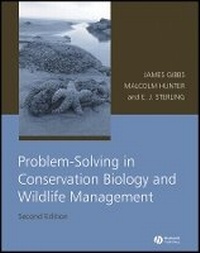
Problem-Solving in Conservation Biology and Wildlife Management 2e
Published on 26. October 2009
Software
Other digital
344 pages
978-1-4443-1957-6 (ISBN)
Description
This set of exercises has been created expressly for students and teachers of conservation biology and wildlife management who want to have an impact beyond the classroom. The book presents a set of 32 exercises that are primarily new and greatly revised versions from the book's successful first edition. These exercises span a wide range of conservation issues: genetic analysis, population biology and management, taxonomy, ecosystem management, land use planning, the public policy process and more. All exercises discuss how to take what has been learned and apply it to practical, real-world issues. Accompanied by a detailed instructor's manual and a student website with software and support materials, the book is ideal for use in the field, lab, or classroom. Also available: Fundamentals of Conservation Biology , 3rd edition (2007) by Malcolm L Hunter Jr and James Gibbs, ISBN 9781405135450 Saving the Earth as a Career : Advice on Becoming a Conservation Professional (2007) by Malcolm L Hunter Jr, David B Lindenmayer and Aram JK Calhoun, ISBN 9781405167611
Reviews / Votes
"Much of this book is presented in term of timely and realistic questions or problems that many conservation biologists and wildlife managers face. Readers are given manageable data and the appropriate tools to address those questions." ( The Quarterly Review of Biology , March 2009)More details
Language
English
Place of publication
Chicester
United Kingdom
Publishing group
John Wiley and Sons Ltd
Target group
Professional and scholarly
Dimensions
Height: 277 mm
Width: 220 mm
Thickness: 18 mm
Weight
988 gr
ISBN-13
978-1-4443-1957-6 (9781444319576)
Copyright in bibliographic data and cover images is held by Nielsen Book Services Limited or by the publishers or by their respective licensors: all rights reserved.
Schweitzer Classification
Other editions
Additional editions
James P. Gibbs | Malcolm L. Hunter | Eleanor J. Sterling
Problem-Solving in Conservation Biology and Wildlife Management
E-Book
08/2011
2nd Edition
Wiley-Blackwell
€48.99
Available for download
James P. Gibbs | Malcolm L. Hunter | Eleanor J. Sterling
Problem-Solving in Conservation Biology and Wildlife Management
E-Book
03/2009
2nd Edition
Wiley-Blackwell
€48.99
Available for download
Persons
James Gibbs is Associate Professor of Environmental and Forest Biology at the State University of New York's College of Environmental Science and Forestry. Malcolm J. Hunter Jr is the Libra Professor of Conservation Biology and Professor of Wildlife Ecology at the University of Maine, Orono. He is also the former President of the Society for Conservation Biology. Eleanor J. Sterling is Director of the Center for Biodiversity and Conservation at the American Museum of Natural History and Director of Graduate Studies in the Department of Ecology, Evolution, and Environmental Biology at Columbia University.
Content
Preface. Copying. Acknowledgments. Part 1. Introduction . 1. What Is Biodiversity? Spiders As Exemplars Of The Biodiversity Concept. 2. What Is Conservation Biology? An Analysis Of The Critical Ecosystem Partnership Fund's Strategies And Funding Priorities. 3. Why Is Biodiversity Important? Why Is It Threatened? An Exploration With The IUCN "Red List" Of Threatened Species. Part 2. Genes. 4. Population Genetics: Diversity Within Versus Among Populations. 5. Genetic Drift: Establishing Population Management Targets To Limit Loss Of Genetic Diversity. 6. Pedigree Management: Controlling The Effects Of Inbreeding As Indicated By Fluctuating Asymmetry. 7. Landscape Genetics: Identifying Movement Corridors In The Landscape. Part 3. Populations . 8. Life Table Analysis: Balancing Commercial Fisheries With Sea Bird "By-Catch". 9. Population Viability Analysis: El Nino Frequency And Penguin Population Persistence. 10. Habitat Loss And Fragmentation: Ecological Traps, Connectivity And Issues Of Scale. 11. Diagnosing Declining Populations: Assessing Monitoring Data To Better Understand Causes Of A Rarity In An Endangered Cactus. 12. Estimating Population Size With Line Transects And DISTANCE. 13. Analyzing Camera Trap Data With PRESENCE. 14. Estimating Population Size With Mark-Recapture Data And MARK. Part 4. Species . 15. Estimating "Biodiversity": Indices, Effort And Inference. 16. Designing A Zoo:Ex-Situ Centers For Conservation, Research, And Education. 17. Plant Reintroductions: Reestablishing Extirpated Populations. 18. Edge Effects: Designing A Nest Predation Experiment. Part 5. Ecosystems And Landscapes. 19. Ecosystem Fragmentation: Patterns And Consequences For Biodiversity. 20. Forest Harvesting: Balancing Timber Production And Parrot Habitat. 21. Protected Areas: A Systematic Conservation Planning Approach For Ecoregions. 22. Island Biogeography: How Park Size And Condition Affect The Number Of Species Protected. 23. GIS For Conservation: Mapping And Analyzing Distributions Of Wild Potato Species For Reserve Design. 24. Global Change: Will A Cold-Adapted Frog Survive In A Warmer World?. 25. Climate Envelope Modeling: Inferring The Ranges Of Species. Part 6. Policy And Organizations . 26. Population, Consumption, Or Governance: Which Drives Species Imperilment Most In Africa And Europe?. 28. Overconsumption: Who's Smarter... Students Or Their Professors?. 28. Conservation Values: Assessing Public Attitudes. 29. Priority Setting: Where Around The Globe Should We Invest Our Conservation Efforts?. 30. An International Debate: Commercial Fishing In Galapagos National Park. 31. Conservation Law: Should The Polar Bear Be Listed As A Threatened Species?. 32. Conservation Policy: Shaping Your Government. Index