

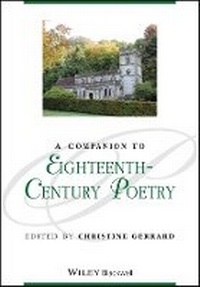
A Companion to Eighteenth-century Poetry
Published on 22. November 2007
Software
Other digital
624 pages
978-0-470-99663-8 (ISBN)
Description
This broad-ranging Companion gives readers a thorough grounding in both the background and the substance of eighteenth-century poetry in all its rich variety. * An up-to-date and wide-ranging guide to eighteenth-century poetry. * Reflects the dramatic transformation which has taken place in the study of eighteenth-century poetry over the past two decades. * Opens with a section on contexts, discussing poetry's relationships with patriotism, politics, science, and the visual arts, for example. * Discusses poetry by male and female poets from all walks of life. * Includes numerous close readings of individual poems, ranging from Pope's The Rape of the Lock to Mary Collier's The Woman's Labour. * Includes more provocative contributions on subjects such as rural poetry and the self-taught tradition, British poetry 'beyond the borders', the constructions of femininity, women as writers and women as readers. * Designed to be used alongside David Fairer and Christine Gerrard's Eighteenth-century Poetry: An Annotated Anthology (Blackwell Publishing, Second Edition, 2003).
More details
Language
English
Place of publication
Hoboken
United Kingdom
Publishing group
John Wiley and Sons Ltd
Target group
Professional and scholarly
Dimensions
Height: 254 mm
Width: 178 mm
Thickness: 40 mm
Weight
1214 gr
ISBN-13
978-0-470-99663-8 (9780470996638)
Copyright in bibliographic data and cover images is held by Nielsen Book Services Limited or by the publishers or by their respective licensors: all rights reserved.
Schweitzer Classification
Other editions
Additional editions
Christine Gerrard
A Companion to Eighteenth-Century Poetry
E-Book
12/2013
Wiley-Blackwell
€36.99
Available for download
Christine Gerrard
A Companion to Eighteenth-Century Poetry
E-Book
05/2008
Wiley-Blackwell
€36.99
Available for download
Person
Christine Gerrard is Fellow and Tutor in English at Lady Margaret Hall, Oxford University. She is the author of The Patriot Opposition to Walpole: Politics, Poetry, and National Myth, 1725-1742 (1994) and Aaron Hill: The Muses' Projector, 1685-1750 (2003). She is the co-editor, with David Fairer, of Eighteenth-Century Poetry: An Annotated Anthology (Blackwell, second edition, 2003).
Content
Notes on Contributors. Acknowledgments. Introduction: Christine Gerrard (Lady Margaret Hall, Oxford University). Part I: Contexts and Perspectives:. 1. Poetry, Politics and the Rise of Party: Christine Gerrard (Lady Margaret Hall, Oxford University). 2. Poetry, Politics, and Empire: Suvir Kaul (University of Pennsylvania). 3. Poetry and Science: Clark Lawlor (University of Northumbria at Newcastle). 4. Poetry and Religion: Emma Mason (University of Warwick). 5. Poetic Enthusiasm: John D. Morillo (North Carolina State University). 6. Poetry and the Visual Arts: Robert Jones (University of Leeds). 7. Poetry, Popular Culture, and the Literary Marketplace: George Justice (University of Missouri-Columbia). 8. Women Poets and their Writing in Eighteenth-Century Britain: Charlotte Grant (formerly Senior Research Fellow at the AHRC Centre for the Study of the Domestic Interior). 9. Poetry, Sentiment, and Sensibility: Jennifer Keith (University of North Carolina at Greensboro). Part II: Readings:. 10. John Gay, The Shepherd's Week: Mina Gorji (Magdalen College, Oxford University). 11. Alexander Pope, The Rape of the Lock and "Eloisa to Abelard": Valerie Rumbold (University of Birmingham). 12. Jonathan Swift, The "Stella" Poems: Ros Ballaster (Mansfield College, Oxford). 13. Lady Mary Wortley Montagu, Six Town Eclogues and Other Poems: Isobel Grundy (University of Alberta, Canada). 14. James Thomson, The Seasons: Christine Gerrard (Lady Margaret Hall, Oxford University). 15. Stephen Duck, The Thresher's Labour, and Mary Collier, The Woman's Labour: John Goodridge (Nottingham Trent University). 16. Mary Leapor, "Crumble-Hall": David Fairer (University of Leeds). 17. Mark Akenside, The Pleasures of Imagination: Adam Rounce (Keele University). 18. Samuel Johnson, London and The Vanity of Human Wishes: David F. Venturo (College of New Jersey). 19. William Collins, "Ode on the Poetical Character": John Sitter (University of Notre Dame). 20. Thomas Gray, Elegy Written in a Country Church Yard: Suvir Kaul (University of Pennsylvania). 21. Christopher Smart, Jubilate Agno: Chris Mounsey (University of Winchester). 22. Oliver Goldsmith, The Deserted Village, and George Crabbe, The Village: Caryn Chaden (DePaul University). 23. William Cowper, The Task: Freya Johnston (University of Warwick). 24. Robert Burns, "Tam o' Shanter": Murray Pittock (Manchester University). Part III: Forms and Genres:. 25. Rhyming Couplets and Blank Verse: Richard Bradford (University of Ulster, Coleraine). 26. Epic and Mock-Heroic: Richard Terry (University of Sunderland). 27. Verse Satire: Brean Hammond (University of Nottingham). 28. The Ode: Margaret M. Koehler (Otterbein College). 29. The Georgic: Juan Christian Pellicer (University of Oslo). 30. The Verse Epistle: Bill Overton (Loughborough University). Part IV: Themes and Debates:. 31. The Constructions of Femininity: Kathryn R. King (University of Montevallo, Alabama). 32. Whig and Tory Poetics: Abigail Williams (St Peter's College, Oxford University). 33. The Classical Inheritance: David Hopkins (University of Bristol). 34. Augustanism and Pre-Romanticism: Thomas Woodman (University of Reading). 35. Recovering the Past: Shakespeare, Spenser, and British Poetic Tradition: Carolyn D. Williams (University of Reading). 36. The Pleasures and Perils of the Imagination: Paul Baines (University of Liverpool). 37. The Sublime: Shaun Irlam (University at Buffalo). 38. Poetry and the City: Markman Ellis (Queen Mary, University of London). 39. Cartography and the Poetry of Place: Rachel Crawford (University of San Fransisco). 40. Rural Poetry and the Self-Taught Tradition: Bridget Keegan (Creighton University, Nebraska). 41. Poetry Beyond the English Borders: Gerard Carruthers (University of Glasgow). Index