

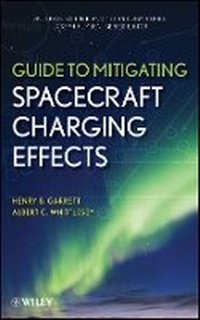
Guide to Mitigating Spacecraft Charging Effects
Published on 7. May 2012
Software
Other digital
242 pages
978-1-118-24140-0 (ISBN)
More details
Language
English
Place of publication
New York
United States
Target group
Professional and scholarly
Dimensions
Height: 250 mm
Width: 150 mm
Thickness: 15 mm
Weight
666 gr
ISBN-13
978-1-118-24140-0 (9781118241400)
Copyright in bibliographic data and cover images is held by Nielsen Book Services Limited or by the publishers or by their respective licensors: all rights reserved.
Schweitzer Classification
Other editions
Additional editions
Henry B. Garrett | Albert C. Whittlesey
Guide to Mitigating Spacecraft Charging Effects
E-Book
04/2012
Wiley
€127.99
Available for download
Henry B. Garrett | Albert C. Whittlesey
Guide to Mitigating Spacecraft Charging Effects
E-Book
04/2012
Wiley
€127.99
Available for download
Persons
Henry B. Garrett , PhD, is a principal scientist and, until 2011, the chief technologist for the Office of Safety and Mission Success at NASA's Jet Propulsion Laboratory (JPL). He represented JPL at the Pentagon as part of the Ballistic Missile Defense Organization where he acted as deputy program manager for the highly successful DoD/NASA Clementine Lunar Mission and Program Manager for the Clementine InterStage Adapter Satellite. The recipient of the Air Force's Harold Brown Award and Legion of Merit and NASA Medals for Exceptional Engineering Achievement and for Exceptional Service, Dr. Garrett is the coauthor of Spacecraft Environment Interactions and the author of several NASA spacecraft charging guidelines. Albert C. Whittlesey , member of the staff, Principal in the Office of Safety and Mission Success, has been a part of the Electromagnetic Compatibility (EMC) group since his arrival at JPL in 1962. Mr. Whittlesey has authored numerous symposium presentations and journal articles about various facets of EMC and spacecraft charging. He received a NASA Exceptional Engineering Achievement Medal for his technical leadership in EMC and ESD. Mr. Whittlesey is also the author of several NASA spacecraft charging guidelines with Dr. Garrett.
Content
Note from the Series Editor xi Foreword xiii Preface xv 1 Introduction 1 2 Introduction to the Physics of Charging and Discharging 6 2.1 Physical Concepts, 6 2.1.1 Plasma, 6 2.1.2 Penetration, 8 2.1.3 Charge Deposition, 10 2.1.4 Conductivity and Grounding, 11 2.1.5 Breakdown Voltage, 11 2.1.6 Dielectric Constant, 12 2.1.7 Shielding Density, 12 2.1.8 Electron Fluxes (Fluences) at Breakdown, 12 2.2 Electron Environment, 13 2.2.1 Units, 14 2.2.2 Substorm Environment Specifications, 15 2.3 Modeling Spacecraft Charging, 16 2.3.1 The Physics of Surface Charging, 17 2.3.2 The Physics of Dielectric Charging, 19 2.4 Discharge Characteristics, 19 2.4.1 Dielectric Surface Breakdowns, 21 2.4.2 Buried (Internal) Charge Breakdowns, 22 2.4.3 Spacecraft-to-Space Breakdowns, 22 2.5 Coupling Models, 23 2.5.1 Lumped-Element Modeling, 23 2.5.2 Electromagnetic Coupling Models, 23 3 Spacecraft Design Guidelines 26 3.1 Processes, 26 3.1.1 Introduction, 26 3.1.2 Design, 27 3.1.3 Analysis, 28 3.1.4 Testing and Measurement, 28 3.1.5 Inspection, 29 3.2 Design Guidelines, 29 3.2.1 General ESD Design Guidelines, 29 3.2.2 Surface ESD Design Guidelines, Excluding Solar Arrays, 40 3.2.3 Internal ESD Design Guidelines, 41 3.2.4 Solar Array ESD Design Guidelines, 44 3.2.5 Special Situations ESD Design Guidelines, 54 4 Spacecraft Test Techniques 62 4.1 Test Philosophy, 62 4.2 Simulation of Parameters, 63 4.3 General Test Methods, 64 4.3.1 ESD-Generating Equipment, 64 4.3.2 Methods of ESD Applications, 68 5 Control and Monitoring Techniques 76 5.1 Active Spacecraft Charge Control, 76 5.2 Environmental and Event Monitors, 76 6 Material Notes and Tables 79 6.1 Dielectric Material List, 79 6.2 Conductor Material List, 80 A Nomenclature 83 A.1 Constants and Measurement Units, 83 A.2 Acronyms and Abbreviations, 84 A.3 Defined Terms, 89 A.4 Variables, 92 A.5 Symbols, 93 B The Space Environment 95 B.1 Introduction to Space Environments, 95 B.1.1 Quantitative Representations of the Space Environment, 95 B.1.2 Data Sources, 99 B.2 Geosynchronous Environments, 102 B.2.1 Geosynchronous Plasma Environments, 102 B.2.2 Geosynchronous High-Energy Environments, 104 B.3 Other Earth Environments, 110 B.3.1 MEO, 110 B.3.2 PEO, 111 B.3.3 Molniya Orbit, 112 B.4 Other Space Environments, 112 B.4.1 Solar Wind, 112 B.4.2 Earth, Jupiter, and Saturn Magnetospheres Compared, 113 C Environment, Electron Transport, and Spacecraft Charging Computer Codes 122 C.1 Environment Codes, 122 C.1.1 AE8/AP8, 122 C.1.2 CRRES, 122 C.1.3 Flux Model for Internal Charging (FLUMIC), 123 C.1.4 GIRE/SATRAD, 123 C.1.5 Handbook of Geophysics and the Space Environment, 123 C.1.6 L2 Charged Particle Environment (L2-CPE), 123 C.1.7 MIL-STD-1809, Space Environment for USAF Space Vehicles, 123 C.1.8 Geosynchronous Plasma Model, 124 C.1.9 Others, 124 C.2 Transport Codes, 124 C.2.1 Cosmic Ray Effects on MicroElectronics 1996 (CREME96), 124 C.2.2 EGS4, 125 C.2.3 Geant4, 125 C.2.4 Integrated TIGER Series (ITS), 125 C.2.5 MCNP/MCNPE, 126 C.2.6 NOVICE, 126 C.2.7 NUMIT, 126 C.2.8 SHIELDOSE, 127 C.2.9 SPENVIS/DICTAT, 127 C.2.10 TRIM, 127 C.2.11 Summary, 128 C.3 Charging Codes, 128 C.3.1 Environment Work Bench (EWB), 128 C.3.2 Multi-Utility Spacecraft Charging Analysis Tool (MUSCAT), 128 C.3.3 Nascap-2k and NASCAP Family of Charging Codes, 129 C.3.4 SEE Interactive Spacecraft Charging Handbook, 129 C.3.5 Spacecraft Plasma Interaction System (SPIS), 129 D Internal Charging Analyses 132 D.1 The Physics of Dielectric Charging, 132 D.2 Simple Internal Charging Analysis, 134 D.3 Detailed Analysis, 135 D.4 Spacecraft Level Analysis, 136 D.4.1 Dose-to-Fluence Approximation, 136 E Test Methods 138 E.1 Electron-Beam Tests, 138 E.2 Dielectric Strength/Breakdown Voltage, 139 E.3 Resistivity--Conductivity Determination, 140 E.4 Simple Volume Resistivity Measurement, 141 E.5 Electron-Beam Resistivity Test Method, 142 E.6 NonContacting Voltmeter Resistivity Test Method, 143 E.7 Dielectric Constant, Time Constant, 144 E.8 Vzap Test [MIL-STD-883G, Method 3015.7 Human Body Model (HBM)], 145 E.9 Transient Susceptibility Tests, 146 E.10 Component/Assembly Testing, 148 E.11 Surface Charging ESD Test Environments, 148 E.12 System Internal ESD Testing, 148 F Voyager SEMCAP Analysis 150 G Simple Approximations: Spacecraft Surface Charging Equations 152 H Derivation of Rule Limiting Open-Circuit Board Area 156 I Expanded Worst-Case Geosynchronous Earth Environments Descriptions 159 J Key Spacecraft Charging Documents 162 J.1 U.S. Government Documents, 162 J.1.1 DoD, 162 J.1.2 NASA, 164 J.2 Non-U.S. Government Documents, 166 J.2.1 American Society for Testing and Materials (ASTM), 166 J.2.2 European Cooperation for Space Standardization (ECSS)/European Handbooks, 166 J.2.3 European Space Research and Technology Centre, 167 J.2.4 Japanese Aerospace Exploration Agency (JAXA), 167 J.2.5 Other, 167 K List of Figures and Tables 168 Index 173