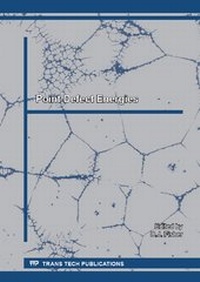
The point defect is just one of the menagerie of defects (comprising dislocations, disvections, discommensurations, stacking-faults, antiphase boundaries, etc.) which affect the mechanical and other properties of all materials. The class of point defect can be further divided into interstitial, substitutional and antisite. Various combinations of these defects lead to pairings such as those of Frenkel and Shottky type. The present volume comprises a compilation of selected data concerning point defects in metals, semiconductors, carbon and carbides, nitrides, halides, oxides and miscellaneous materials including solid inert gases. Not mentioned here are Stone-Wales defects, which were covered in volume 356. The 458 entries of the present volume cover the period from 1962 to 2014.
The point defect is just one of the menagerie of defects (comprising dislocations, disvections, discommensurations, stacking-faults, antiphase boundaries, etc.) which affect the mechanical and other properties of all materials. The class of point defect can be further divided into interstitial, substitutional and antisite. Various combinations of these defects lead to pairings such as those of Frenkel and Shottky type. The present volume comprises a compilation of selected data concerning point defects in metals, semiconductors, carbon and carbides, nitrides, halides, oxides and miscellaneous materials including solid inert gases. Not mentioned here are Stone-Wales defects, which were covered in volume 356. The 458 entries of the present volume cover the period from 1962 to 2014.
Series
Language
Place of publication
Target group
Professional and scholarly
Dimensions
Height: 142 mm
Width: 125 mm
Thickness: 10 mm
Weight
ISBN-13
978-3-03859-100-9 (9783038591009)
DOI
10.4028/www.scientific.net/DDF.360
Copyright in bibliographic data and cover images is held by Nielsen Book Services Limited or by the publishers or by their respective licensors: all rights reserved.
Schweitzer Classification