

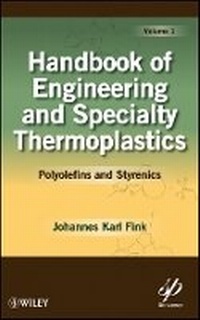
Handbook of Engineering and Specialty cs: Volume 1, Polyolefins and Styrenics
Published on 16. June 2010
Software
Other digital
400 pages
978-0-470-88171-2 (ISBN)
Description
Utilizes an encyclopedic approach to cover the developments in polyolefins and styrenics during the last decade This book focuses on common types of polymers belonging to the class of polyolefins and styrenics. The text is arranged according to the chemical constitution of polymers and reviews the developments that have taken place in the last decade. A brief introduction to the polymer type is given and previous monographs and reviews dealing with the topic are listed for quick reference. The text continues with monomers, polymerization, fabrication techniques, properties, application, as well as safety issues.
Providing a rather encyclopedic approach to polyolefins and styrenics, The Handbook of Engineering and Specialty Thermoplastics : Presents a listing of suppliers and commercial grades Reviews current patent literature, essential for the engineer developing new products Contains as extensive tradenames index with information that is fairly unique Concludes with an index of acronyms The Handbook of Engineering and Specialty Thermoplastics: Polyolefins and Styrenics provides a comprehensive reference for chemical engineers and offers advanced students with a textbook for use in courses on chemically biased plastics technology and polymer science.
Providing a rather encyclopedic approach to polyolefins and styrenics, The Handbook of Engineering and Specialty Thermoplastics : Presents a listing of suppliers and commercial grades Reviews current patent literature, essential for the engineer developing new products Contains as extensive tradenames index with information that is fairly unique Concludes with an index of acronyms The Handbook of Engineering and Specialty Thermoplastics: Polyolefins and Styrenics provides a comprehensive reference for chemical engineers and offers advanced students with a textbook for use in courses on chemically biased plastics technology and polymer science.
More details
Language
English
Place of publication
Chichester
United Kingdom
Publishing group
John Wiley and Sons Ltd
Target group
Professional and scholarly
Dimensions
Height: 250 mm
Width: 150 mm
Thickness: 15 mm
Weight
666 gr
ISBN-13
978-0-470-88171-2 (9780470881712)
Copyright in bibliographic data and cover images is held by Nielsen Book Services Limited or by the publishers or by their respective licensors: all rights reserved.
Schweitzer Classification
Other editions
Additional editions
Johannes Karl Fink
Handbook of Engineering and Specialty Thermoplastics, Volume 1
Polyolefins and Styrenics
E-Book
12/2010
Wiley-Scrivener
€200.99
Available for download
Johannes Karl Fink
Handbook of Engineering and Specialty Thermoplastics, Volume 1
Polyolefins and Styrenics
E-Book
06/2010
Wiley-Scrivener
€190.99
Available for download
Person
Johannes Karl Fink , PhD is Professor of Macromolecular Chemistry at Montanuniversitat, Loeben, Austria. His industry and academic career spans more than 30 years in the fields of polymers, and his research interests include characterization, flame retardancy, thermodynamics and degradation of polymers, pyrolysis, and adhesives. Professor Fink has published several books on physical chemistry and polymer science including A Concise Introduction to Additives for Thermoplastic Polymers (Wiley/Scrivener-2010).
Content
Preface. 1 Metathesis Polymers. 1.1 Monomers. 1.2 Polymerization and Fabrication. 1.3 Properties. 1.4 Fabrication Methods. 1.5 Fluorinated Polymers. 1.6 Special Additives. 1.7 Applications. 1.8 Suppliers and Commercial Grades. 1.9 Safety. References. 2 Cyclic Olefin Copolymers. 2.1 Monomers. 2.2 Polymerization and Fabrication. 2.3 Properties. 2.4 Applications. 2.5 Suppliers and Commercial Grades. 2.6 Safety. 2.7 Environmental Impact and Recycling. References. 3 Ultra HighMolecularWeight Poly(ethylene). 3.1 Monomers. 3.2 Polymerization and Fabrication. 3.3 Properties. 3.4 Special Additives. 3.5 Applications. 3.6 Suppliers and Commercial Grades. 3.7 Safety. References. 4 Poly(methyl)pentene. 4.1 Monomers. 4.2 Polymerization and Fabrication. 4.3 Properties. 4.4 Applications. 4.5 Suppliers and Commercial Grades. References. 5 Ionomers. 5.1 Monomers. 5.2 Polymerization and Fabrication. 5.3 Properties. 5.4 Special Additives. 5.5 Applications. 5.6 Suppliers and Commercial Grades. References. 6 Poly(isobutylene). 6.1 Monomers. 6.2 Polymerization and Fabrication. 6.3 Properties. 6.4 Special Additives. 6.5 Applications. 6.6 Suppliers and Commercial Grades. 6.7 Environmental Impact and Recycling. References. 7 Ethylene Vinyl Acetate Copolymers. 7.1 Monomers. 7.2 Polymerization and Fabrication. 7.3 Properties. 7.4 Applications. 7.5 Suppliers and Commercial Grades. References. 8 Acrylonitrile-Butadiene-Styrene Polymers. 8.1 Monomers. 8.2 Polymerization and Fabrication. 8.3 Properties. 8.4 Special Additives. 8.5 Applications. 8.6 Suppliers and Commercial Grades. 8.7 Safety. 8.8 Environmental Impact and Recycling. References. 9 High Impact Poly(styrene). 9.1 Monomers. 9.2 Polymerization and Fabrication. 9.3 Properties. 9.4 Special Additives. 9.5 Applications. 9.6 Suppliers and Commercial Grades. 9.7 Safety. 9.8 Environmental Impact and Recycling. References. 10 Styrene/Acrylonitrile Polymers. 10.1 Monomers. 10.2 Polymerization and Fabrication. 10.3 Properties. 10.4 Special Additives. 10.5 Applications. 10.6 Suppliers and Commercial Grades. 10.7 Environmental Impact and Recycling. References. 11 Methyl methacrylate/Butadiene/Styrene Polymers. 11.1 Monomers. 11.2 Polymerization and Fabrication. 11.3 Properties. 11.4 Special Additives. 11.5 Applications. 11.6 Suppliers and Commercial Grades. References. 12 Acrylonitrile/Styrene/Acrylate Polymers. 12.1 Monomers. 12.2 Polymerization and Fabrication. 12.3 Properties. 12.4 Special Additives. 12.5 Applications. 12.6 Suppliers and Commercial Grades. References. Index. Tradenames. Acronyms. Chemicals. General Index.