

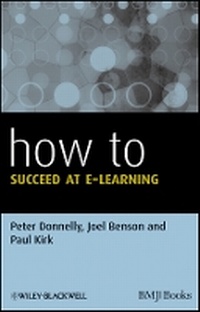
How to Succeed at e-learning
Published on 24. May 2012
Software
Other digital
160 pages
978-1-118-30845-5 (ISBN)
Description
A basic guide to getting the best from e-learning for medical students, teachers and all healthcare professionals How to Succeed at e-Learning answers the needs ofall healthcare professionals either starting or continuing their studies but not knowing where to begin with e-learning.It is a valuable guide for learners in undergraduate and postgraduate medicine as well as related health professionals and essential for teachers of medicine who are beginning to transfer from print to electronic teaching and need to understand effective methods of presentation.
More details
Language
English
Place of publication
New York
United States
Target group
Professional and scholarly
Dimensions
Height: 250 mm
Width: 150 mm
Thickness: 15 mm
Weight
666 gr
ISBN-13
978-1-118-30845-5 (9781118308455)
Copyright in bibliographic data and cover images is held by Nielsen Book Services Limited or by the publishers or by their respective licensors: all rights reserved.
Schweitzer Classification
Other editions
Additional editions
Peter Donnelly | Joel Benson | Paul Kirk
How to Succeed at E-learning
E-Book
05/2012
Wiley-Blackwell
€37.99
Available for download
Peter Donnelly | Joel Benson | Paul Kirk
How to Succeed at E-learning
E-Book
05/2012
Wiley-Blackwell
€37.99
Available for download
Person
Peter Donnelly MB, BCh, BAO, FRCPysch, BA (Open), Deputy Dean, Wales Deanery, Cardiff University, Cardiff, UK Paul Kirk BSc (Hons), MSc, PGCert Ed., E.Learning Unit Development Manager, Wales Deanery, Cardiff University, Cardiff, UK Joel Benson BA (Hons), PGC (ODL), Electronic Resources Officer, Wales Deanery, Cardiff University, Cardiff, UK
Content
Acknowledgements, ix Chapter 1: Introduction, 1 1.1 Overview of the book, 1 1.2 Basic issues, 1 1.3 Challenges as drivers, 2 1.4 The start of technology in learning, 2 Reference, 4 Chapter 2: E-learning ... what is it?, 5 2.1 Definitions, 5 2.2 Advantages of e-learning, 24 References, 26 Chapter 3: Evidence e-learning works, 29 3.1 Systematic reviews, 29 3.2 Examples of subject-specific studies (categorised by profession), 33 3.3 Summary of findings, 36 3.4 Conclusion, 37 References, 37 Chapter 4: Using e-learning to teach, 41 4.1 Requirement, 42 4.2 Exploration, 54 4.3 The course, 63 4.4 The assessment, 66 4.5 Choosing a platform, 67 4.6 Summary, 68 References, 68 Chapter 5: Access to e-learning, 71 5.1 The basics: files and folders, 71 5.2 Security, 72 5.3 The book and the browser, 73 5.4 Collaborative research, 76 References, 80 Chapter 6: Examples of technology in use, 83 6.1 A Taste of Medicine, 83 6.2 Examples of innovative e-learning from developing countries, 85 6.3 Examples from developed countries, 92 References, 93 Chapter 7: E-learning qualifications, 95 7.1 What to look for in an online course, 96 7.2 Clinical courses, 98 7.3 Leadership courses, 106 7.4 Management courses, 109 7.5 General information on internationally available online MBAs, 113 7.6 Mentoring courses, 114 7.7 Legal courses, 117 References, 120 Chapter 8: Research, 123 8.1 Just in time, just enough and on the move, 123 8.2 What is virtual reality (VR)?, 124 8.3 Virtual reality systems in medicine, 125 8.4 VR in obstetrics and gynaecology, 125 8.5 Life-size patient simulators, 127 8.6 Other simulation examples, 128 8.7 Whole-heart modelling, 129 8.8 Telling stories: understanding real-life genetics, 129 8.9 Second Life VR, 129 References, 133 Chapter 9: Looking towards the future, 135 9.1 The recent past, 135 9.2 Why is 'computing power' important and how is it defined?, 137 9.3 Past trends informing future trends, 137 9.4 Experiments involving neurosurgical implants, 139 9.5 Ongoing development in mobile technology, 140 9.6 Summary, 141 References, 141 Chapter 10: Conclusion, 143 Index, 147