

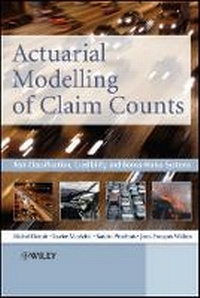
Actuarial Modelling of Claim Counts - Risk Classification, Credibility and Bonus-Malus Systems
Published on 27. November 2007
Software
Other digital
384 pages
978-0-470-51742-0 (ISBN)
Description
There are a wide range of variables for actuaries to consider when calculating a motorist's insurance premium, such as age, gender and type of vehicle. Further to these factors, motorists' rates are subject to experience rating systems, including credibility mechanisms and Bonus Malus systems (BMSs). Actuarial Modelling of Claim Counts presents a comprehensive treatment of the various experience rating systems and their relationships with risk classification. The authors summarize the most recent developments in the field, presenting ratemaking systems, whilst taking into account exogenous information. The text:* Offers the first self-contained, practical approach to a priori and a posteriori ratemaking in motor insurance.* Discusses the issues of claim frequency and claim severity, multi-event systems, and the combinations of deductibles and BMSs.* Introduces recent developments in actuarial science and exploits the generalised linear model and generalised linear mixed model to achieve risk classification.* Presents credibility mechanisms as refinements of commercial BMSs.* Provides practical applications with real data sets processed with SAS software.
Actuarial Modelling of Claim Counts is essential reading for students in actuarial science, as well as practicing and academic actuaries. It is also ideally suited for professionals involved in the insurance industry, applied mathematicians, quantitative economists, financial engineers and statisticians.
Actuarial Modelling of Claim Counts is essential reading for students in actuarial science, as well as practicing and academic actuaries. It is also ideally suited for professionals involved in the insurance industry, applied mathematicians, quantitative economists, financial engineers and statisticians.
Reviews / Votes
"An excellent text on experience rating that picks up the actuarial reader at almost every level. The authors have found an excellent balance between theory and practice." (Journal of the American Statistical Association, June 2009)More details
Language
English
Place of publication
Hoboken
United Kingdom
Publishing group
John Wiley and Sons Ltd
Target group
Professional and scholarly
Dimensions
Height: 253 mm
Width: 177 mm
Thickness: 27 mm
Weight
872 gr
ISBN-13
978-0-470-51742-0 (9780470517420)
Copyright in bibliographic data and cover images is held by Nielsen Book Services Limited or by the publishers or by their respective licensors: all rights reserved.
Schweitzer Classification
Other editions
Additional editions
Michel Denuit | Xavier Marechal | Sandra Pitrebois
Actuarial Modelling of Claim Counts
Risk Classification, Credibility and Bonus-Malus Systems
E-Book
09/2007
Wiley
€113.99
Available for download
Person
Michel Denuit - Professor, Institute of Actuarial Science, UCL, Belgium. Michel Denuit is Professor of Statistics and Actuarial Science at the Universite Catholique de Louvain, Belgium. His major fields of research are risk theory and stochastic inequalities. He has (co-)authored numerous articles that have appeared in applied and theoretical journals and served as member of the editorial board for several journals (including Insurance: Mathematics and Economics). He is a section editor on Wiley's Encyclopedia of Actuarial Science, and is the author of two previous books, one of them with Wiley. Xavier Marechal - Universite Catholique de Louvain, Belgium & CEO of Reacfin, Belgium. Sandra Pitrebois - Universite Catholique de Louvain, Belgium & Secura Belgian Re, Brussels. Jean-Francois Walhin - Universite Catholique de Louvain, Belgium & Secura Belgian Re, Brussels
Content
Foreword. Preface. Notation. Part I Modelling Claim Counts. 1 Mixed Poisson Models for Claim Numbers. 1.1 Introduction. 1.2 Probabilistic Tools. 1.3 Poisson Distribution. 1.4 Mixed Poisson Distributions. 1.5 Statistical Inference for Discrete Distributions. 1.6 Numerical Illustration. 1.7 Further Reading and Bibliographic Notes. 2 Risk Classification. 2.1 Introduction. 2.2 Descriptive Statistics for Portfolio A. 2.3 Poisson Regression Model. 2.4 Overdispersion. 2.5 Negative Binomial Regression Model. 2.6 Poisson-Inverse Gaussian Regression Model. 2.7 Poisson-LogNormal Regression Model. 2.8 Risk Classification for Portfolio A. 2.9 Ratemaking using Panel Data. 2.10 Further Reading and Bibliographic Notes. Part II Basics of Experience Rating. 3 Credibility Models for Claim Counts. 3.1 Introduction. 3.2 Credibility Models. 3.3 Credibility Formulas with a Quadratic Loss Function. 3.4 Credibility Formulas with an Exponential Loss Function. 3.5 Dependence in the Mixed Poisson Credibility Model. 3.6 Further Reading and Bibliographic Notes. 4 Bonus-Malus Scales. 4.1 Introduction. 4.2 Modelling Bonus-Malus Systems. 4.3 Transition Probabilities. 4.4 Long-Term Behaviour of Bonus-Malus Systems. 4.5 Relativities with a Quadratic Loss Function. 4.6 Relativities with an Exponential Loss Function. 4.7 Special Bonus Rule. 4.8 Change of Scale. 4.9 Dependence in Bonus-Malus Scales. 4.10 Further Reading and Bibliographic Notes. Part III Advances in Experience Rating. 5 Efficiency and Bonus Hunger. 5.1 Introduction. 5.2 Modelling Claim Severities. 5.3 Measures of Efficiency for Bonus-Malus Scales. 5.4 Bonus Hunger and Optimal Retention. 5.5 Further Reading and Bibliographic Notes. 6 Multi-Event Systems. 6.1 Introduction. 6.2 Multi-Event Credibility Models. 6.3 Multi-Event Bonus-Malus Scales. 6.4 Further Reading and Bibliographic Notes. 7 Bonus-Malus Systems with Varying Deductibles. 7.1 Introduction. 7.2 Distribution of the Annual Aggregate Claims. 7.3 Introducing a Deductible within a Posteriori Ratemaking. 7.4 Numerical Illustrations. 7.5 Further Reading and Bibliographic Notes. 8 Transient Maximum Accuracy Criterion. 8.1 Introduction. 8.2 Transient Behaviour and Convergence of Bonus-Malus Scales. 8.3 Quadratic Loss Function. 8.4 Exponential Loss Function. 8.5 Numerical Illustrations. 8.6 Super Bonus Level. 8.7 Further Reading and Bibliographic Notes. 9 Actuarial Analysis of the French Bonus-Malus System. 9.1 Introduction. 9.2 French Bonus-Malus System. 9.3 Partial Liability. 9.4 Further Reading and Bibliographic Notes. Bibliography. Index.