

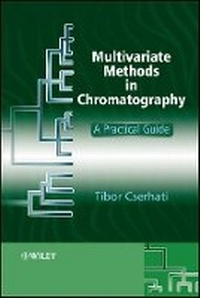
Multivariate Methods in Chromatography - A Practical Guide
Published on 22. July 2008
Software
Other digital
352 pages
978-0-470-75414-6 (ISBN)
Description
* A comprehensive, compilation and evaluation of the newest results in the field of enumerate evaluation of chromatographic data * Aimed at the practicing professional, researchers and advanced students working in this area * Special emphasis on practical applications * While the principles of chromatography and multivariate mathematical-statistical methods are discussed separately, the book focuses on their interconnection. * Written by a chromatographer for chromatographers
More details
Language
English
Place of publication
Hoboken
United Kingdom
Publishing group
John Wiley and Sons Ltd
Target group
Professional and scholarly
Dimensions
Height: 254 mm
Width: 176 mm
Thickness: 26 mm
Weight
778 gr
ISBN-13
978-0-470-75414-6 (9780470754146)
Copyright in bibliographic data and cover images is held by Nielsen Book Services Limited or by the publishers or by their respective licensors: all rights reserved.
Schweitzer Classification
Other editions
Additional editions
E-Book
09/2008
Wiley
€152.99
Available for download
Person
Content
Preface. Introduction. List of Abbreviations, Acronyms and Symbols. Chapter 1. Fundamentals. 1.1. Multilinear and nonlinear regression analyses. 1.2. Stepwise regression analysis and partial least squares method. 1.3. Two and three-dimensional principal component analysis, various factor analytical techniques. 1.4. Canonical correlation analysis. 1.5. Discriminance analysis. 1.6. Spectral mapping. 1.7 Nonlinear mapping. 1.8. Cluster analysis. 1.9. Other multivariate techniques (fixed-size window movement, rank annihilation, etc). 1.10. Measured and calculated physicochemical parameters of chromatographis systems and analytes. Chapter 2. Gas Chromatography (GC). 2.1. Theory and practice of gas chromatography. 2.2. Comparison of GC stationary phases using homogenous and non-homogenous set of analytes. 2.3. Elucidation of similarities and dissimilarities among samples. 2.3.1. Human health and pharmaceuticals. 2.3.2. Forensic analyses. 2.3.3. Biology and agrobiology. 2.3.4. Food and food products. 2.3.4.1. Wines. 2.3.4.2. Oils. 2.3.4.3. Foods of plant origin. 2.3.4.4. Miscellaneous food products. 2.3.5. Environmental analyses. 2.3.5.1. Volatile organic compounds (VOC), polycyclic aromatic hydrocarbons (PAH), and polychlorinated biphenyls (PCB). 2.3.5.2. Miscellaneous environmental pollutants. 2.3.5.3. Gasoline. 2.3.6. Other synthetic compounds. 2.3.7. Miscellaneous applications. Chapter 3. Liquid Chromatography (LC). 3.1. Thin-layer chromatography (TLC). 3.1.1. Theory and practice of thin-layer chromatography. 3.1.2. Multidimensional classification of TLC stationary and/or mobile phases. 3.1.3. Relationships between molecular parameters and TLC retention of analytes. 3.1.3.1. Pharmaceuticals and natural organic compounds. 3.1.3.2. Fatty acids and bile acids. 3.1.3.3. Pesticides and pesticide adjuvants. 3.1.4. Relationship between TLC retention parameters and biological activity of analytes. 3.1.5. Miscellaneous applications. 3.2. High performance liquid chromatography (HPLC). 3.2.1. Theory and practice of HPLC. 3.2.2. Multidivariate classification of HPLC stationary and/or mobile phases. 3.2.2.1. Classification of stationary or mobile phases. 3.2.2.1.1. Principal component analysis (PCA). 3.2.2.1.2. Other multivariate techniques. 3.2.2.4. Classification of chromatographic systems. 3.2.2.4.1. Multilinear and multi nonlinear regression analyses (MLR and MNLR). 3.2.2.4.2. Principal component analysis (PCA), cluster analysis (CA) and other multivariate techniques. 3.2.3. Differentiation between homologous and non-homologoues sets of analytes. 3.2.3.1. Human health. 3.2.3.2. Biological applications. 3.2.3.3. Agrobiochemistry. 3.2.3.4. Microbiology. 3.2.3.5. Natural (herbal) medicines. 3.2.3.6. Synthetic pharmaceuticals. 3.2.3.7. Wines. 3.2.3.8. Cheeses. 3.2.3.9. Miscellaneous foods and food products. 3.2.3.10. Polycyclic aromatic hydrocarbons. 3.2.3.11. Pesticides and homologous series of pollutants. 3.2.3.12. Non homologous series of pollutants. 3.2.3.13. Other environmental pollutants. 3.2.3.14. Miscellaneous HPLC applications. Chapter 4. Electrically Driven Systems. 4.1. Theory and practice of electrically driven systems. 4.2. Gel electrophoretic techniques. 4.2.1. Theory and human health aspects. 4.2.2. Microorganisms. 4.2.3. Microbial communities. 4.2.4. Plant tissues. 4.3. Capillary zone electrophoresis (CZE). 4.3.1. New advances in CZE theory. 4.3.2. Human health and pharmacology. 4.3.3. Other applications. 4.4. Micellar electrokinetic chromatography (MEKC) and related technologies. Index.