

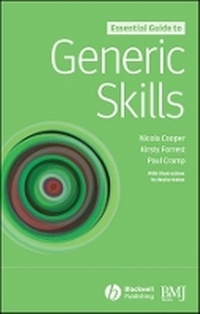
Essential Guide to Generic Skills
Published on 21. January 2008
Software
Other digital
256 pages
978-0-470-75792-5 (ISBN)
Description
This is a vital text to help you with the competency assessment in the UK Foundation Programme giving practical advice in an easy to follow format. It advises new doctors on note-keeping, time management/organisation, communicating with colleagues, the structure of the NHS, and how to deal with the ethical and legal issues they face when on-call. Also looks at emotional intelligence, learning styles or how different personality types can work together more effectively.
More details
Language
English
Place of publication
Hoboken
United Kingdom
Publishing group
John Wiley and Sons Ltd
Target group
Professional and scholarly
Dimensions
Height: 233 mm
Width: 156 mm
Thickness: 13 mm
Weight
478 gr
ISBN-13
978-0-470-75792-5 (9780470757925)
Copyright in bibliographic data and cover images is held by Nielsen Book Services Limited or by the publishers or by their respective licensors: all rights reserved.
Schweitzer Classification
Other editions
Additional editions
Nicola Cooper | Kirsty Forrest | Paul Cramp
Essential Guide to Generic Skills
E-Book
05/2008
BMJ Books
€44.99
Available for download
Persons
Dr Nicola Cooper, MRCP, Specialist Registrar in General Internal Medicine and Care of the Elderly, Yorkshire, UK Dr Kirsty Forrest, FRCA, Consultant in Anaesthesia, The Leeds Teaching Hospitals NHS Trust, Yorkshire, UK Dr Paul Cramp, MRCP FRCA, Consultant in Anaesthesia and Intensive Care, Bradford Teaching Hospitals NHS Trust, Yorkshire, UK
Content
Part 1 Clinical and Communication skills . 1 Professionalism. 2 The consultation. 3 Health promotion. 4 Clinical reasoning. 5 Communication with colleagues. 6 Medical records. 7 Prioritising time. Part 2 Legal and Ethical Issues in Healthcare . 8 Capacity and consent. 9 The Mental Health Act and common law. 10 Confidentiality. 11 Death certification and the coroner. 12 Fitness to drive. 13 Adult and child protection. 14 Ethical principles in healthcare. 15 Advance directives. 16 End of life issues. 17 NHS complaints procedure. Part 3 Clinical Governance and Patient Safety. 18 Why things go wrong. 19 Human factors. 20 Safe prescribing. 21 Infection control. 22 Use of evidence and guidelines. 23 Audit. Part 4 Teaching and Training. 24 Learning about learning. 25 Teaching large groups. 26 Teaching small groups. 27 Presentations. 28 Teaching a skill. 29 How to give feedback. 30 How doctors are assessed. Index