

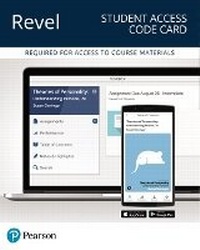
Revel Access Code for Theories of Personality
Understanding Persons
7th Edition
Published on 3. April 2018
Software
Product license key
9998 pages
978-0-13-458395-2 (ISBN)
Description
For courses in Personality Psychology
Bring theory into practice with illustrative biographies, clear explanations, and the most current research
Revel (TM) Theories of Personality provides an overview of major classic and current theories of personality, brings theories to life through the interpretation of illustrative biographies, and integrates a clear explanation of theory with the latest research. In the 7th Edition, you'll find updated literature throughout, as well as timely discussions on interesting topics such as Jung's theory, bullying, epigenetics, and more. Author Susan Cloninger encourages readers to think critically, and to see how understanding other people can bring both academic and practical benefits to our lives.
Revel is Pearson's newest way of delivering our respected content. Fully digital and highly engaging, Revel replaces the textbook and gives students everything they need for the course. Informed by extensive research on how people read, think, and learn, Revel is an interactive learning environment that enables students to read, practice, and study in one continuous experience - for less than the cost of a traditional textbook.
NOTE: Revel is a fully digital delivery of Pearson content. This ISBN is for the standalone Revel access card. In addition to this access card, you will need a course invite link, provided by your instructor, to register for and use Revel.
Bring theory into practice with illustrative biographies, clear explanations, and the most current research
Revel (TM) Theories of Personality provides an overview of major classic and current theories of personality, brings theories to life through the interpretation of illustrative biographies, and integrates a clear explanation of theory with the latest research. In the 7th Edition, you'll find updated literature throughout, as well as timely discussions on interesting topics such as Jung's theory, bullying, epigenetics, and more. Author Susan Cloninger encourages readers to think critically, and to see how understanding other people can bring both academic and practical benefits to our lives.
Revel is Pearson's newest way of delivering our respected content. Fully digital and highly engaging, Revel replaces the textbook and gives students everything they need for the course. Informed by extensive research on how people read, think, and learn, Revel is an interactive learning environment that enables students to read, practice, and study in one continuous experience - for less than the cost of a traditional textbook.
NOTE: Revel is a fully digital delivery of Pearson content. This ISBN is for the standalone Revel access card. In addition to this access card, you will need a course invite link, provided by your instructor, to register for and use Revel.
More details
Edition
7th edition
Language
English
Place of publication
United States
Publishing group
Pearson Education (US)
Target group
College/higher education
Dimensions
Height: 279 mm
Width: 216 mm
Thickness: 2 mm
Weight
14 gr
ISBN-13
978-0-13-458395-2 (9780134583952)
Copyright in bibliographic data and cover images is held by Nielsen Book Services Limited or by the publishers or by their respective licensors: all rights reserved.
Schweitzer Classification
Other editions
Previous edition
Book
08/2012
6th Edition
Pearson
€266.35
Article exhausted; check for reprint
Person
About our authors Susan C. Cloninger, PhD, is a professor emerita from The Sage Colleges, at Troy and Albany, New York, where she taught psychology for 36 years. Her graduate study was at the University of Michigan in Ann Arbor, where she earned a PhD in psychology with specialization in personality, particularly social motivation. In addition to Theories of Personality: Understanding Persons, she has contributed to the Cambridge Handbook of Personality Psychology.
In retirement, Sue is active as a volunteer in a supportive housing unit for persons with a history of homelessness and mental illness; in her Unitarian Universalist church; as an amateur gardener; and with her grandchildren. Her professional curiosity is a quest for understanding that bridges issues from biological to social-political understanding.
In retirement, Sue is active as a volunteer in a supportive housing unit for persons with a history of homelessness and mental illness; in her Unitarian Universalist church; as an amateur gardener; and with her grandchildren. Her professional curiosity is a quest for understanding that bridges issues from biological to social-political understanding.
Content
1. Introduction to Personality Theory
2. Freud's Classical Psychoanalysis
3. Jung's Analytical Psychology
4. Adler's Individual Psychology
5. Erikson's Psychosocial Development
6. Horney, Relational Theory, and the Interpersonal Psychoanalytic Approach
7. Allport's Personological Trait Theory
8. Two Factor Analytic Trait Theories
9. Biological Theories
10. Behavioral Theories
11. Kelly's Personal Construct Theory
12. Mischel's Traits in Cognitive Social Learning Theory
13. Bandura's Theory on Performance in Cognitive Social Learning
14. Rogers's Person-Centered Theory
15. Maslow's Need Hierarchy Theory and Positive Psychology
16. Buddhist Psychology
17. Concluding Remarks
2. Freud's Classical Psychoanalysis
3. Jung's Analytical Psychology
4. Adler's Individual Psychology
5. Erikson's Psychosocial Development
6. Horney, Relational Theory, and the Interpersonal Psychoanalytic Approach
7. Allport's Personological Trait Theory
8. Two Factor Analytic Trait Theories
9. Biological Theories
10. Behavioral Theories
11. Kelly's Personal Construct Theory
12. Mischel's Traits in Cognitive Social Learning Theory
13. Bandura's Theory on Performance in Cognitive Social Learning
14. Rogers's Person-Centered Theory
15. Maslow's Need Hierarchy Theory and Positive Psychology
16. Buddhist Psychology
17. Concluding Remarks