

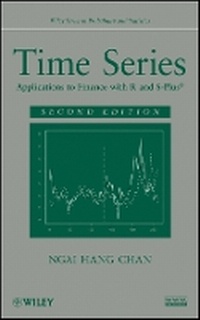
Time Series - Applications to Finance with R and S-Plus(R) 2e
Published on 28. January 2011
Software
Other digital
336 pages
978-1-118-03246-6 (ISBN)
Description
This book is designed to help readers grasp the conceptual underpinnings of time series modeling in order to gain a deeper understanding of the ever-changing dynamics of the financial world. It covers theory and application equally for readers from both financial and mathematical backgrounds. The book offers succinct coverage of standard topics in statistical time series -- such as forecasting and spectral analysis -- in a manner that is both technical and conceptual. An author website provides instructor notations and additional software subroutines, as well as complete solutions to the exercises in the text.
Reviews / Votes
"Both are on topics of intense interest among academicians and financial practitioners. Their inclusoin makes the book more up-to-date and hopefully entertains a broader spectrum of readers. Upon many requests from users of the first edition, a new chapter on solutions to selected exercises has also been prepared so as to make the book more accessible to instructors and students alike." (Mathematical Reviews, 2011)More details
Language
English
Place of publication
New York
United States
Target group
Professional and scholarly
Dimensions
Height: 240 mm
Width: 164 mm
Thickness: 23 mm
Weight
604 gr
ISBN-13
978-1-118-03246-6 (9781118032466)
Copyright in bibliographic data and cover images is held by Nielsen Book Services Limited or by the publishers or by their respective licensors: all rights reserved.
Schweitzer Classification
Other editions
Additional editions
E-Book
01/2011
2nd Edition
Wiley
€133.99
Available for download
Person
NGAI HANG CHAN, PhD, is Head and Chair Professor of Statistics at the Chinese University of Hong Kong. He has published extensively in the areas of time series, statistical finance, econometrics, risk management, and stochastic processes. A Fellow of the Institute of Mathematical Statistics and the American Statistical Association, Dr. Chan is the coauthor of Simulation Techniques in Financial Risk Management, also published by Wiley.
Content
List of Figures. List of Tables. Preface. Preface to the First Edition. 1 Introduction. 1.1 Basic Description. 1.2 Simple Descriptive Techniques. 1.3 Transformations. 1.4 Example. 1.5 Conclusions. 1.6 Exercises. 2 Probability Models. 2.1 Introduction. 2.2 Stochastic Processes. 2.3 Examples. 2.4 Sample Correlation Function. 2.5 Exercises. 3 Autoregressive Moving Average Models. 3.1 Introduction. 3.2 Moving Average Models. 3.3 Autoregressive Models. 3.4 ARMA Models. 3.5 ARIMA Models. 3.6 Seasonal ARIMA. 3.7 Exercises. 4 Estimation in the Time Domain. 4.1 Introduction. 4.2 Moment Estimators. 4.3 Autoregressive Models. 4.4 Moving Average Models. 4.5 ARMA Models. 4.6 Maximum Likelihood Estimates. 4.7 Partial ACF. 4.8 Order Selections. 4.9 Residual Analysis. 4.10 Model Building. 4.11 Exercises. 5 Examples in S PLUS and R . 5.1 Introduction. 5.2 Example 1. 5.3 Example 2. 5.4 Exercises. 6 Forecasting. 6.1 Introduction. 6.2 Simple Forecasts. 6.3 Box and Jenkins Approach. 6.4 Treasury Bill Example. 6.5 Recursions. 6.6 Exercises. 7 Spectral Analysis. 7.1 Introduction. 7.2 Spectral Representation Theorems. 7.3 Periodogram. 7.4 Smoothing of Periodogram. 7.5 Conclusions. 7.6 Exercises. 8 Nonstationarity. 8.1 Introduction. 8.2 Nonstationarity in Variance. 8.3 Nonstationarity in Mean: Random Walk with Drift. 8.4 Unit Root Test. 8.5 Simulations. 8.6 Exercises. 9 Heteroskedasticity. 9.1 Introduction. 9.2 ARCH. 9.3 GARCH. 9.4 Estimation and Testing for ARCH. 9.5 Example of Foreign Exchange Rates. 9.6 Exercises. 10 Multivariate Time Series. 10.1 Introduction. 10.2 Estimation of mu and GAMMA. 10.3 Multivariate ARMA Processes. 10.4 Vector AR Models. 10.5 Example of Inferences for VAR. 10.6 Exercises. 11 State Space Models. 11.1 Introduction. 11.2 State Space Representation. 11.3 Kalman Recursions. 11.4 Stochastic Volatility Models. 11.5 Example of Kalman Filtering of Term Structure. 11.6 Exercises. 12 Multivariate GARCH. 12.1 Introduction. 12.2 General Model. 12.3 Quadratic Form. 12.4 Example of Foreign Exchange Rates. 12.5 Conclusions. 12.6 Exercises. 13 Cointegrations and Common Trends. 13.1 Introduction. 13.2 Definitions and Examples. 13.3 Error Correction Form. 13.4 Granger's Representation Theorem. 13.5 Structure of Cointegrated Systems. 13.6 Statistical Inference for Cointegrated Systems. 13.7 Example of Spot Index and Futures. 13.8 Conclusions. 13.9 Exercises. 14 Markov Chain Monte Carlo Methods. 14.1 Introduction. 14.2 Bayesian Inference. 14.3 Markov Chain Monte Carlo. 14.4 Exercises. 15 Statistical Arbitrage. 15.1 Introduction. 15.2 Pairs Trading. 15.3 Cointegration. 15.4 Simple Pairs Trading. 15.5 Cointegrations and Pairs Trading. 15.6 Hang Seng Index Components Example. 15.7 Exercises. 16 Answers to Selected Exercises. 16.1 Chapter 1. 16.2 Chapter 2. 16.3 Chapter 3. 16.4 Chapter 4. 16.5 Chapter 5. 16.6 Chapter 6. 16.7 Chapter 7. 16.8 Chapter 8. 16.9 Chapter 9. 16.10 Chapter 10. 16.11 Chapter 11. 16.12 Chapter 12. 16.13 Chapter 13. 16.14 Chapter 14. 16.15 Chapter 15. References. Subject Index. Author Index.