

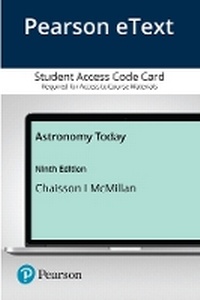
Astronomy Today
9th Edition
Will be published approx. on 17. December 2017
Software
Product license key
978-0-13-487379-4 (ISBN)
Description
Connects introductory astronomy to a broad understanding of the universe
With Astronomy Today, authors Eric Chaisson and Steve McMillan communicate their excitement about astronomy, combining up-to-date science with insightful pedagogy. The text emphasizes visualization and focuses on the process of scientific discovery in order to teach students "how we know what we know." The 9th Edition reflects current research and discoveries in the field of astronomy including the Horizon mission on Pluto, the Mars Maven mission on Mars, and the discovery of a potentially habitable planet around Proxima Centauri.
For courses in Introductory Astronomy.
Pearson eText is an easy-to-use digital textbook that you can purchase on your own or instructors can assign for their course. The mobile app lets you keep on learning, no matter where your day takes you - even offline. You can also add highlights, bookmarks, and notes in your Pearson eText to study how you like.
NOTE: This ISBN is for the Pearson eText access card. Pearson eText is a fully digital delivery of Pearson content. Before purchasing, check that you have the correct ISBN. To register for and use Pearson eText, you may also need a course invite link, which your instructor will provide. Follow the instructions provided on the access card to learn more.
With Astronomy Today, authors Eric Chaisson and Steve McMillan communicate their excitement about astronomy, combining up-to-date science with insightful pedagogy. The text emphasizes visualization and focuses on the process of scientific discovery in order to teach students "how we know what we know." The 9th Edition reflects current research and discoveries in the field of astronomy including the Horizon mission on Pluto, the Mars Maven mission on Mars, and the discovery of a potentially habitable planet around Proxima Centauri.
For courses in Introductory Astronomy.
Pearson eText is an easy-to-use digital textbook that you can purchase on your own or instructors can assign for their course. The mobile app lets you keep on learning, no matter where your day takes you - even offline. You can also add highlights, bookmarks, and notes in your Pearson eText to study how you like.
NOTE: This ISBN is for the Pearson eText access card. Pearson eText is a fully digital delivery of Pearson content. Before purchasing, check that you have the correct ISBN. To register for and use Pearson eText, you may also need a course invite link, which your instructor will provide. Follow the instructions provided on the access card to learn more.
More details
Edition
9th edition
Language
English
Place of publication
United States
Publishing group
Pearson Education (US)
Target group
College/higher education
Dimensions
Height: 279 mm
Width: 216 mm
Thickness: 2 mm
Weight
14 gr
ISBN-13
978-0-13-487379-4 (9780134873794)
Copyright in bibliographic data and cover images is held by Nielsen Book Services Limited or by the publishers or by their respective licensors: all rights reserved.
Schweitzer Classification
Persons
Eric Chaisson holds a Doctorate in Astrophysics from Harvard University, where he spent 10 years on the faculty of Arts and Sciences. For more than two decades thereafter, he served on the senior science staff at the Space Telescope Science Institute and held various professorships at Johns Hopkins and Tufts universities. He is now back at Harvard, where he teaches and conducts research at the Harvard-Smithsonian Center for Astrophysics. Eric has written 12 books on astronomy and has published nearly 200 scientific papers in professional journals.
Steve McMillan holds a Bachelor's and Master's Degree in Mathematics from Cambridge University and a Doctorate in Astronomy from Harvard University. He held postdoctoral positions at the University of Illinois and Northwestern University, where he continued his research in theoretical astrophysics, star clusters, and high-performance computing. Steve is currently Distinguished Professor of Physics at Drexel University and a frequent visiting researcher at Princeton's Institute for Advanced Study and Leiden University. He has published more than 100 articles and scientific papers in professional journals.
Emily L. Rice, College of Staten Island, City University of New York
Emily holds bachelor's degrees in physics and astronomy and German from the University of Pittsburgh and a master's degree and doctorate in astronomy and astrophysics from UCLA. After completing her Ph.D. she held a postdoctoral position at the American Museum of Natural History, where she is still a resident research associate. Emily is currently Assistant Professor at the College of Staten Island and doctoral faculty in physics at the Graduate Center, both part of the City University of New York. In addition to her research on low-mass stars, brown dwarfs, and exoplanets as co-PI of the Brown Dwarfs in New York City (BDNYC) group, she is the co-author of Astronomy Labs: A Concept Oriented Approach and co-founder of the astronomy fashion blog STARtorialist.
Steve McMillan holds a Bachelor's and Master's Degree in Mathematics from Cambridge University and a Doctorate in Astronomy from Harvard University. He held postdoctoral positions at the University of Illinois and Northwestern University, where he continued his research in theoretical astrophysics, star clusters, and high-performance computing. Steve is currently Distinguished Professor of Physics at Drexel University and a frequent visiting researcher at Princeton's Institute for Advanced Study and Leiden University. He has published more than 100 articles and scientific papers in professional journals.
Emily L. Rice, College of Staten Island, City University of New York
Emily holds bachelor's degrees in physics and astronomy and German from the University of Pittsburgh and a master's degree and doctorate in astronomy and astrophysics from UCLA. After completing her Ph.D. she held a postdoctoral position at the American Museum of Natural History, where she is still a resident research associate. Emily is currently Assistant Professor at the College of Staten Island and doctoral faculty in physics at the Graduate Center, both part of the City University of New York. In addition to her research on low-mass stars, brown dwarfs, and exoplanets as co-PI of the Brown Dwarfs in New York City (BDNYC) group, she is the co-author of Astronomy Labs: A Concept Oriented Approach and co-founder of the astronomy fashion blog STARtorialist.