

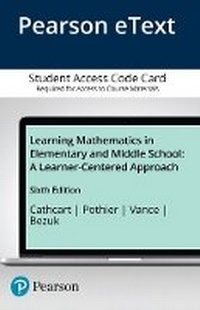
Learning Mathematics in Elementary and Middle School
A Learner-Centered Approach, Enhanced Pearson eText -- Access Card
6th Edition
Published on 19. February 2014
Software
Product license key
464 pages
978-0-13-382469-8 (ISBN)
Description
Using Common Core State Standards and authentic videos and examples of students' work, this resource illustrates and encourages a learner-centered approach to instruction.
This popular text promotes a learner-centered approach to teaching elementary and middle school mathematics. It provides valuable research-based instructional strategies, resources, and activities to help teachers evaluate how children think mathematically and how to link that knowledge to developmentally appropriate teaching practice. With its strong focus on Common Core Standards and analyzing children's work to meet the individual needs of students, the book helps ensure that all students and teachers can be successful with math.
Uses samples of real children solving problems, videos, activities, and examples to bring the concepts to life.
Integrates the Common Core State Standards throughout.
For courses in Elementary Mathematics Methods
Pearson eText is an easy-to-use digital textbook that instructors can assign for their course. The mobile app lets you keep on learning, no matter where your day takes you - even when you're offline. You can also add highlights, bookmarks, and notes in your Pearson eText to study how you like.
NOTE: You are purchasing an access card only. Pearson eText is a fully digital delivery of Pearson content. Before purchasing, check with your instructor to confirm the correct ISBN. To register for and use Pearson eText, you may also need a course invite link, which your instructor will provide. Follow the instructions provided on the access card to learn more.
This popular text promotes a learner-centered approach to teaching elementary and middle school mathematics. It provides valuable research-based instructional strategies, resources, and activities to help teachers evaluate how children think mathematically and how to link that knowledge to developmentally appropriate teaching practice. With its strong focus on Common Core Standards and analyzing children's work to meet the individual needs of students, the book helps ensure that all students and teachers can be successful with math.
Uses samples of real children solving problems, videos, activities, and examples to bring the concepts to life.
Integrates the Common Core State Standards throughout.
For courses in Elementary Mathematics Methods
Pearson eText is an easy-to-use digital textbook that instructors can assign for their course. The mobile app lets you keep on learning, no matter where your day takes you - even when you're offline. You can also add highlights, bookmarks, and notes in your Pearson eText to study how you like.
NOTE: You are purchasing an access card only. Pearson eText is a fully digital delivery of Pearson content. Before purchasing, check with your instructor to confirm the correct ISBN. To register for and use Pearson eText, you may also need a course invite link, which your instructor will provide. Follow the instructions provided on the access card to learn more.
More details
Edition
6th edition
Language
English
Place of publication
United States
Publishing group
Pearson Education (US)
Target group
College/higher education
Dimensions
Height: 10 mm
Width: 10 mm
Thickness: 10 mm
Weight
68 gr
ISBN-13
978-0-13-382469-8 (9780133824698)
Copyright in bibliographic data and cover images is held by Nielsen Book Services Limited or by the publishers or by their respective licensors: all rights reserved.
Schweitzer Classification
Persons
George S. Cathcart, University of Alberta
Yvonne M. Pothier, Mount Saint Vincent University
James H. Vance, University of Victoria
and
Dr. Nadine Bezuk is interested in helping teachers help all children be successful in math. She teaches elementary math methods for prospective teachers and conducts professional development for inservice teachers. She's particularly interested in the effective teaching of fractions. She has taught elementary, middle school, and high school math, along with developmental math at the college level. She is the director of the San Diego State University (SDSU) Professional Development Collaborative, associate director of the SDSU Center for Research in Mathematics and Science Education, and active in the Association of Mathematics Teacher Educators (AMTE), having served as President and as Executive Director. She has been the author of all 6 editions of Learning Mathematics in Elementary and Middle Schools and has published several articles in journals of the National Council of Teachers of Mathematics, and is a regular speaker at NCTM conferences.
Yvonne M. Pothier, Mount Saint Vincent University
James H. Vance, University of Victoria
and
Dr. Nadine Bezuk is interested in helping teachers help all children be successful in math. She teaches elementary math methods for prospective teachers and conducts professional development for inservice teachers. She's particularly interested in the effective teaching of fractions. She has taught elementary, middle school, and high school math, along with developmental math at the college level. She is the director of the San Diego State University (SDSU) Professional Development Collaborative, associate director of the SDSU Center for Research in Mathematics and Science Education, and active in the Association of Mathematics Teacher Educators (AMTE), having served as President and as Executive Director. She has been the author of all 6 editions of Learning Mathematics in Elementary and Middle Schools and has published several articles in journals of the National Council of Teachers of Mathematics, and is a regular speaker at NCTM conferences.
Content
1. Teaching Mathematics: Influences and Directions
2. Learning and Teaching Mathematics
3. Developing Mathematical Thinking and Problem-Solving Ability
4. Assessing Mathematics Understanding
5. Developing Number Concepts
6. Developing Understanding of Numeration
7. Developing Whole-Number Operations: Meaning of Operations
8. Developing Whole-Number Operations: Mastering the Basic Facts
9. Estimation and Computational Procedures for Whole Numbers
10. Developing Fraction Concepts
11. Developing Fraction Computation
12. Developing Decimal Concepts and Computation
13. Understanding Ratio, Proportion, and Percent
14. Developing Geometric Thinking and Spatial Sense
15. Developing Measurement Concepts and Skills
16. Collecting, Organizing, and Interpreting Data
17. Developing Algebraic Thinking
References
Index
2. Learning and Teaching Mathematics
3. Developing Mathematical Thinking and Problem-Solving Ability
4. Assessing Mathematics Understanding
5. Developing Number Concepts
6. Developing Understanding of Numeration
7. Developing Whole-Number Operations: Meaning of Operations
8. Developing Whole-Number Operations: Mastering the Basic Facts
9. Estimation and Computational Procedures for Whole Numbers
10. Developing Fraction Concepts
11. Developing Fraction Computation
12. Developing Decimal Concepts and Computation
13. Understanding Ratio, Proportion, and Percent
14. Developing Geometric Thinking and Spatial Sense
15. Developing Measurement Concepts and Skills
16. Collecting, Organizing, and Interpreting Data
17. Developing Algebraic Thinking
References
Index