

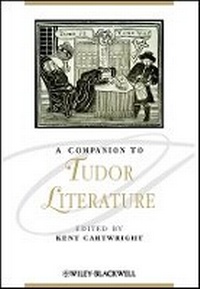
Companion to Tudor Literature
Published on 18. January 2010
Software
Other digital
568 pages
978-1-4443-1721-3 (ISBN)
Description
A Companion to Tudor Literature presents a collection of thirty-one newly commissioned essays focusing on English literature and culture from the reign of Henry VII in 1485 to the death of Elizabeth I in 1603. Presents students with a valuable historical and cultural context to the period Discusses key texts and representative subjects, and explores issues including international influences, religious change, travel and New World discoveries, women's writing, technological innovations, medievalism, print culture, and developments in music and in modes of seeing and reading
Reviews / Votes
"The Companion is both a learned introduction for scholars of English literature, and a fascinating compilation of academic essays well suited to university libraries". (Languages & Literature, November 2010) "The Companion is both a learned introduction for scholars of English literature, and a fascinating compilation of academic essays well suited to university libraries." (Reference Reviews, October 2010)More details
Language
English
Place of publication
Chicester
United Kingdom
Publishing group
John Wiley and Sons Ltd
Target group
College/higher education
Dimensions
Height: 253 mm
Width: 181 mm
Thickness: 35 mm
Weight
1166 gr
ISBN-13
978-1-4443-1721-3 (9781444317213)
Copyright in bibliographic data and cover images is held by Nielsen Book Services Limited or by the publishers or by their respective licensors: all rights reserved.
Schweitzer Classification
Other editions
Additional editions
Kent Cartwright
A Companion to Tudor Literature
E-Book
01/2010
Wiley-Blackwell
€39.99
Available for download
Person
Kent Cartwright is Professor of English and Chair of the Department of English at the University of Maryland. He is author of Shakespearean Tragedy and Its Double: The Rhythms of Audience Response (1991), which was selected as a Choice "outstanding academic book"; and Theatre and Humanism: English Drama in the Sixteenth Century (1999), winner of the Calvin and Rose Hoffman Prize for its chapter on Christopher Marlowe's Tamburlaine. He is also a recipient of a National Endowment for the Humanities Long-Term Fellowship at the Folger Shakespeare Library.
Content
Acknowledgments. Notes on Contributors. List of Illustrations. Chronology. Map of England in the Sixteenth Century. Introduction (Kent Cartwright). I: Historical and Cultural Contexts. 1. The Reformation, Lollardy, and Catholicism (Peter Marshall). 2. Witchcraft in Tudor England and Scotland (Kathryn A. Edwards). 3. The Tudor Experience of Islam (Matthew Dimmock). 4. Protestantism, Profit, and Politics: Tudor Representations of the New World (Nancy Bradley Warren). 5. International Influences and Tudor Music (Ross W. Duffin). 6. Tudor Technology in Transition (Adam Max Cohen). 7. Enclosing the Body: Tudor Conceptions of Skin (Tanya Pollard). II: Manuscript, Print, and Letters. 8. Manuscripts in Tudor England (Steven W. May and Heather Wolfe). 9. John Skelton and the State of Letters (Seth Lerer). 10. The Henrician Courtier Writing in Manuscript and Print (Wyatt, Surrey, Bryan, and Others: David R. Carlson). 11. Old Authors, Women Writers, and the New Print Technology (Helen Smith). 12. Printers of Interludes (Peter Happe). III: Literary Origins, Presences, Absences. 13. Medievalism in English Renaissance Literature (Deanne Williams). 14. The Tudor Origins of Medieval Drama (Theresa M. Coletti and McMurray Gibson). 15. French Presences in Tudor England (A. E. B. Coldiron). 16. Italian in Tudor England: Why Couldn't a Woman Be More Like a Man? (Pamela J. Benson). IV: Authors, Works, and Modes. 17. More's Utopia: Medievalism and Radicalism (Anne Lake Prescott). 18. The Literary Voices of Katherine Parr and Anne Askew (Joan Pong Linton). 19. Reformation Satire, Scatology, and Iconoclastic Aesthetics in Gammer Gurton's Needle (Robert Hornback). 20. Bad Fun and Tudor Laughter (Pamela Allen Brown). 21. Perspective and Realism in the Renaissance (Alastair Fowler). 22. Seeing Through Words In Theories Of Poetry: Sidney, Puttenham, Lodge (Gavin Alexander). 23. Tudor Versification and the Rise of Iambic Pentameter (Jeff Dolven). 24. John Lyly's Galatea : Politics and Literary Allusion (Mike Pincombe). 25. Sidney's Arcadia , Romance, and the Responsive Woman Reader (Clare R. Kinney). 26. Nature and Techne in Spenser's Faerie Queene (Jessica Wolfe). 27. "In Poesie the mirrois of our Age": The Countess of Pembroke's 'Sydnean' Poetics (Suzannne Trill). 28. 'Conceived of young Horatio his son': The Spanish Tragedy and the Psychotheology of Revenge (Heather Hirschfeld). 29. West of England: The Irish Specter in Tamburlaine (Kimberly Anne Coles). 30. The Real and the Unreal in Tudor Travel Writing (Mary C. Fuller). 31. Jack in the City: The Unfortunate Traveler , Tudor London, and Literary History (Steve Mentz).