

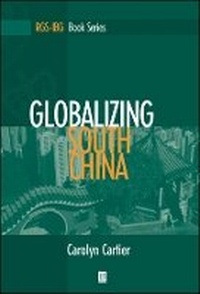
Globalizing South China
Published on 13. May 2008
Software
Other digital
336 pages
978-0-470-71276-4 (ISBN)
Description
This insightful account demonstrates that capitalism in China has a history and a geography, and combines perspectives from both to demonstrate that regional economic restructuring in South China is far from an economic 'miracle's. Find out more information about the RGS-IBG journals by following the links below: AREA: http://www.blackwellpublishing.com/journal.asp?ref=0004-0894 The Geographical Journal: http://www.blackwellpublishing.com/journal.asp?ref=0016-7398 Transactions of the Insititute of British Geographers: http://www.blackwellpublishing.com/journal.asp?ref=0020-2754
Reviews / Votes
"Relying on a wide grounding in the historical literature as well as a specialist's sense of spatial history, [Cartier] offers nuanced, often fascinating portraits of South China's economic and cultural dynamism." Choice "The book has broken new ground in promoting the study and understanding of urban and regional development and also China study. With the meticulous evaluation of research materials under the contextualist approach, Globalizing South China exhibits a high standard of scholarship and intellectual sophistication." Journal of Oriental StudiesMore details
Language
English
Place of publication
Hoboken
United Kingdom
Publishing group
John Wiley and Sons Ltd
Target group
Professional and scholarly
Dimensions
Height: 234 mm
Width: 160 mm
Thickness: 30 mm
Weight
606 gr
ISBN-13
978-0-470-71276-4 (9780470712764)
Copyright in bibliographic data and cover images is held by Nielsen Book Services Limited or by the publishers or by their respective licensors: all rights reserved.
Schweitzer Classification
Other editions
Additional editions
Person
Carolyn Cartier is assistant Professor of Geography at the University of Southern California, Los Angeles.
Content
List of Plates. List of Figures and Tables. List of Maps. Series Editors' Preface. Preface. Chapter 1 Negotiating Geographical Knowledges. Chapter 2 Region and Representation. Chapter 3 Maritime Frontier/Mercantile Region. Chapter 4 Open Ports and the Treaty System. Chapter 5 Revolution and Diaspora. Chapter 6 Gendered Industrialization. Chapter 7 Zone Fever. Chapter 8 Urban Triumphant. Epilogue. References. Index.