

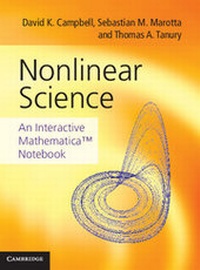
Nonlinear Science: An Interactive Mathematica (TM) Notebook
1st Edition
Published on 11. October 2012
Software
DVD-ROM
978-0-521-13882-6 (ISBN)
Description
This interactive Mathematica (TM) notebook provides a ready-made tool by which users can undertake their own mathematical experiments and explore the behavior of nonlinear systems, from chaos in low-dimensional maps and coupled ordinary differential equations to solitons and coherent structures in nonlinear partial differential equations and 'intrinsic localized modes' and 'discrete breathers' in extended lattice systems. The Mathematica (TM) format produces detailed numerical solutions and high quality graphics to help users develop a deeper understanding of nonlinear systems by exploring their behavior in real time. It also allows users to modify the existing templates to study other systems of their own choice. This software can supplement nonlinear dynamics courses and is also ideal for graduate students and researchers working in this field. Suitable for Windows XP, Windows Vista, Windows 7, Mac OS X and Linux. This software will run with Mathematica (TM) versions 5.2, 6.0, 7.0 and 8.0.
More details
Language
English
Place of publication
Cambridge
United Kingdom
Target group
Professional and scholarly
College/higher education
Illustrations
Worked examples or Exercises
Dimensions
Height: 187 mm
Width: 140 mm
Thickness: 5 mm
Weight
60 gr
ISBN-13
978-0-521-13882-6 (9780521138826)
Copyright in bibliographic data and cover images is held by Nielsen Book Services Limited or by the publishers or by their respective licensors: all rights reserved.
Schweitzer Classification
Persons
David K. Campbell is Professor of Physics and Electrical and Computer Engineering at Boston University. An international leader in the field of nonlinear science, he has received the Julius Edgar Lilienfeld Prize of the American Physical Society for his research. Sebastian M. Marotta is a Professor of Mathematics at the University of the Pacific, California. He has been developing Mathematica (TM) programs for research and teaching purposes for more than ten years. Thomas A. Tanury is a test engineer at Ultra Electronics Ocean Systems in Braintree, Massachusetts. In 2005, he graduated from Boston University where he majored in electrical engineering and minored in mathematics.
Content
1. 1-Dimensional maps; 2. 2-Dimensional maps; 3. ODEs (ordinary differential equations); 4. PDEs (partial differential equations); 5. Discrete spatially extended systems (DSES).