

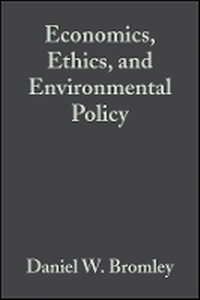
Economics, Ethics and Environmental Policy - Contested Choices
Published on 17. March 2008
Software
Other digital
304 pages
978-0-470-69367-4 (ISBN)
Description
Economics, Ethics, and Environmental Policy: Contested Choices offers a comprehensive analysis of the ethical problems associated with basing environmental policy on economic analysis, and ways to overcome these problems.
More details
Language
English
Place of publication
Hoboken
United Kingdom
Publishing group
John Wiley and Sons Ltd
Target group
Professional and scholarly
Dimensions
Height: 255 mm
Width: 177 mm
Thickness: 27 mm
Weight
668 gr
ISBN-13
978-0-470-69367-4 (9780470693674)
Copyright in bibliographic data and cover images is held by Nielsen Book Services Limited or by the publishers or by their respective licensors: all rights reserved.
Schweitzer Classification
Other editions
Additional editions
E-Book
05/2008
Wiley-Blackwell
€59.99
Available for download
Persons
Daniel W. Bromley is Anderson-Bascom Professor of Applied Economics in the Department of Agricultural and Applied Economics at the University of Wisconsin-Madison. He has written and edited numerous books including Sustaining Development (1999), The Handbook of Environmental Economics (1995), Making the Commons Work (1992), Environment and Economy (1991), and Economic Interests and Institutions (1989). He is also the editor of the journal Land Economics, the oldest and most distinguished international journal in environmental and natural resources economics. Jouni Paavola is a Senior Research Associate at the Centre for Social and Economic Research on the Global Environment (CSERGE) at the University of East Anglia and an Associate Fellow at the Oxford Centre for the Environment, Ethics, and Society (OCEES), Mansfield College, Oxford, UK. He has authored a number of publications on economics, ethics, and history of environmental policy.
Content
List of Figures. List of Tables. List of Contributors. Preface. Part I: Introduction. 1. Contested Choices. (Jouni Paavola and Daniel W. Bromley). Part II: Economics, Ethics, and Policy Choices. 2. Are Choices Trade-offs? (Alan Holland). 3. The Ignorance Argument: What Must We Know to Be Fair to the Future? (Bryan Norton). 4. Benefit-Cost Considerations Should Be Decisive When There is Nothing More Important at Stake. (Alan Randall). 5. Environmental Policy as the Process of Reasonable Valuing. (Juha Hiedanpaa and Daniel W. Bromley). Part III: Ethical Concerns and Policy Goals. 6. Rethinking the Choice and Performance of Environmental Policies. (Jouni Paavola). 7. What to Do with Inconsistent, Non-Welfaristic and Undeveloped Preferences? (Olof Johansson-Stenman). 8. Awkward Choices: Economics and Nature Conservation. (Nick Hanley and Jason Shogren). Part IV: Ethical Dimensions of Policy Consequences. 9. All Policy Instruments Require A Moral Choice as to Whose Interests Count. (Allan Schmid). 10. Efficient or Fair: Ethical Paradoxes in Environmental Policy. (Arild Vatn). 11. Trading with the Enemy: Examining North-South Perspectives in the Climate Change Debate. (Bhaskar Vira). 12. Social Costs and Sustainability. (Martin O'Connor). Part V: Ethics in Aaction: Emperical Analysis. 13. Empirical Signs of Ethical Concern in Economic Valuation of the Environment. (Clive Spash). 14. Motivating Existence Values: The Many and Varied Sources of the Stated WTP for Endangered Species. (Andreas Kontoleon and Timothy Swanson). 15. Environmental and Ethical Dimensions of the Provision of a Basic Need: Water and Sanitation Services in East Africa. (Nick Johnstone , John Thompson , Munguti Katui-Katua , Mark Mujwajuzi , James Tumwine , Elizabeth Wood , and Ina Porras). Part VI: Conclusions. 16. Economics, Ethics, and Environmental Policy. (Daniel W. Bromley and Jouni Paavola). Index.